


































Choosing a smartphone is rarely about finding a device that's perfect at everything. More often, it's about deciding which features matter enough to pay for and which compromises you're willing to accept. That's especially true when considering a more affordable phone such as the Google Pixel 10a.Google's Pixel A-series has traditionally aimed to bring the core Pixel experience to a more accessible price point. Rather than competing with premium phones feature for feature, the idea is to preserve the things many people actually notice every day camera processing, useful software, Google services, security, and a clean Android experience while cutting back in areas that may matter less to mainstream buyers.So, what do you really gain and give up by choosing the Google Pixel 10a instead of a more expensive flagship?Let's break down the trade-offs.
What You Gain: A More Affordable Pixel Experience
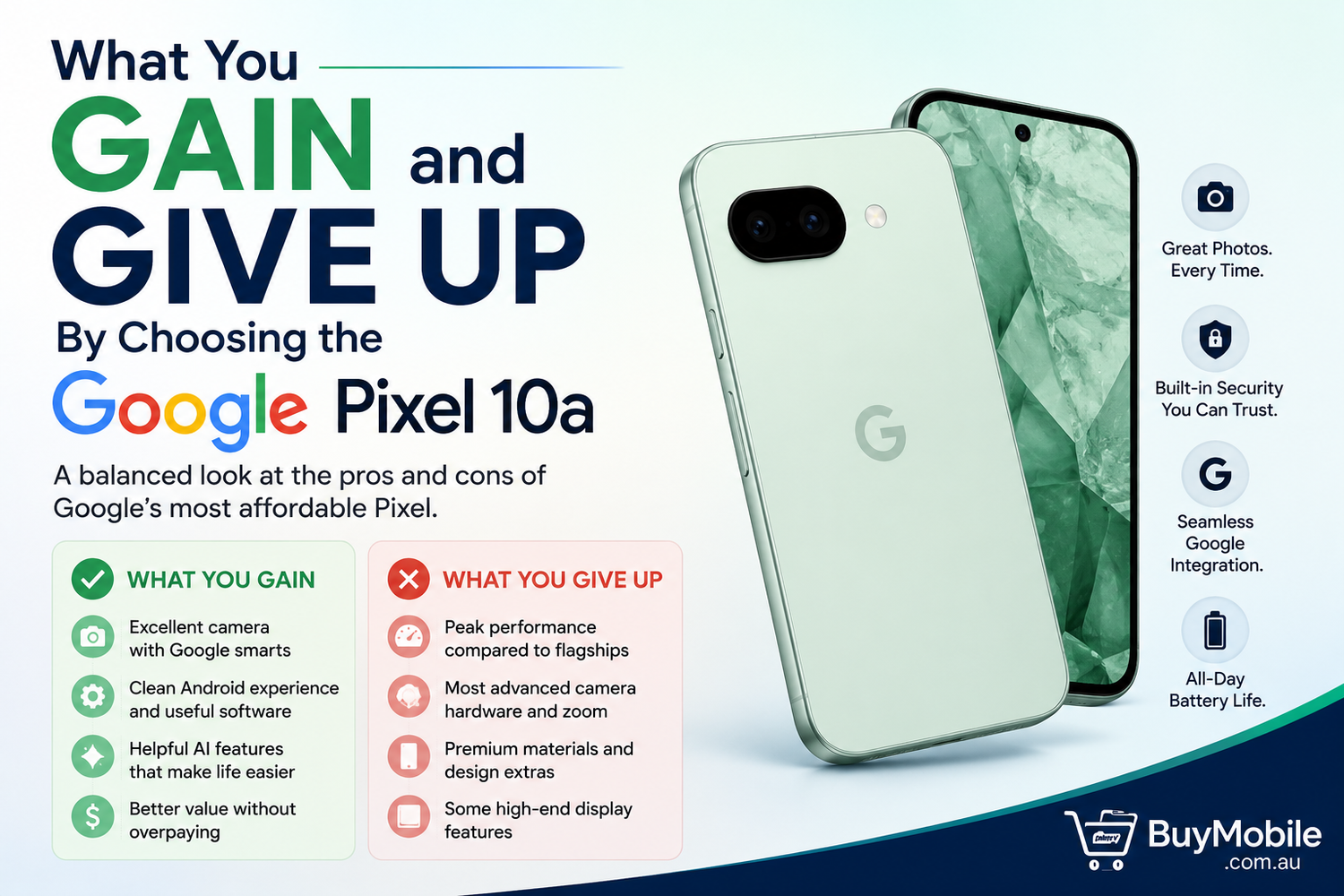
The most obvious advantage of choosing the Pixel 10a is value.Flagship smartphones have become expensive, particularly once you move toward larger storage configurations and premium models. A more affordable Pixel gives buyers another route into Google's smartphone ecosystem without requiring the same level of spending.That's particularly appealing if your everyday smartphone usage consists mainly of messaging, social media, photography, navigation, streaming, email, and web browsing.You may discover that you simply don't need all the hardware included in an ultra-premium device.The real attraction of the Pixel 10a isn't necessarily being the cheapest phone available. It's potentially offering the features people associate with Pixel phones at a more approachable price.
What You Gain: Google's Approach to Android
Software is one of the strongest reasons to consider a Pixel.Google's phones provide an Android experience closely integrated with services such as Google Photos, Maps, Gmail, Drive, Gemini, and other parts of the Google ecosystem.That integration can make the phone feel straightforward and cohesive.Pixel devices also tend to emphasize useful software features rather than filling the experience with unnecessary complexity.For someone who wants a smartphone that works well with the Google services they already use every day, the Pixel 10a could feel particularly natural.Long-term software support is another factor worth checking when buying. Updates can significantly affect a phone's useful lifespan, security, and overall value.
What You Gain: Computational Photography
You don't necessarily need the biggest collection of camera sensors to take enjoyable smartphone photographs.Google has built much of the Pixel reputation around computational photography using software processing to improve the images produced by the camera hardware.This approach can be especially valuable on an A-series device.Rather than trying to compete purely through expensive camera components, a Pixel can use Google's image-processing expertise to produce attractive everyday photographs.That could make the Pixel 10a particularly appealing to parents, travellers, pet owners, students, and anyone who wants to take a phone out of their pocket and quickly capture a good-looking image.You don't need to understand shutter speeds or editing software. Point, shoot, and let the phone handle much of the processing.
What You Gain: Useful AI Features
Artificial intelligence has become increasingly central to Google's smartphone strategy.Depending on the Pixel 10a's supported features, software version, language, account requirements, and region, Google's AI tools can potentially assist with tasks involving photography, communication, search, organization, and everyday productivity.The important question isn't how many AI features appear on a specifications page.It's whether you actually use them.A tool that saves several minutes every day can become far more valuable than an impressive hardware specification you barely notice.Pixel phones are particularly interesting in this area because Google controls both major parts of the experience: Android and many of the AI-powered services running on top of it.
What You Gain: A Phone Focused on Everyday Needs
Not everyone wants a smartphone that feels like a portable gaming computer.For many buyers, consistency is more important than maximum benchmark performance.A well-balanced mid-range phone needs to open applications quickly, switch between common tasks smoothly, take reliable photos, handle navigation, stream videos, and remain comfortable throughout a normal day.That's where the Pixel 10a's philosophy makes sense.Instead of asking, "Is this the fastest phone available?" a more useful question might be, "Is it fast enough that I stop thinking about performance?"For mainstream buyers, that's often what matters.
What You Give Up: Flagship-Level Performance
Choosing a more affordable smartphone inevitably involves compromises.One of those may be peak performance compared with Google's premium Pixel models and other high-end Android flagships.This difference may not be particularly noticeable while reading email, using WhatsApp, browsing Chrome, or watching YouTube.It can become more relevant when playing demanding games, performing intensive photo or video editing, or pushing the device through extended heavy workloads.Serious mobile gamers should therefore look beyond everyday responsiveness and consider sustained performance, thermal behaviour, and frame rates.For casual users, however, paying extra for performance they rarely exploit may not provide much practical value.
What You Give Up: The Most Advanced Camera Hardware
A Pixel 10a may deliver excellent everyday photography without providing every camera capability available on a premium flagship.Higher-end phones can justify their prices with more sophisticated camera systems, particularly when it comes to optical zoom, specialist lenses, advanced video features, and difficult low-light situations.This creates an important distinction.There's a difference between wanting a very good smartphone camera and wanting the most versatile smartphone camera system possible.If you mostly photograph friends, family, food, pets, landscapes, and holidays, an A-series Pixel may provide everything you realistically need.If photography is one of your main hobbies, the additional camera flexibility of a premium model could be worth paying for.
What You Give Up: Some Premium Materials and Design Extras
Premium smartphones aren't expensive purely because they're faster.Part of their price goes toward materials, manufacturing techniques, displays, camera hardware, and other design details.A value-focused device may use more practical materials or provide fewer luxury touches.Whether that matters is personal.If you immediately put every phone into a protective case, the difference between premium materials may become less important in everyday use.On the other hand, someone who keeps a smartphone for several years and appreciates premium construction may feel that spending more is worthwhile.The best choice depends on whether you view design as a major feature or simply want something comfortable and durable.
What You Give Up: Some High-End Display Features
Displays are another area where smartphone manufacturers can differentiate their premium devices.A flagship may offer advantages in areas such as brightness, refresh behaviour, resolution, efficiency, or other advanced display characteristics.The question is how noticeable those improvements are to you.If you spend hours gaming outdoors or are particularly sensitive to display quality, paying more may make sense.If your screen time consists mostly of social media, browsing, messaging, Google Maps, and YouTube, a good mid-range display can already provide an enjoyable experience.Don't assume that "not flagship" automatically means "bad."The difference is often between good and more luxurious, rather than unusable and excellent.
What You Give Up: The Prestige of Owning the Flagship
This isn't a technical specification, but it influences buying decisions more than people sometimes admit.Premium smartphones are aspirational products.Having the newest top-end model can be enjoyable, and there's nothing wrong with valuing premium technology.The Pixel 10a takes a different approach.It's likely to appeal more to someone who asks what they actually need rather than automatically buying the most expensive option.You may give up some bragging rights, but you also keep more money in your pocket.For many buyers, that's a trade worth making.
The Bigger Question: What Will You Actually Notice?
When comparing phones, specifications can make small differences appear enormous.One device may have a faster processor, another a more sophisticated camera system, and another a brighter display.But everyday life doesn't happen inside a comparison table.Think about what you did with your smartphone yesterday.Perhaps you checked messages, took several photos, watched videos, navigated somewhere, browsed social media, paid for something, and answered emails.Would a significantly more expensive phone have transformed those tasks?If the answer is no, the Pixel 10a's compromises may be easier to accept.
Who Should Choose the Google Pixel 10a?
The Pixel 10a makes the most sense for everyday Android users, students, casual photographers, Google ecosystem users, budget-conscious buyers, and people upgrading from an older smartphone.It may also suit users who value software and camera processing more than premium materials or extreme gaming performance.By contrast, demanding gamers, professional content creators, camera enthusiasts, and buyers who always want the highest-end hardware may be better served by a premium device.
Final Verdict: Are the Trade-Offs Worth It?
Choosing the Google Pixel 10a is ultimately an exercise in deciding which smartphone features deserve your money.What you potentially gain is compelling: a more affordable route into the Pixel ecosystem, Google's Android experience, computational photography, intelligent software, and enough capability for the tasks most people perform every day.What you give up is largely at the premium end of the experience: the fastest possible performance, the most advanced camera hardware, certain high-end display capabilities, and some luxury design elements.For some buyers, those compromises will be deal-breakers.For many others, they could be exactly what makes the Pixel 10a attractive.A great value smartphone doesn't need to beat a flagship at everything. It needs to preserve the features you'll appreciate every day while removing enough expensive extras to make the price more sensible.And that may be the most important thing the Google Pixel 10a offers: not everything a smartphone can possibly do, but potentially everything you actually need it to do.