


































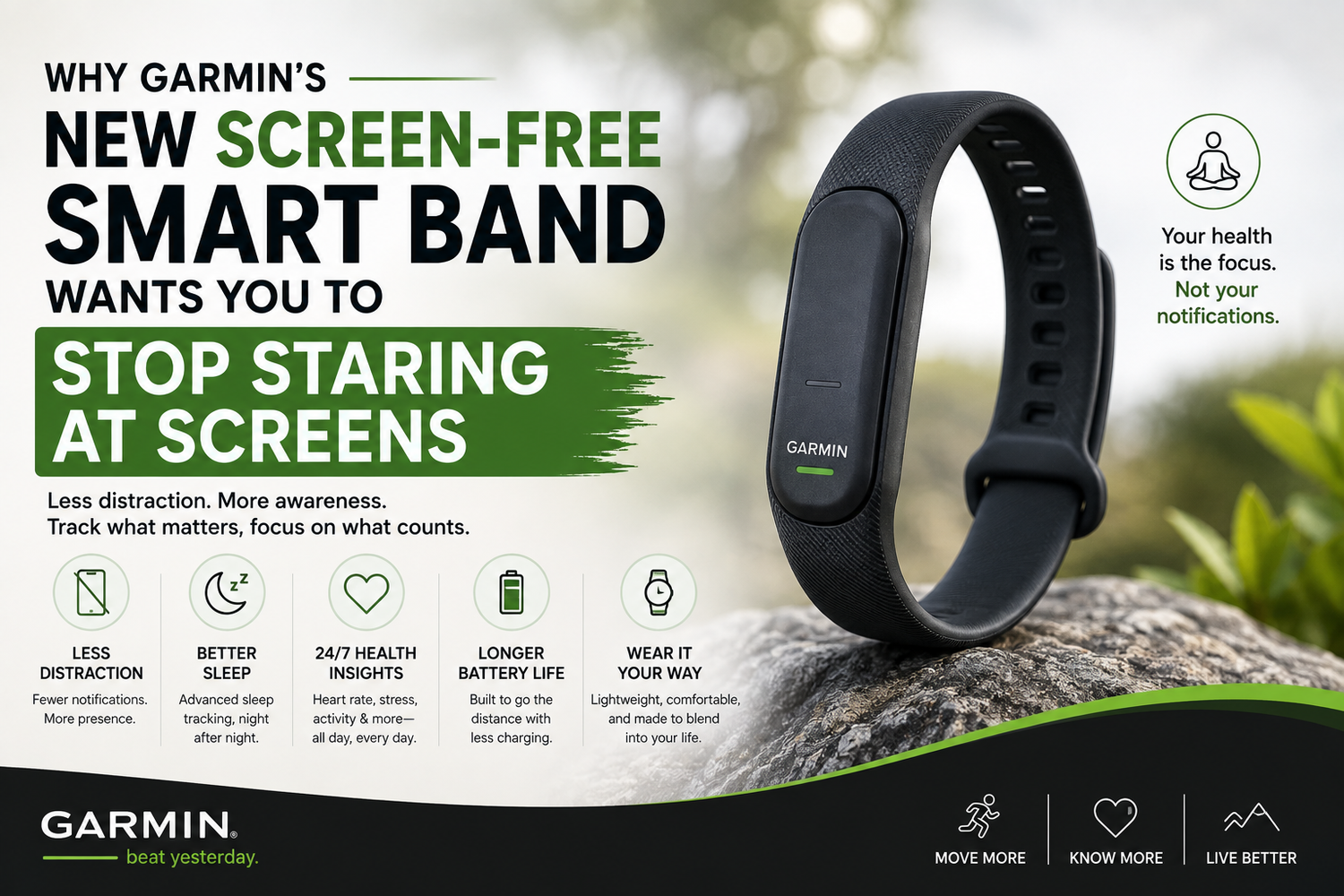
Smartwatches have become miniature computers for our wrists. They show messages, weather updates, workout statistics, calendars, music controls, health alerts, and dozens of other pieces of information throughout the day. While that convenience is useful, it creates an interesting problem: a device designed to improve your health can also become another screen demanding your attention.That is why the idea behind Garmin’s new screen-free smart band is so interesting.Instead of giving users another bright display to check every few minutes, a screen-free wearable focuses on quietly collecting health and fitness information in the background. You wear it, continue with your day, and check the detailed information on your phone when you actually want to.It represents a different philosophy for wearable technology track more, distract less.So why would Garmin want you to stop staring at your wrist?
1. The Screen Is No Longer the Main Attraction
For years, wearable manufacturers have competed over displays.Screens have become larger, brighter, sharper, and more responsive. That's excellent if you want a smartwatch capable of handling notifications, maps, apps, and other interactive features.But not everybody needs that.A screen-free smart band shifts the focus away from what the wearable can show and toward what it can measure.Instead of constantly presenting numbers on your wrist, the band can quietly gather supported health, activity, sleep, and recovery data.The experience becomes much more passive.For people who already spend hours looking at smartphones, computers, televisions, and tablets, that simplicity could be refreshing.
2. Fewer Notifications Mean Fewer Distractions
We've all experienced it.Your wrist vibrates, so you look down. It's a notification you didn't really need to see. But now you're thinking about the message, opening your phone, and potentially becoming distracted for several minutes.A screen-free wearable can break that cycle.Without a conventional smartwatch display constantly inviting interaction, you're less likely to repeatedly check your wrist.That could make the device particularly attractive to people trying to reduce digital distractions while still monitoring their health and activity.The philosophy is simple: your wearable should collect information about your life without constantly interrupting it.For meetings, family time, workouts, and social situations, that could be a meaningful advantage.
3. It Could Complement a Traditional Watch
One problem with smartwatches is that they replace whatever watch you already enjoy wearing.Perhaps you own a mechanical watch with sentimental value. Maybe you prefer a classic analogue design. Wearing a smartwatch on the other wrist can feel excessive, while giving up health tracking isn't ideal either.A discreet screen-free band offers another possibility.Because it isn't trying to be a traditional watch, it can potentially sit on one wrist while your favourite timepiece remains on the other.That creates an interesting audience for Garmin: people who want modern health tracking but don't want their wearable to dominate their personal style.Rather than asking users to choose between a traditional watch and a fitness device, a screen-free band can potentially let them use both.
4. Health Data Can Become More Passive
One of the biggest strengths of modern Garmin wearables is the ecosystem surrounding the sensors.Depending on the specific capabilities supported by the band, Garmin can use wearable data to build a broader picture around areas such as daily activity, heart rate, sleep, stress, and recovery.The important difference is that you don't necessarily need to watch those numbers change throughout the day.Your wearable collects information while you live your life.Later, the Garmin Connect app can provide a more detailed place to review compatible metrics and trends.This approach may actually encourage healthier use of fitness data.Instead of reacting emotionally to every number displayed on your wrist, you can review trends when you have time to interpret them properly.
5. Sleep Tracking Makes Perfect Sense Without a Screen
A display provides almost no benefit while you're asleep.In fact, removing one could potentially make a wearable feel more focused on overnight tracking.Sleep monitoring depends heavily on consistency. If a wearable is comfortable enough to keep on overnight and doesn't need to compete for wrist time with another watch, users may be more likely to collect regular sleep information.Garmin's broader ecosystem can use supported overnight measurements to provide insights into rest and recovery.The value isn't necessarily knowing exactly what happened during one particular night.It's being able to observe patterns across weeks and months.A lightweight, distraction-free band could be particularly well suited to that type of continuous tracking.
6. It Encourages You to Listen to Your Body
There's an unexpected downside to having health statistics available every second: sometimes we start trusting numbers more than ourselves.You might feel energetic but become concerned because a recovery metric looks lower than expected. Or you might constantly check heart rate numbers during a workout instead of paying attention to how your body feels.A screen-free design changes that relationship.You can still collect data, but it isn't always directly in front of you.During everyday activities, you're encouraged to focus more on the experience itself.Then you can look at the information later and use it as context.For many users, this could create a healthier balance between data awareness and data obsession.
7. Workouts Become Less About Watching Numbers
Serious runners and cyclists often need real-time statistics such as pace, distance, heart rate zones, navigation, or lap information. For those users, a Garmin sports watch with a display remains extremely useful.But not every workout requires a dashboard.If you're walking, strength training, attending a fitness class, or simply trying to remain more active throughout the day, you may prefer to exercise without constantly looking at numbers.A screen-free band supports that more relaxed approach.Track the activity where supported, concentrate on the workout, and review the information afterward.It isn't necessarily designed to replace every Garmin sports watch. Instead, it represents another style of fitness tracking for users who value simplicity.
8. A Simpler Device Could Encourage Continuous Wear
The best health tracker is often the one you actually wear.A wearable can have dozens of sophisticated features, but they provide little value when the device spends half the week sitting on a bedside table.A screen-free band can potentially prioritize comfort, subtlety, and continuous wear.Without the need to accommodate a large display and smartwatch-style interface, the design can focus more heavily on becoming something you forget is on your wrist.That's particularly important for long-term trends.Health and recovery insights generally become more meaningful when the wearable has consistent information rather than occasional snapshots.The less intrusive the device feels, the easier that consistency may become.
9. Battery Life Becomes Part of the Appeal
Displays consume power.
Removing a large, bright smartwatch screen changes the power requirements of a wearable, although actual battery endurance still depends on sensors, connectivity, software, and how the device is used.Longer intervals between charges can be particularly valuable for health tracking.Every time you remove a wearable to charge it, you create a gap in the information being collected.If a simpler band can spend more time on your wrist and less time connected to a charger, that could make continuous tracking easier.The goal isn't simply impressive battery specifications.It's reducing the amount of maintenance required to keep the device useful.
10. It Reflects a Bigger Shift in Wearable Technology
For years, technology companies have tried to put more information in front of us.The next stage may be about deciding which information doesn't need a screen at all.Smart rings have already demonstrated interest in passive health tracking without conventional displays. A screen-free Garmin band follows a similar philosophy while fitting into Garmin's established fitness ecosystem.This could create a clearer distinction between two categories of wearable.A smartwatch is something you actively interact with.A screen-free health tracker is something you mostly allow to work in the backgroundNeither approach is automatically better. They simply suit different users.
Who Is a Screen-Free Garmin Band For?
This type of wearable could be particularly appealing to traditional watch owners, people trying to reduce screen time, sleep-tracking enthusiasts, casual fitness users, and anyone who finds smartwatches distracting.It could also work well as a secondary wearable for people who don't want to wear a larger sports watch continuously.However, it won't suit everyone.Runners who rely on real-time pace information, hikers who need maps, or users who want notifications and apps directly on their wrist will probably prefer a Garmin watch with a display.That's the point.A screen-free band isn't necessarily trying to replace every smartwatch.It's offering an alternative.