


































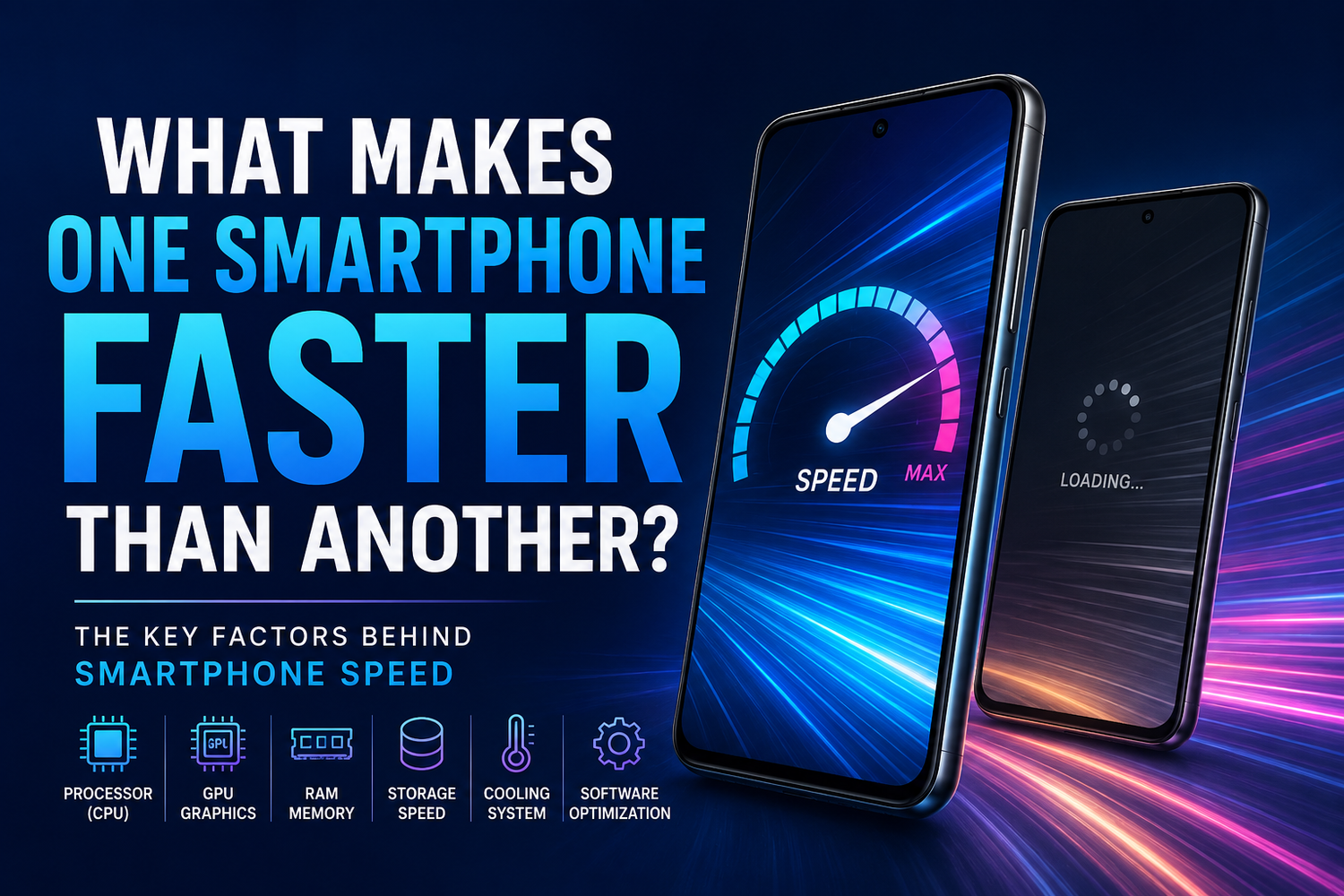
Two smartphones can look almost identical from the outside yet feel completely different when you start using them. One opens apps instantly, switches between games smoothly and processes photos without noticeable delay. Another hesitates when multitasking, reloads apps frequently or begins to slow down during demanding tasks.So, what actually makes one smartphone faster than another?The obvious answer might be the processor, but smartphone performance is more complicated than simply choosing the device with the newest chip or the biggest numbers on the specification sheet.RAM, storage speed, cooling, software optimisation, display refresh rate and even battery condition can influence how fast a phone feels.Here's what you should understand before judging smartphone performance.
1. The Processor Is the Starting Point
The processor, often discussed as part of a smartphone's system-on-chip or SoC, is one of the biggest factors affecting performance.Think of it as the phone's central engine.It handles enormous numbers of calculations required for everyday tasks, from launching apps and loading websites to processing photographs and running games.Modern smartphone chips commonly contain multiple CPU cores designed for different workloads. Some focus on demanding performance, while others prioritise efficiency for lighter background tasks.A faster processor can help apps respond more quickly and complete demanding operations sooner.But there's an important catch:A powerful processor doesn't automatically guarantee a fast phone.The rest of the hardware and software must allow that processor to perform effectively.
2. CPU Cores Aren't the Whole Story
You'll often see smartphones advertised as having eight-core or "octa-core" processors.Does eight cores automatically make a phone faster than one with six?Not necessarily.Core design, architecture, clock speed, manufacturing technology and software optimisation all matter.A newer CPU core can sometimes accomplish more work than an older core even when their headline clock speeds appear similar.This is why comparing processor specifications purely by the number of cores or GHz can be misleading.It's similar to comparing cars based only on engine RPM without considering the rest of the vehicle.The complete design matters.
3. The GPU Makes a Big Difference in Gaming
The Graphics Processing Unit, or GPU, is particularly important for games and visually demanding applications.The GPU is responsible for rendering graphics.If you're playing a sophisticated 3D game, the phone needs to calculate environments, lighting, textures, characters and animations rapidly enough to create smooth movement.A stronger GPU can support higher graphical settings and potentially smoother frame rates.This is why two phones that feel similarly fast while browsing Instagram may behave very differently when you launch a demanding game.Casual users may not need the most powerful GPU available.Serious mobile gamers are far more likely to notice the difference.
4. RAM Determines How Much Your Phone Can Juggle
RAM is temporary working memory.When you open an application, some of the information required by that app is held in RAM so the phone can access it quickly.Having more RAM can help the device keep multiple applications available simultaneously.Imagine switching between your browser, camera, Spotify, WhatsApp and a shopping app.With sufficient RAM and good software management, those applications may remain ready when you return to them.With limited RAM, the operating system may close background applications to free memory. When you return, the app needs to reload.That can make the phone feel slower.However, more RAM isn't automatically better forever.A phone with 16GB isn't necessarily twice as fast as one with 8GB. Once you have enough memory for your workload, additional capacity may provide little noticeable benefit.
5. Storage Speed Is an Underrated Factor
Most buyers think about smartphone storage only in terms of capacity.128GB, 256GB or 512GB?But storage speed matters too.Your phone constantly reads and writes information. Apps need to load data, photographs need to be saved and files need to be accessed.Faster storage can reduce waiting times during these operations.This is one reason a premium smartphone can sometimes feel noticeably more responsive than an inexpensive model even when both have plenty of available storage space.Storage technology isn't as exciting to advertise as camera megapixels, but it contributes to the overall experience.
6. Software Optimisation Can Make or Break Performance
Hardware is only half the story.The operating system and manufacturer's software need to use the hardware efficiently.Good software optimisation can make animations feel smooth, manage memory intelligently and allocate processing power where it's needed.Poor optimisation can make powerful hardware feel surprisingly ordinary.This is why benchmark scores don't always perfectly reflect everyday experience.A phone might produce excellent numbers in a performance test but still have awkward animations or aggressive background-app management.Another device with slightly weaker benchmark results could feel smoother because its software has been carefully tuned.When choosing a smartphone, real-world responsiveness matters as much as laboratory-style scores.
7. Display Refresh Rate Changes How Fast a Phone Feels
Here's something interesting: a smartphone can look faster without actually completing tasks faster.That's partly because of display refresh rate.Traditional smartphone displays commonly operate at 60Hz, meaning the screen can refresh up to 60 times per second.Higher-refresh-rate screens, such as 90Hz or 120Hz displays, can make scrolling and animations appear smoother when the software and content support those rates.Open a menu or scroll through a website and a high-refresh-rate phone may immediately feel more responsive.The processor hasn't necessarily loaded the website faster.Your eyes are simply seeing smoother motion.Perceived speed matters almost as much as raw speed during everyday use.
8. Heat Can Slow Down Even a Powerful Phone
Smartphone processors generate heat when working hard.The problem is that phones are small, thin devices without the large cooling systems found inside desktop computers.If internal temperatures become too high, a smartphone may reduce processor performance to control heat.This is known as thermal throttling.Imagine playing a demanding game for 40 minutes.A phone might deliver excellent performance during the first few minutes but gradually reduce speed as temperatures increase.Another device with better thermal management might maintain its performance for longer.This is why sustained performance is especially important for gamers and people who regularly perform demanding tasks.A short benchmark doesn't always reveal the entire picture.
9. App Developers Matter Too
Sometimes your phone isn't the reason an application feels slow.The app itself may simply be poorly optimised.Developers need to account for different processors, operating-system versions, screen sizes and hardware configurations.An inefficient application can consume unnecessary resources or respond slowly even on powerful hardware.Network-dependent apps introduce another variable.If a social media feed takes several seconds to appear, your processor might be waiting for information from the internet.In that situation, upgrading to a faster smartphone may not solve the problem.Your Wi-Fi or mobile connection could be the bottleneck.
10. Battery Condition Can Affect the Experience
Smartphone batteries naturally age.As they accumulate charging cycles and chemical ageing occurs, their ability to hold energy declines.Battery and power-management systems can also influence performance under certain conditions.An older phone with a degraded battery, nearly full storage and years of accumulated applications may therefore feel considerably different from when it was new.This doesn't necessarily mean the processor has physically become slower.The environment around it has changed.Battery health, background applications, storage availability and newer software requirements can all affect the experience.
11. Why Do Flagship Phones Usually Feel Faster?
Flagship smartphones generally combine several performance advantages rather than relying on one component.They may offer a high-end processor, stronger GPU, fast storage, generous RAM, sophisticated cooling and a high-refresh-rate display.Manufacturers also tend to optimise their premium devices carefully because those phones represent the brand's best technology.The result is a device that can feel responsive across almost everything.But this doesn't mean everyone needs flagship performance.Messaging, web browsing, streaming music, navigation and social media don't necessarily require the fastest processor available.Modern mid-range phones can be extremely capable for ordinary tasks.
12. Does a Faster Phone Stay Fast for Longer?
Potentially.Buying more performance than you currently need can provide some headroom for future software.Applications become more demanding over time. Operating systems gain features, games improve their graphics and AI-powered functions can require additional processing resources.A powerful phone may therefore remain comfortable with future workloads for longer.However, processor performance isn't the only factor affecting longevity.Software-update support, battery replacement options, storage capacity and the way you care for the device also matter.A fast phone that stops receiving important software updates isn't necessarily a better long-term purchase.
Benchmark Scores vs Real-World Speed
Benchmark applications can be useful because they provide standardised measurements for comparing devices.But don't treat a benchmark score like the final answer.A phone that scores 20% higher doesn't automatically feel 20% faster when you're sending messages.Performance differences become more noticeable during demanding workloads such as gaming, video editing, large file processing and intensive multitasking.For everyday buyers, ask a simpler question:Is this phone fast enough for what I actually do?That's far more useful than trying to own the highest benchmark number.