


































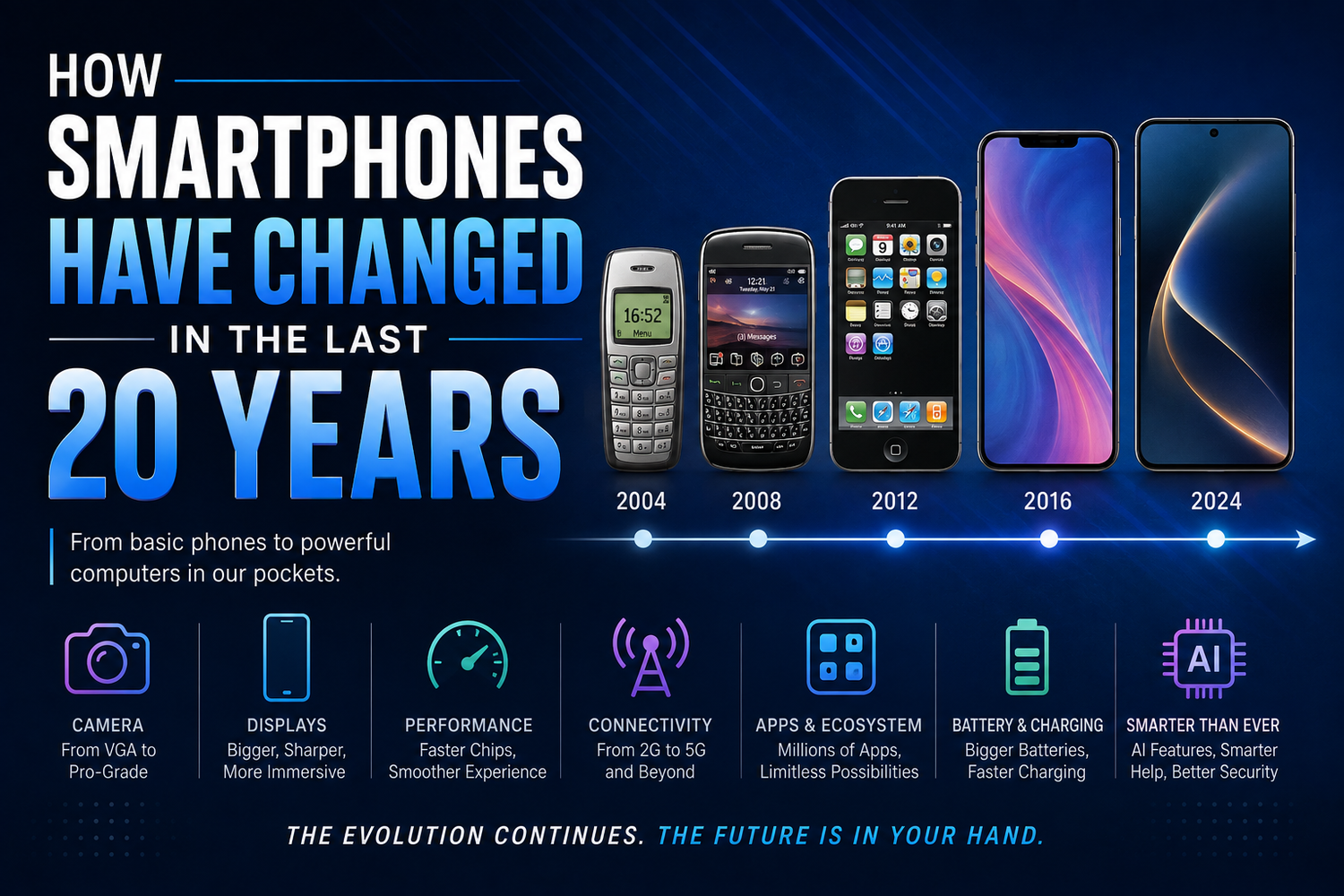
Twenty years ago, the idea that your phone could replace your camera, GPS navigator, music player, wallet, alarm clock and even part of your computer would have sounded ambitious.Mobile phones in the mid-2000s were already becoming more capable. Some offered cameras, web browsers, email and downloadable applications. BlackBerry devices were becoming essential business tools, Nokia dominated much of the mobile market, and early smartphones from companies such as Palm and HTC demonstrated what pocket computing could become.But compared with today's devices, they belonged to a very different era.Over the last 20 years, smartphones have evolved from communication devices with extra features into powerful computers that influence almost every part of daily life.So, what changed?
1. Physical Keyboards Almost Disappeared
Look at a mobile phone from 2006 and there's a good chance you'll find plenty of buttons.Numeric keypads were everywhere. Business-oriented smartphones often featured full QWERTY keyboards, while flip and slider designs were popular alternatives.Modern smartphones look dramatically simpler.The arrival of increasingly capable touchscreen devices transformed the industry's approach to design. Instead of dedicating permanent physical space to buttons, manufacturers could make most of the front of the phone a display.The keyboard became software.Need to type? It appears.Want to watch a movie? It disappears.That flexibility helped turn the smartphone screen into the device's primary interface.
2. Screens Became Enormous
A large phone screen in the mid-2000s would look tiny today.Modern smartphones commonly have displays measuring well over six inches diagonally. Improvements in screen technology and shrinking bezels have allowed manufacturers to increase display size without making phones quite as enormous as those measurements might suggest.Resolution has improved dramatically too.Modern OLED and AMOLED displays can deliver deep blacks, strong contrast, high brightness and smooth refresh rates. Premium phones may offer adaptive high-refresh-rate displays that make scrolling and animations feel extremely fluid.The screen has evolved from somewhere to read messages into a portable cinema, gaming display, photo editor and workspace.
3. Phone Cameras Replaced the Compact Camera for Many People
Perhaps no smartphone feature has transformed more dramatically than the camera.Twenty years ago, phone cameras were largely about convenience. Image quality was limited, low-light photography was difficult and digital zoom often produced poor results.Today, high-end smartphones can contain several cameras with different purposes.A typical premium setup might include a main camera, ultrawide lens and dedicated telephoto or periscope camera.But hardware is only half the story.Modern smartphones use computational photography, combining sophisticated image processing with multiple exposures and software algorithms to improve photographs.Features such as HDR, portrait effects, night photography and advanced stabilisation can operate with minimal effort from the user.The result is simple: for millions of people, the smartphone has become their only camera.
4. Mobile Internet Went From Optional to Essential
Using the internet on a phone once felt like an additional feature.Today, a smartphone without an internet connection can feel strangely incomplete.The progression from 2G and 3G through 4G and now 5G has dramatically increased what mobile devices can do online.Streaming high-resolution video, joining video meetings, downloading large applications, navigating with live traffic information and uploading photographs to cloud services have become ordinary activities.This connectivity also changed how applications are designed.Many modern apps assume your device will be connected almost constantly.The smartphone isn't simply a computer in your pocket.It's a computer permanently connected to an enormous network of services.
5. Apps Changed Everything
Early mobile phones often came with a fixed selection of applications.You used whatever the manufacturer provided, perhaps with limited options for installing additional software.The modern app-store model completely changed that relationship.Instead of manufacturers deciding everything your phone could do, developers could create applications for almost any imaginable purpose.Banking.Food delivery.Navigation.Dating.Language learning.Fitness.Video editing.Gaming.Ride sharing.The smartphone became a platform rather than simply a product.That's arguably one of the most important developments of the last 20 years.
6. Smartphones Replaced Entire Categories of Gadgets
Think about the devices people commonly carried or owned around 2006.A digital camera.An MP3 player.A GPS navigator.A calculator.A voice recorder.Perhaps a handheld gaming system.You may still own dedicated versions of these devices today, particularly if you need specialist capabilities.But for everyday tasks, the smartphone can replace many of them.That consolidation explains why people are willing to spend significant amounts of money on premium phones.You're not necessarily buying just a telephone.You're buying one device that performs jobs previously handled by numerous products.
7. Mobile Gaming Became Serious
Early phone games were often simple experiences designed around limited hardware.Modern smartphone gaming is a completely different industry.Today's phones contain powerful processors and GPUs capable of running sophisticated 3D games. High-refresh-rate screens, advanced cooling systems and dedicated gaming features can make smartphones surprisingly capable gaming machines.Cloud gaming has expanded the possibilities further by allowing compatible games to be streamed from remote servers.There are even smartphones designed specifically for gaming, complete with aggressive cooling, gaming controls and performance-focused software.The difference from playing Snake on a keypad phone couldn't be much greater.
8. Batteries Became Larger but Our Demands Grew Too
You might remember old mobile phones lasting several days between charges.Why can't every modern smartphone do that?Because modern phones are doing dramatically more.Large high-resolution displays, powerful processors, cameras, GPS, background syncing, 5G connections and demanding applications all require energy.Battery capacities have increased substantially, while processors and displays have become more efficient.Charging has evolved too.Fast wired charging can provide significant power in relatively short periods on supported devices, while wireless charging has become common among many premium models.The focus has shifted from simply asking “How many days does it last?” to balancing battery endurance with enormous computing capability.
9. Security Became Personal
Twenty years ago, locking a phone might mean entering a PIN.PINs and passwords still exist, but modern smartphones increasingly rely on biometric security.Fingerprint scanners became mainstream, followed by sophisticated facial-recognition systems on certain devices.Your phone now contains far more sensitive information than older mobile devices ever did.Banking applications, private photographs, emails, authentication codes, payment cards and work documents may all be stored or accessible through it.That makes smartphone security far more important than it was two decades ago.
10. Your Phone Became Your Wallet
Leaving home without your wallet once created an immediate problem.Today, some people are more worried about forgetting their smartphone.Mobile payment systems allow compatible phones to make contactless payments at supported terminals. Digital tickets, boarding passes, loyalty cards and other credentials can also be stored on smartphones.Depending on where you live, more forms of identification and access are becoming digital too.The smartphone is gradually becoming not just something you carry but a digital representation of many things you previously carried separately.
11. Software Updates Became a Major Buying Consideration
Older mobile phones didn't always receive years of meaningful software development after purchase.Modern smartphones are different.Operating-system upgrades can introduce new features long after the phone leaves the factory, while security patches help protect devices against newly discovered vulnerabilities.Software support has therefore become an important part of smartphone value.When comparing two devices today, it's worth asking not only what they can do now but how long the manufacturer intends to support them.A phone designed to remain secure and updated for years may be a better investment than a slightly cheaper model with limited long-term support.
12. Artificial Intelligence Is Becoming the Next Big Shift
The newest stage of smartphone evolution revolves around AI.Artificial intelligence isn't completely new to phones. Machine learning has been used behind the scenes for years in areas such as photography, voice recognition and battery management.What's changing is how visible AI has become.Modern devices increasingly offer generative and context-aware tools for tasks such as editing photographs, summarising information, translating conversations, assisting with writing and searching content.Some processing can happen directly on the device, while other features may depend on cloud services.Whether every AI feature proves genuinely useful remains to be seen.But AI is clearly becoming one of the major battlegrounds for the next generation of smartphones.
13. Foldables Brought Physical Design Back Into the Conversation
For years, smartphone design became increasingly predictable.Almost every device was a rectangular slab dominated by a touchscreen.Foldables disrupted that pattern.Book-style foldables can transform from relatively conventional phones into small tablet-like devices. Flip-style models can fold into much smaller packages.They're still smartphones, but they challenge the idea that a phone must remain one fixed shape.After years of evolution focused largely on internal components, manufacturers are once again experimenting with the physical form of the device.
14. Smartphones Became Part of Larger Ecosystems
Your phone increasingly doesn't work alone.It communicates with smartwatches, wireless earbuds, tablets, laptops, televisions, cars and smart-home devices.Take a photograph on your phone and it may automatically appear on your computer.Start listening through earbuds and they may move between compatible devices.Your smartwatch can display phone notifications or help track a workout.This ecosystem approach means choosing a smartphone can influence which other products you buy later.The phone has become the centre of a collection of connected technology.