































Today, Samsung is a name associated with smartphones, televisions, tablets, semiconductors, appliances and foldable displays. Walk into almost any electronics store and you're likely to see the Samsung name somewhere.But the company wasn't originally an electronics manufacturer and the word “Samsung” existed decades before the first Galaxy smartphone.In fact, the meaning behind the name reveals something about the ambitions of Samsung's founder, Lee Byung-chull, when he established his business in South Korea.Samsung literally means “three stars” in Korean. But why three? Why stars? And how did a name chosen for a small trading business become one of the world's most recognizable technology brands?Here's the story.
What Does Samsung Actually Mean?
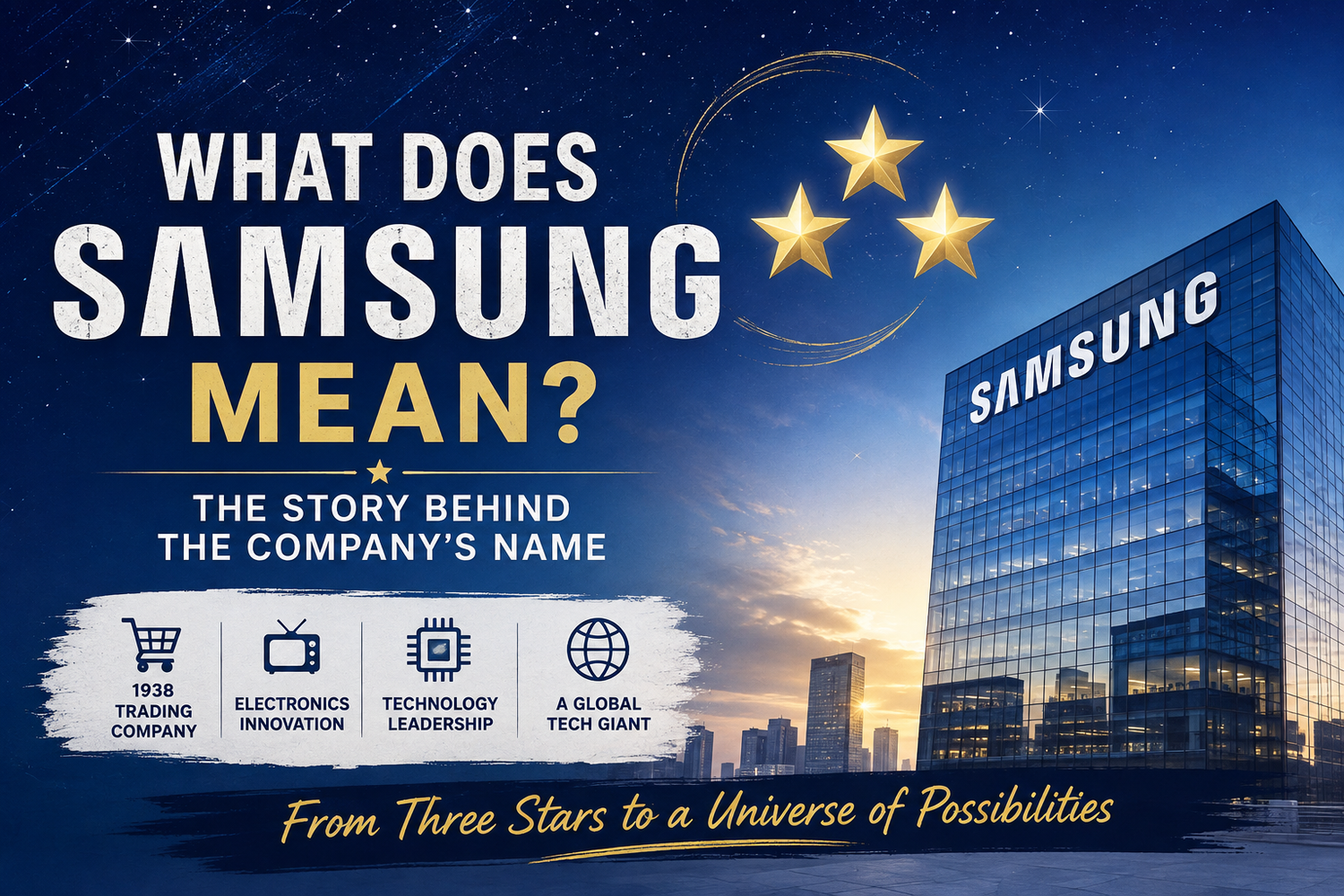
The Korean name Samsung is written 삼성, and Samsung itself explains the meaning as “three stars.”The meaning goes deeper than simply counting celestial objects.According to Samsung's official brand history, “three” represents qualities such as being large, plentiful and strong, while “star” represents something bright, lofty and eternally shining. The name reflected founder Lee Byung-chull's ambition for the company to become large, powerful and enduring. In other words, Samsung wasn't chosen because the company had three founders or three products.It was an expression of ambition.Lee wanted the company he was building to endure and shine like stars in the sky.Considering how dramatically Samsung would expand during the following decades, the name eventually became remarkably appropriate.
Samsung Didn't Begin With Smartphones
If you've grown up knowing Samsung primarily through Galaxy phones, you might imagine that the company's history began with electronics.It didn't.Samsung traces its beginnings to March 1, 1938, when Lee Byung-chull founded a small grocery trading operation. Historical Samsung material identifies the early business as Samsung Sanghoe.The company traded goods rather than manufacturing smartphones, televisions or memory chips.Samsung's own historical material has described its early activities as including noodles and other goods. That's what makes Samsung's history so unusual from a modern perspective.The name that now appears on advanced foldable smartphones and huge televisions originally belonged to a trading business established before the Second World War.
Why Did Lee Byung-chull Choose “Three Stars”?
The symbolism of the name makes more sense when you consider Lee Byung-chull's ambitions.Samsung explains that the founder envisioned the company becoming large, strong and everlasting. The imagery of stars captured the idea of something bright and enduring. “Three” also has positive associations with strength and abundance in Samsung's own explanation of its heritage.Put those ideas together and the name becomes almost like an early mission statement.Lee wasn't naming the business after what it currently was.He was naming it after what he hoped it could become.That distinction is important.In 1938, Samsung was nowhere close to being a global technology company. The name therefore represented an aspiration rather than a description.
The Three Stars Actually Appeared in Samsung's Logo
The meaning wasn't hidden in company documents either.Samsung literally used three stars in its earlier logos.Over the decades, the company's visual identity changed significantly, but the stars remained an important element for years. Samsung says representations of the three stars continued appearing in previous logos until 1993. That's an interesting detail for anyone familiar only with modern Samsung branding.Today, you see a clean SAMSUNG wordmark.Older branding made the meaning of the company's name much more obvious.Three stars weren't simply decoration. They visually represented the same ideas behind the original name.
How Did Samsung Get Into Electronics?
The Samsung name existed for decades before Samsung Electronics.Samsung Electronics dates its beginnings to 1969, more than 30 years after the original Samsung business was founded.This marked the beginning of the journey that would eventually make Samsung famous in consumer technology.During the 1970s, Samsung expanded its mass production of home appliances and became a major manufacturer of black-and-white televisions. The company also began laying foundations for what would eventually become an enormous semiconductor business. This is where the Samsung story begins looking more familiar.The trading company was becoming an industrial and electronics powerhouse.Yet the same name remained.
From Televisions to Semiconductors
Samsung's expansion wasn't limited to consumer electronics.Semiconductors would become one of the most important parts of the company's technology story.Modern consumers may primarily encounter Samsung through Galaxy smartphones and televisions, but behind those consumer products sits extensive expertise in areas such as memory, displays and semiconductor manufacturing.That broader technological capability helped Samsung become much more than simply a company assembling finished electronics.It became involved in producing many of the components modern electronics depend upon.The original “three stars” idea building something large and enduring was becoming increasingly visible in the scale of the organisation.
Then Came Mobile Phones
Eventually, Samsung entered telecommunications and mobile devices.Those early phones looked nothing like today's Galaxy S, Galaxy Z Fold or Galaxy Z Flip devices.Mobile phones evolved rapidly through the 1990s and 2000s, moving from relatively simple communication tools to increasingly sophisticated multimedia devices.Then smartphones changed everything.Samsung became one of the companies that embraced the transition aggressively, particularly through Android.The Galaxy brand would eventually become so important that many consumers now associate Samsung almost automatically with smartphones.Yet “Galaxy” is a relatively recent chapter in a story that began in 1938.
There's an Interesting Connection Between “Samsung” and “Galaxy”
There is also a fun linguistic coincidence in Samsung's modern branding.Samsung means three stars.Its most famous consumer technology brand is Galaxy.Samsung itself uses cosmic language when discussing its heritage, describing its journey from the “three stars” concept toward a wider “universe of possibilities.” That makes the modern combination of Samsung Galaxy feel surprisingly natural.However, it's important not to reverse-engineer too much history into the naming. The original Samsung name predates Galaxy smartphones by many decades.Still, from a modern branding perspective, stars and galaxies fit together almost perfectly.
Why Did Samsung Remove the Stars From Its Modern Logo?
As Samsung became increasingly international, its visual identity became simpler.By the 1990s, the company was competing in rapidly globalising markets. Consumer electronics companies increasingly needed branding that worked consistently on everything from tiny electronic components to televisions and international advertising.Samsung says the three-star imagery remained part of earlier logos until 1993, when the company moved into the modern era of its visual identity. The stars disappeared from the logo.But they didn't disappear from the name.Every time someone says “Samsung,” they're still effectively saying “three stars.”The symbolism survived even after the visual stars were removed.
A Name That Had to Grow With the Company
Company names can become awkward when businesses evolve.A name associated with one specific product can become restrictive if the company enters completely different industries.Samsung didn't have that problem.Because the name expressed an abstract idea strength, scale and longevity it could move across industries surprisingly well.It worked for a trading company.It worked for electronics.It worked for semiconductors.It worked for televisions.And eventually, it worked for smartphones, smartwatches, tablets and foldable devices.That's one reason the name has aged so effectively.It doesn't describe what Samsung makes.It describes what its founder wanted Samsung to become.
Samsung's Transformation Makes the Name More Interesting
There's something almost poetic about comparing Samsung's beginnings with the company people recognize today.In 1938, Lee Byung-chull couldn't have been thinking about 5G smartphones, artificial intelligence or foldable OLED displays.Those technologies were generations away.But he could think about scale and longevity.The ambition represented by “three stars” was broad enough to survive technological revolutions that couldn't possibly have been predicted when the company was founded.Samsung moved through trading, manufacturing and industrial expansion before becoming deeply associated with electronics and technology.The products changed.The name didn't.
What Does the Samsung Name Represent Today?
For modern consumers, “Samsung” probably doesn't immediately translate into “three stars.”Instead, the name has accumulated new associations.Galaxy smartphones.Televisions.Tablets.Wearables.Home appliances.Displays and semiconductors.That is what happens when a brand survives for decades: the meaning of its name becomes layered.There is the literal meaning three stars.There is the founder's intended meaning strength, scale and longevity.And then there is the meaning created by nearly nine decades of business history.All three now exist together.