



































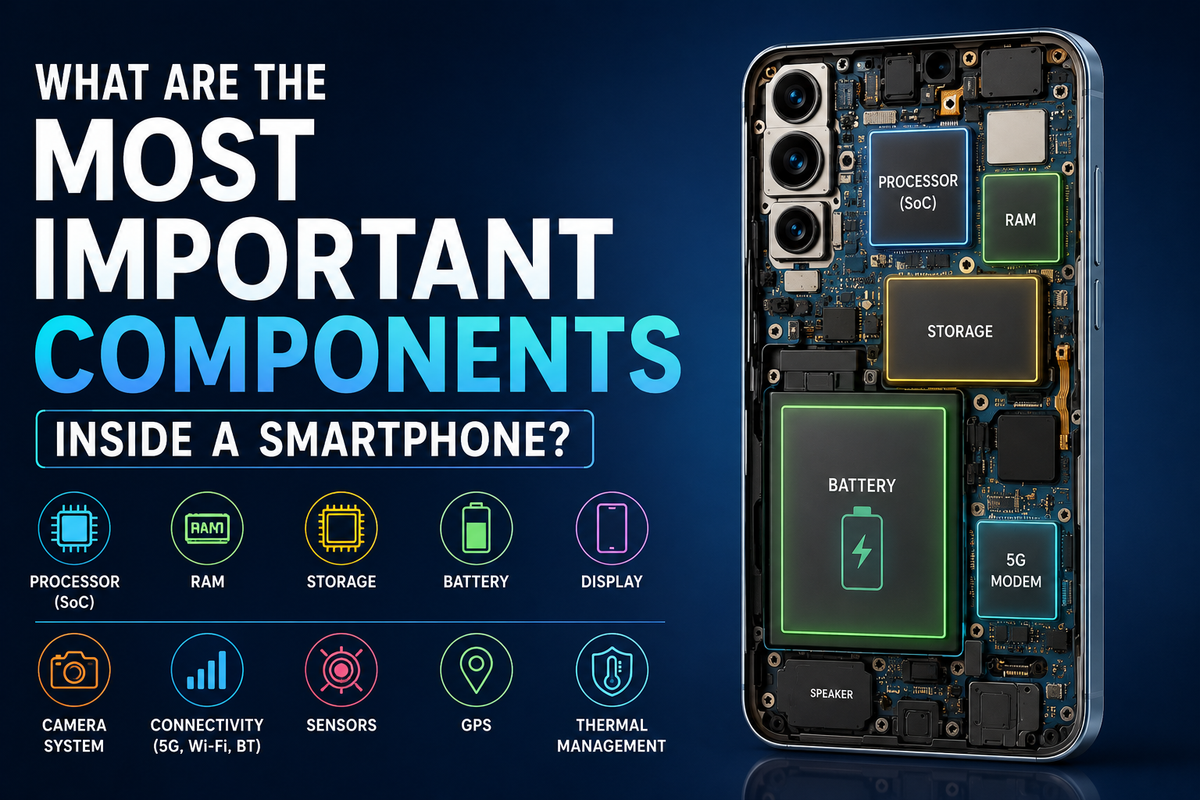
A smartphone looks surprisingly simple from the outside. You see a display, a few cameras, some buttons and perhaps a charging port. Underneath that slim exterior, however, is a tightly packed collection of components responsible for everything from taking photos and running apps to connecting to mobile networks and finding your location.Understanding these components can also make smartphone specifications easier to compare. A phone is not fast simply because it has plenty of RAM, and a camera is not automatically better because it has more megapixels. The overall experience depends on many pieces of hardware working efficiently with the software.Here are some of the most important components found inside a modern smartphone.
System on a Chip
The System on a Chip, usually shortened to SoC, is one of the most important pieces of hardware inside a smartphone.You can think of it as the phone's main computing centre. Rather than having a large collection of separate chips, many important processing components are integrated into a single compact package.The CPU handles general calculations and instructions. It plays a role when you launch apps, browse websites, manage files or perform everyday tasks.The GPU focuses primarily on graphics. It becomes particularly important when playing games, rendering animations and handling visually demanding applications.Modern smartphone chips can also include specialised processors for artificial intelligence, photography and other tasks.The speed of the processor matters, but efficiency is equally important. A powerful chip that consumes excessive energy or produces too much heat would not be ideal for a small battery-powered device.
RAM
RAM is the smartphone's short-term working memory.When you open an application, the phone places information it currently needs into RAM because it can be accessed much faster than data stored permanently on the device.RAM becomes particularly noticeable during multitasking.Imagine switching between a browser with several tabs, a messaging app, email, maps and music. Having enough RAM can help the phone keep more of those applications ready rather than constantly reloading them.However, more RAM does not automatically guarantee better performance. The processor, memory speed and operating system's memory management are also important.Unlike internal storage, RAM is temporary. Its contents are not designed to remain after the device loses power.
Internal Storage
While RAM handles temporary information, internal storage keeps your data for the longer term.This is where the operating system, apps, photos, videos, documents, games and downloaded files are stored.Storage capacities such as 128GB, 256GB and 512GB are common across modern smartphones, with some premium devices offering even more.Capacity is not the only consideration. Storage speed can affect how quickly large files are transferred and how efficiently demanding applications access their data.Someone who records lots of high-resolution video or installs large games may need considerably more storage than someone who mainly uses messaging, browsing and streaming apps.
Battery
The battery supplies energy to practically every component inside the smartphone.Modern phones generally use rechargeable lithium-based batteries designed to provide substantial energy while fitting into a thin device.Battery capacity is commonly measured in milliampere-hours, or mAh. A higher capacity can help, but comparing mAh numbers alone does not tell you which phone will last longer.Battery life also depends on the efficiency of the processor, display brightness, refresh rate, network connection, software and how you use the device.A smartphone performing navigation at high brightness over a mobile network will normally consume considerably more energy than one sitting idle on Wi-Fi.
Display and Touchscreen
The display is probably the component you interact with more than anything else.Modern smartphones commonly use OLED, AMOLED or LCD-based screens. The display produces the images, text and video you see, while the touch-sensitive system detects interactions with your fingers.Specifications such as resolution, brightness and refresh rate can change how the screen feels in everyday use.Higher brightness improves visibility in bright conditions. Higher refresh rates can make scrolling and animations appear smoother. Resolution affects how much detail the screen can display.The display can also be one of the biggest consumers of battery power, particularly when brightness is high.
Camera System
Smartphone cameras are much more complicated than their megapixel numbers suggest.A typical camera system includes a lens, image sensor and supporting electronics. Light travels through the lens before reaching the sensor, where it is converted into digital information.The smartphone then processes that information before producing the final photograph.Modern devices often use computational photography to combine multiple frames, improve dynamic range, reduce noise and optimise colours.Many smartphones also include several cameras with different purposes. A main camera may handle most everyday photography, while an ultra-wide captures a broader field of view and a telephoto camera provides optical zoom.This is why comparing cameras purely by megapixels can be misleading.
Modem and Antennas
A smartphone would be much less useful without its ability to communicate wirelessly.The cellular modem allows the device to connect to compatible mobile networks such as 4G and 5G. Antennas transmit and receive the radio signals required to maintain those connections.When you stream music over mobile data, browse the internet away from Wi-Fi or make a cellular connection, these components are working in the background.Network conditions can also influence battery life. When reception is poor, the phone may need to work harder to maintain a reliable connection.
Wi-Fi, Bluetooth and NFC
Smartphones contain additional wireless technologies for different types of communication.Wi-Fi provides high-speed connections to local networks, allowing you to access the internet without relying entirely on mobile data.Bluetooth is commonly used for wireless earbuds, speakers, smartwatches, cars and other accessories.NFC is designed for very short-range communication and is widely associated with compatible contactless payment systems.These technologies may seem like software features because they are controlled through menus, but each relies on dedicated hardware inside the phone.
Smartphone Sensors
Some of the smallest components inside a smartphone perform surprisingly important jobs.An accelerometer detects acceleration and movement, while a gyroscope helps understand orientation and rotation. These sensors can help games detect movement and allow the interface to rotate when you turn the phone.A proximity sensor can determine when the smartphone is near your face during a call, helping prevent accidental touchscreen input.An ambient light sensor measures surrounding light so automatic brightness can adjust the display.Depending on the model, smartphones can contain several other sensors for navigation, environmental measurements and specialised functions.
Satellite Navigation
Your smartphone can communicate with satellite navigation systems to help determine its position.This technology powers many everyday functions, including turn-by-turn navigation, fitness tracking, location sharing and mapping.Although people commonly call the technology GPS, modern smartphones may support multiple global satellite navigation systems.Phones can also combine satellite information with Wi-Fi, cellular networks and motion sensors to improve positioning in different situations.
Thermal Management System
Powerful processors generate heat, particularly during gaming, video editing, navigation and other demanding workloads.Smartphone manufacturers therefore need ways to spread and manage that heat.Depending on the device, internal thermal solutions can include graphite sheets, heat spreaders, thermal materials or vapour chambers.Temperature sensors and software also continuously monitor operating conditions.If the phone becomes too hot, the system can temporarily reduce performance or adjust certain functions to help control temperature. This process is one reason sustained performance can vary between phones using similar processors.
Motherboard
The motherboard is effectively the central platform connecting many of these components.Processors, memory, storage and other electronics need pathways through which they can communicate and receive power.Designing a smartphone motherboard is particularly challenging because internal space is extremely limited.Manufacturers need to accommodate the motherboard alongside a large battery, several cameras, speakers, vibration hardware, antennas and cooling components while keeping the device thin.The internal arrangement of these parts therefore plays an important role in smartphone design.