


































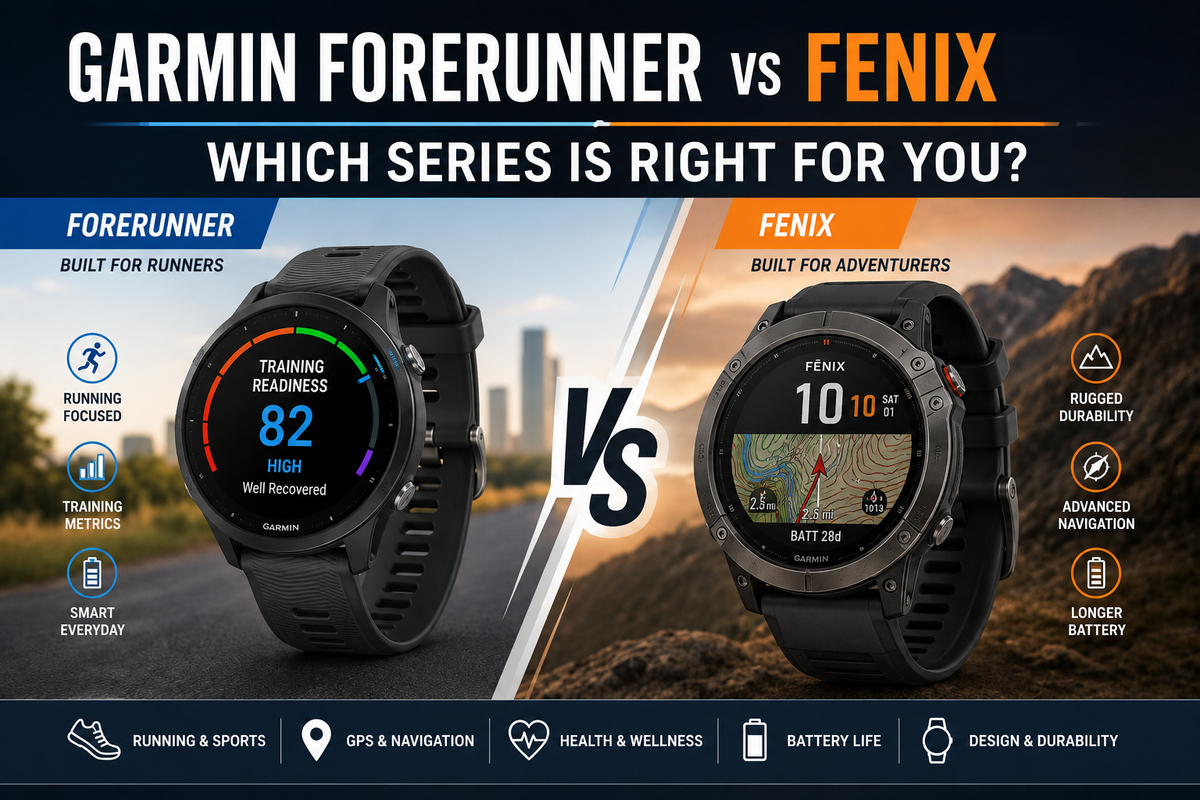
Choosing a Garmin watch can become surprisingly complicated. Two of the most popular Garmin families, Forerunner and Fenix, can track running, heart rate, sleep, workouts and GPS activities, yet they are designed with somewhat different users in mind.The easiest way to understand the difference is that Forerunner is primarily built around running and performance training, while Fenix expands the experience toward rugged multisport use, outdoor adventures, navigation and premium durability.The gap has become smaller as premium Forerunner models have gained advanced features. Garmin's current Forerunner range stretches from watches for beginner runners to the premium Forerunner 970, while the Fenix family targets users wanting a premium multisport GPS smartwatch.So which series makes more sense for you?
Forerunner Is Built Around Running
The name gives away the main purpose of the Forerunner family.Garmin designs these watches with runners in mind, from someone preparing for their first 5K to experienced marathon and triathlon athletes.Current Forerunner watches can provide GPS tracking, pace, distance and wrist-based heart rate, while more advanced models add detailed training and recovery tools. Garmin positions the Forerunner 570 for advanced runners and the Forerunner 970 for runners and multisport athletes looking for a premium experience.If your typical week revolves around running sessions, gym workouts and perhaps cycling or swimming, a Forerunner can provide an enormous amount of useful information without requiring you to buy Garmin's most rugged outdoor watch.
Fenix Is Designed for Broader Adventures
The Fenix philosophy is different.Rather than concentrating primarily on runners, the Fenix family is designed as a premium multisport and outdoor watch.Garmin highlights rugged construction, advanced mapping and navigation on the Fenix range. The Fenix 8 family, for example, includes a built-in LED flashlight and advanced mapping and navigation features, while different models offer substantial battery life.That makes Fenix particularly attractive for hiking, trail running, climbing, long-distance adventures and users who regularly move between different sports.A runner can absolutely use a Fenix. In fact, Garmin itself includes Fenix among its watches for elite runners.The question is whether you need everything else that comes with it.
Forerunner Usually Feels More Running-Focused
One reason runners often prefer Forerunner is that the series feels purpose-built for training.Garmin's current advanced Forerunner models offer features such as Training Readiness, Training Status, adaptive Garmin Coach plans and multi-band GPS. The Forerunner 970 goes further with specialised performance metrics such as running tolerance, while running economy and step speed loss can be available when paired with the compatible HRM 600.These metrics can help serious runners understand not only what happened during a workout but also how training is affecting their body over time.You can use this information to decide whether to push harder, recover or adjust your training.For someone whose main goal is improving a 5K, 10K, half-marathon or marathon time, that running-first approach can make Forerunner an obvious choice.
Fenix Is Better Suited to Rugged Environments
Running through a city and hiking through remote terrain place very different demands on a watch.This is where Fenix starts to make more sense.The Fenix family puts greater emphasis on ruggedness and outdoor functionality. Garmin's Fenix 8 generation includes a rugged design and a built-in LED flashlight, while advanced mapping and navigation are major parts of the experience.These features become more valuable when your activities regularly take you away from familiar roads.For someone who spends weekends hiking, trail running, exploring unfamiliar areas or participating in multiple outdoor sports, the additional capability can justify choosing Fenix.For someone who mostly runs around their neighbourhood, local park or athletics track, some of those capabilities may simply go unused.
Navigation Is No Longer a Simple Difference
There was once an easier distinction between the two families when discussing maps.Today, premium Forerunner watches can also provide sophisticated navigation.The Forerunner 970, for example, includes full-colour built-in mapping. Garmin specifically positions it for navigating city streets and trails, meaning serious runners no longer necessarily need to move to Fenix just because they want maps.However, mapping is not standard across every Forerunner.Garmin's comparison data shows built-in mapping on the Forerunner 970 but not the Forerunner 570.Therefore, the exact model matters just as much as the series name.If navigation is essential, check the capabilities of the individual watch rather than assuming every Forerunner or Fenix behaves identically.
Battery Life Can Favour Fenix
Battery life is one of Garmin's biggest advantages compared with many conventional smartwatches, and both families can last significantly longer than a device that requires daily charging.The exact battery life depends heavily on the model, size, display settings and GPS modes.For example, Garmin rates the Forerunner 570 at up to 11 days in smartwatch mode for the 47mm model and the Forerunner 970 at up to 15 days.Fenix can push considerably further depending on the configuration. Garmin says the 51mm Fenix 8 AMOLED can reach up to 29 days in smartwatch mode, while the 51mm solar version can reach up to 48 days under Garmin's specified solar-use conditions.That difference becomes valuable on multi-day trips where charging opportunities are limited.For normal running and everyday wear, however, Forerunner battery life is already substantial.
What About Everyday Health Tracking?
You do not need to be exercising every hour to benefit from either series.Garmin watches provide broader health and wellness information alongside workout tracking. Depending on the model, that can include sleep insights, heart rate information and recovery-related data.Garmin's comparison pages show features such as sleep score and insights across both premium Fenix models and popular Forerunner watches.This means the decision should not simply be based on which watch can track your health throughout the day.Both families can be useful 24-hour wearables.The bigger differences are the type of activities you perform, the level of ruggedness you want and how much navigation and outdoor functionality you expect.
Forerunner Can Be More Comfortable for Runners
Comfort is easy to overlook when buying a sports watch.A running watch can remain on your wrist during workouts, sleep, recovery and everyday activities. Size and weight therefore matter.The Forerunner philosophy generally prioritises a sport-focused design intended for long periods of training and everyday wear.Fenix watches tend to have a more substantial, rugged appearance.Some users prefer that premium outdoor-watch feeling. Others, particularly runners who want something less noticeable on their wrist, may prefer the feel of a Forerunner.Neither approach is automatically better.Your choice depends on whether lightweight sporting practicality or rugged premium construction matters more to you.
Do Runners Really Need a Fenix?
Probably not in most cases.A dedicated road runner can get highly sophisticated training capabilities from the Forerunner family.The Forerunner 570 provides advanced training and recovery features, while the Forerunner 970 moves into premium territory with a sapphire lens, titanium bezel, mapping, LED flashlight and advanced running metrics.That makes the premium Forerunner models extremely capable even for serious athletes.Fenix starts making more sense when running is only one part of your lifestyle.If Monday is a run, Wednesday is cycling, Saturday is hiking and your holidays involve unfamiliar trails or outdoor adventures, the broader Fenix approach becomes easier to justify.
Who Should Buy a Garmin Forerunner?
Choose a Forerunner if running is your main priority.It is particularly suitable for people training for races, monitoring pace and GPS data, following structured workouts or trying to understand their recovery.The Forerunner range also provides several levels of complexity, meaning you do not necessarily have to pay for elite features when you are just beginning.Even Garmin describes its current lineup as spanning beginner, advanced and elite runners.For road runners, triathletes and fitness-focused users, Forerunner is often the more focused choice.
Who Should Buy a Garmin Fenix?
Choose Fenix if you want one Garmin watch to cover running plus a wider outdoor lifestyle.Its rugged construction, extensive navigation capabilities and potentially longer battery life make it particularly attractive for hiking, trail running and longer adventures.It can still provide sophisticated running and training features, so choosing Fenix does not mean sacrificing serious athletic tracking.Instead, you are expanding beyond a primarily running-focused watch into a more comprehensive outdoor multisport platform.