


































For decades, the idea of carrying a device that could unfold into a larger screen belonged mainly to science fiction. Movies and television shows imagined flexible displays, pocket-sized computers and screens that could change shape. Meanwhile, real mobile phones remained relatively simple devices with rigid screens and physical buttons.Today, foldable smartphones are a genuine product category. Samsung, Motorola, Google, Huawei, Honor, Oppo and other manufacturers have developed devices that can transform from compact phones into larger displays or fold down into pocket-friendly shapes.The journey from science-fiction concept to everyday smartphone, however, took decades of technological development.
Before Foldable Screens, We Had Flip Phones
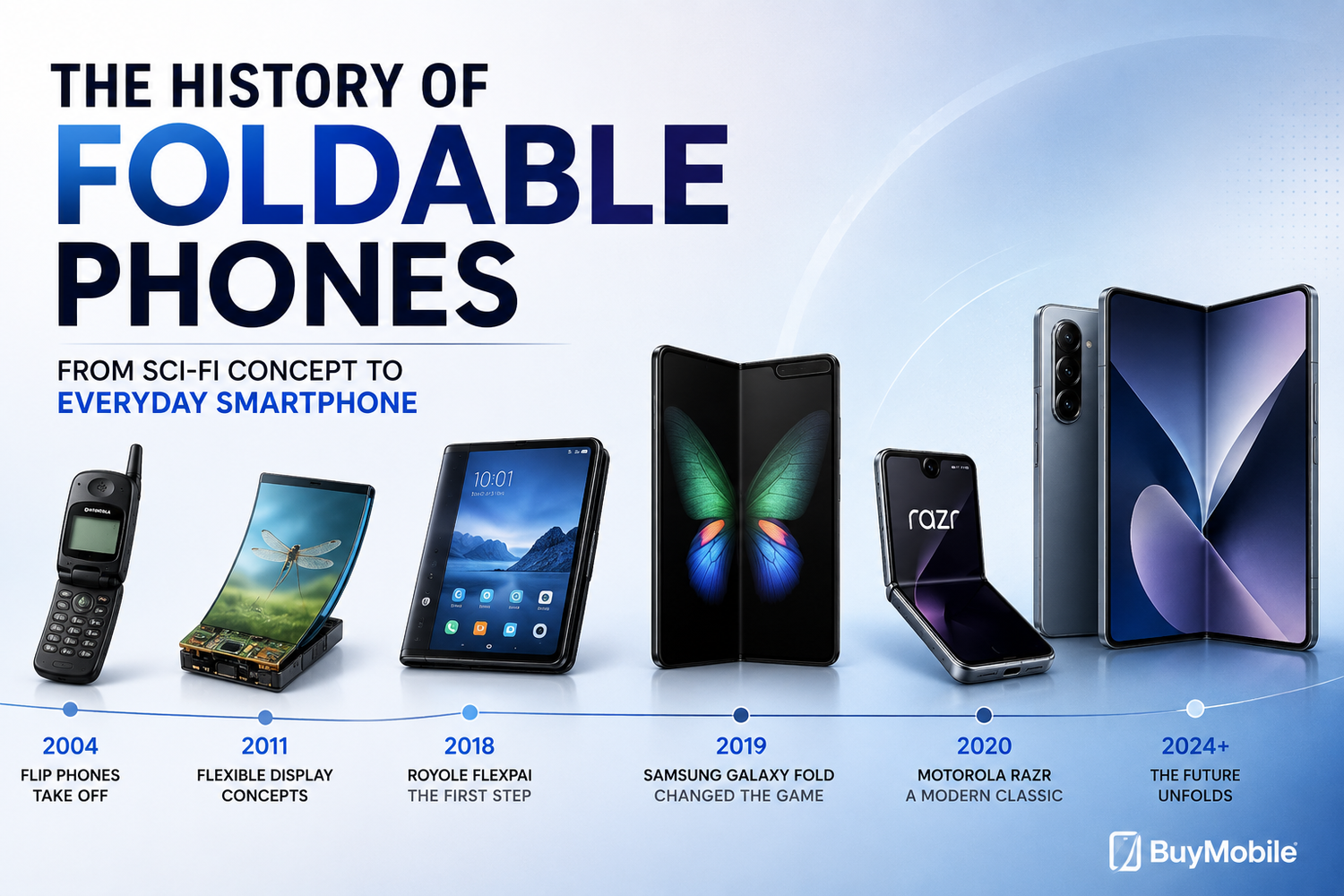
The story of foldable smartphones begins with a useful distinction.Traditional flip phones technically folded, but their screens did not.Devices such as the Motorola StarTAC and later Motorola Razr used hinges to connect two rigid sections. Depending on the design, the screen occupied one half while the keypad occupied the other.These phones demonstrated something important: people liked devices that could become smaller when they weren't being used.The original Motorola Razr became particularly influential because its thin folding design made technology feel fashionable as well as practical.However, today's foldable smartphones needed a much bigger technological breakthrough.The display itself had to bend.
Flexible Displays Were the Missing Piece
Conventional smartphone screens are built around rigid structures. That works perfectly when the phone never needs to change shape.A foldable phone requires something different.The development of flexible OLED display technology was therefore crucial.OLED displays do not require the same type of backlight system used by traditional LCD technology. Their extremely thin construction opened possibilities for displays that could curve and eventually fold.Throughout the 2000s and 2010s, technology companies demonstrated increasingly sophisticated flexible-screen concepts.Some displays could bend.Others could roll.Technology demonstrations generated enormous excitement, but turning them into consumer smartphones remained difficult.A screen bending once during a demonstration is very different from a phone surviving repeated folding every day for several years.
Why Did Foldable Phones Take So Long?
The display wasn't the only challenge.Manufacturers needed to design hinges capable of opening and closing thousands of times while supporting a delicate flexible panel.The display needed protective layers that were flexible enough to bend but durable enough for daily interaction.Internal components also presented a problem.Batteries, processors, cameras, speakers and antennas all had to fit around a folding structure. Manufacturers needed to consider heat management while keeping devices reasonably thin.Then there was software.Android applications had historically been designed for relatively predictable smartphone screens. A foldable could suddenly change from a narrow outer display to a tablet-like internal screen.The operating system and applications needed to understand that transformation.This explains why the journey took years despite flexible-display prototypes appearing much earlier.
The Royole FlexPai Arrived Before Samsung
When people think about the beginning of modern foldables, Samsung Galaxy Fold often comes to mind.But it wasn't technically the first commercially available folding-screen smartphone.Chinese display company Royole introduced the FlexPai in 2018.The device demonstrated that a flexible-screen smartphone could actually reach consumers.However, the FlexPai also illustrated how immature the category remained. Early foldables were thick, unconventional and came with significant compromises.Still, its historical importance shouldn't be ignored.The race to commercialise foldable smartphones had officially begun.
Samsung Galaxy Fold Changed the Conversation
Samsung announced the Galaxy Fold in 2019, and foldable smartphones suddenly attracted mainstream attention.The concept was ambitious.Use the smaller display when the phone was closed, then open the device like a book to reveal a much larger internal screen.It offered a glimpse of a future where one device could function as both smartphone and small tablet.But the Galaxy Fold's launch also demonstrated how difficult this technology was.Some early review devices experienced display problems. Samsung delayed the commercial release and made changes intended to improve protection and durability.For the emerging foldable category, this was an important lesson.Consumers expected a foldable to survive like a real smartphone, not behave like a fragile technology demonstration.
Huawei Took a Different Approach
Around the same period, Huawei introduced the Mate X.Rather than hiding the flexible screen inside when folded, Huawei initially explored an outward-folding design.This highlighted an important stage in foldable history.Nobody knew what the ideal foldable smartphone should look like.Should the screen fold inward?Should it fold outward?Should the phone transform into a tablet?Or should a normal-sized smartphone fold smaller?Manufacturers were effectively experimenting in public.Different designs attempted to solve the same fundamental problem in different ways.
Motorola Brought Back the Razr
Motorola approached foldables from another direction.Instead of creating a phone that opened into a tablet, it revived one of the most recognisable mobile designs ever made: the Razr.The modern Motorola Razr used a flexible touchscreen where older models had separate displays and physical keypads.This created the clamshell foldable category.A normal smartphone-sized screen could now fold into a significantly more compact device.The idea appealed to users who didn't necessarily want tablet-like productivity but appreciated portability, style and nostalgia.Samsung soon pushed the same general form factor further with its Galaxy Z Flip family.
Samsung's Z Flip Helped Expand the Market
The Galaxy Z Flip, introduced in 2020, demonstrated that foldables didn't have to be large productivity devices.They could be compact lifestyle products.This distinction became fundamental to the foldable market.Book-style devices such as the Galaxy Z Fold concentrated on large displays and multitasking.Clamshell devices such as the Galaxy Z Flip and Motorola Razr concentrated on making full-sized smartphones smaller when folded.These two categories remain central to the foldable market today.
Foldables Needed to Become More Durable
Early foldables attracted understandable questions about durability.Would the hinge break?Would dust enter the mechanism?Could the flexible display survive years of touching and folding?What happened if the phone got wet?Manufacturers gradually addressed these concerns.Samsung introduced water resistance to its Galaxy Z Fold3 and Z Flip3 generation, representing an important step toward everyday practicality.Hinges continued evolving.Protective display structures improved.Devices became better at closing more tightly, while newer hinge designs helped manufacturers reduce thickness.Foldables were slowly moving away from their reputation as fragile experiments.
Ultra Thin Glass Was an Important Development
Another important milestone was the adoption of Ultra Thin Glass in foldable display construction.Traditional thick smartphone cover glass cannot bend through the tight radius required by folding phones.Ultra Thin Glass is engineered to be extraordinarily thin, allowing it to flex as part of a multilayer display structure.It still requires protective layers and different handling expectations compared with conventional smartphone glass.Nevertheless, developments like UTG helped foldable displays feel more refined.The goal wasn't simply making a screen capable of bending.It was making one pleasant enough to interact with hundreds of times every day.
Software Became Much Smarter
Hardware improvements alone couldn't make foldables useful.Software had to catch up.Manufacturers worked with Android developers to improve how applications responded when devices were folded and unfolded.Multitasking became particularly important on book-style foldables.Instead of simply stretching one smartphone application across a giant screen, users could run multiple apps simultaneously.Samsung also developed features around partially folded positionsA foldable could effectively become its own stand, creating new possibilities for video calls, photography and media controls.The folding mechanism was becoming part of the user experience rather than simply a method of reducing device size.
Competition Accelerated Development
Samsung became one of the most visible companies in foldables, but competition quickly expanded.Huawei continued developing its Mate foldables.Oppo introduced Find N devices.Honor pushed toward increasingly thin book-style designs.Google entered the category with the Pixel Fold.OnePlus introduced the OnePlus Open.Xiaomi developed its Mix Fold family, while Motorola continued refining the Razr.Competition forced manufacturers to address the weaknesses of early foldables.Phones became thinner.Cover screens became more useful.Hinges improved.Cameras became more competitive.Software became more adaptable.Foldables increasingly needed to compete as great smartphones, not merely interesting folding devices.
The Crease Became Part of the Engineering Battle
One challenge remained particularly visible: the crease.Repeatedly bending multiple display layers along the same area naturally creates mechanical challenges.Different manufacturers experimented with hinge geometries designed to allow the display to bend through a gentler curve.Creases became less distracting on many newer devices, although completely eliminating them while maintaining durability remained challenging.Interestingly, long-term foldable users often reported that the crease became less noticeable during normal use.This demonstrated something important about technology adoption.A specification that appears significant in a showroom can become much less important once the product provides genuine everyday benefits.
Foldables Became Thinner and More Normal
Perhaps the biggest sign of progress has been the gradual disappearance of the "prototype feeling."Early foldables were unusually thick and heavy.Later generations became significantly more refined.Manufacturers concentrated heavily on reducing hinge size, optimising internal components and improving weight distribution.Cover displays also became more practical, allowing book-style foldables to behave increasingly like conventional smartphones when closed.This matters because most people don't want to completely change how they use a phone simply because it folds.Successful foldables need to feel normal when necessary and extraordinary when opened.
From Technology Demonstration to Everyday Device
The history of foldable phones isn't really about making screens bend.It's about making bending screens useful.A book-style foldable can provide additional space for reading, multitasking, gaming, photography and entertainment.A clamshell foldable can provide a normal smartphone experience while becoming considerably smaller when closed.Cover displays can allow quick interactions without opening the device.Partially folded positions can provide hands-free photography and video calls.These benefits explain why foldables survived beyond the novelty stage.