


































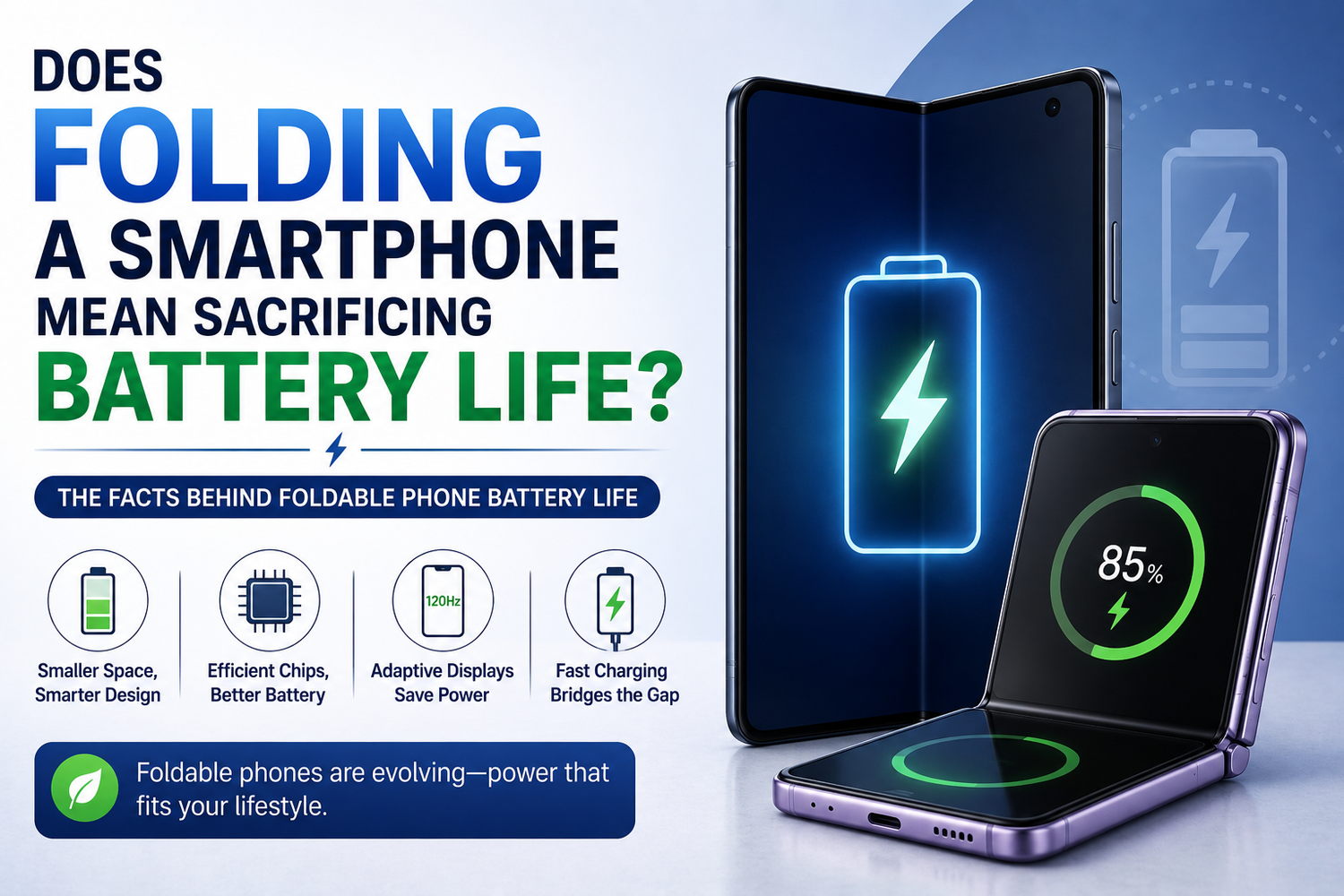
Foldable smartphones have changed what we expect from mobile design. A book-style foldable can open into a tablet-like display, while a flip-style device can transform from a full-sized smartphone into something much more compact. These designs are impressive, but they also create an obvious question for anyone considering a foldable phone.Does folding a smartphone mean sacrificing battery life?The answer is more complicated than simply yes or no. Foldable phones face several battery challenges that traditional smartphones do not. They need space for hinges, multiple displays and complex internal components, while some models also have much larger screens to power.However, battery technology, efficient processors, adaptive displays and smarter software have improved considerably. Modern foldables can provide practical everyday endurance despite their complicated designs.Here is why battery life remains one of the most interesting engineering challenges in foldable smartphones.
Foldable Phones Have Less Space to Work With
Every smartphone manufacturer has to decide how to use the limited space inside a device.A conventional smartphone has one relatively simple rectangular body. Manufacturers can use a substantial portion of that internal area for the battery.Foldable phones are different A book-style foldable needs a sophisticated hinge running through the middle of the device. A flip phone needs a similar mechanism that allows it to fold vertically.That hinge occupies valuable internal space.Manufacturers also need room for processors, cameras, speakers, cooling systems, wireless charging components and antennas.Finding enough room for the battery therefore becomes more difficult.This doesn't mean foldables automatically have small batteries. It means their internal layouts require significantly more creative engineering.
Many Foldables Use Split Battery Designs
One clever solution is dividing the battery between different sections of the phone.Instead of relying on one large battery cell, manufacturers can place battery components in both halves of a foldable device.This allows engineers to use available internal space more efficiently while maintaining the folding mechanism.From the user's perspective, this arrangement normally doesn't change how the phone works. The operating system manages the battery as one overall power source.However, it demonstrates how fundamentally different foldable engineering can be.Even something as basic as deciding where to put the battery becomes more complicated when the phone bends in the middle.
Bigger Displays Require More Power
Book-style foldables have another obvious challenge: their enormous internal displays.Open a device such as a Galaxy Z Fold and you gain significantly more screen space than you would get from an ordinary smartphone.That larger display can be fantastic for watching videos, gaming, reading, editing documents and multitasking.But pixels require power.The larger the active display area, the more energy the phone may need, particularly when brightness is high.This means two people using the same foldable could experience very different battery life.Someone who mainly uses the outer screen for messages and quick tasks may consume considerably less power than someone who spends hours gaming or watching videos on the large internal display.The way you use a foldable matters enormously.
Flip Phones Face a Different Battery Challenge
Clamshell foldables such as the Galaxy Z Flip and Motorola Razr don't open into tablet-sized displays.Their challenge is different.They are designed to become extremely compact when folded.That means manufacturers need to fit batteries into two relatively small sections while also leaving room for the hinge, cameras and other components.A traditional smartphone can use much of its long internal body for battery capacity.A compact flip phone doesn't have the same freedom.This is one reason battery capacity has historically been a particularly important consideration when comparing flip-style foldables with conventional flagship phones.The convenience of a smaller folded design can involve compromises elsewhere.
Battery Capacity Doesn't Tell the Whole Story
When comparing smartphones, many buyers immediately look at the mAh rating.A phone with a larger number appears better.But battery capacity alone doesn't determine endurance.Imagine two smartphones with identical battery capacities.One uses a highly efficient processor and carefully optimised software.The other uses a less efficient chip and keeps its display extremely bright throughout the day.Their battery life could be very different.Foldable phones are affected by the same factors.Processor efficiency, screen technology, refresh rate, cellular connectivity, background applications, camera use and software optimisation all influence how long the device lasts.A smaller battery can sometimes outperform a larger one if the rest of the phone uses energy more efficiently.
Modern Processors Help Foldables Last Longer
Processor efficiency has become extremely important.Modern smartphone chips are designed to complete demanding tasks while reducing unnecessary energy consumption.This matters for foldables because they often target the premium market and use high-performance processors.The processor doesn't need to operate at maximum power when you're simply reading a message.Different processing cores can handle different workloads, allowing the device to balance performance and efficiency.Software also helps decide when maximum performance is necessary.This means newer generations of foldable phones can improve battery endurance without manufacturers simply trying to fit dramatically larger batteries inside them.
Adaptive Refresh Rates Can Save Energy
Premium foldable displays often support high refresh rates.A 120Hz display can make scrolling, animations and gaming feel extremely smooth.But refreshing a screen 120 times every second can consume additional power.Modern display technology can address this with adaptive refresh rates.Instead of permanently operating at the highest refresh rate, the phone can reduce it when the content doesn't require constant updates.Reading a static page doesn't need the same refresh behaviour as rapidly scrolling through a website or playing a game.By dynamically changing the refresh rate, a foldable can provide smooth performance when necessary while reducing unnecessary energy consumption.This is especially valuable on large internal screens.
The Cover Screen Can Actually Help
Interestingly, having a second display doesn't always mean worse battery life.A useful cover screen can sometimes reduce the need to activate the larger display.Imagine receiving a message.If you can read it from the outside screen, you don't need to unfold the device.The same applies to checking the weather, changing music, looking at notifications or answering a quick call.This is particularly interesting on modern flip phones with increasingly capable cover displays.The smaller screen may require less power than repeatedly activating the full-sized internal display.Good foldable design therefore isn't simply about adding more screens.It is about allowing users to choose the most appropriate screen for each task.
Gaming Can Drain a Foldable Quickly
Gaming is one situation where battery differences become easier to notice.A demanding game simultaneously uses the processor, graphics hardware, display, speakers and wireless connection.Now combine that with a large, bright internal foldable display.Power consumption can increase significantly.The same applies to intensive multitasking.Running multiple applications side by side is one of the biggest advantages of a book-style foldable, but those applications still require processing resources.If you buy a foldable specifically because you plan to use its large display heavily, don't expect battery performance to match someone who mostly sends messages and checks email.Heavy use is heavy use regardless of how efficient the phone becomes.
Cameras Also Consume Significant Power
Foldable phones increasingly feature sophisticated camera systems.Photography and particularly video recording can consume considerable energy.The phone may need to operate multiple cameras, process high-resolution image data, run computational photography algorithms and keep a bright display active simultaneously.Recording high-resolution video for extended periods can therefore reduce battery life much faster than casual browsing.This isn't unique to foldables.Traditional flagship phones experience exactly the same issue.However, it reinforces why comparing battery life using capacity numbers alone can be misleading.
5G Can Influence Battery Life Too
Mobile connectivity is another factor.A phone constantly searching for or maintaining a cellular connection requires power.If you're travelling through areas with inconsistent 5G coverage, the device may use additional energy managing network connections.Wi-Fi usage may produce different results.Again, this explains why one reviewer's battery results may not perfectly match yours.Your network conditions, screen brightness, applications and daily routine all contribute to battery endurance.
Fast Charging Reduces the Impact
Even if a foldable doesn't have the largest battery in its price category, charging speed can reduce the inconvenience.A short charging session during breakfast, at work or before leaving home can provide additional power for the rest of the day.Wireless charging can also make frequent top-ups more convenient on supported devices.Of course, fast charging isn't a substitute for good battery life.Nobody wants to constantly search for a charger.But the overall battery experience involves both how long the phone lasts and how easily you can recharge it.
Does the Hinge Itself Consume Battery?
No.The hinge in a typical foldable smartphone is a mechanical structure. Simply opening or closing the phone doesn't meaningfully drain the battery because a motor isn't normally performing the folding action.However, folding the device can trigger software behaviour.The phone may switch between displays, change an application's layout or activate different interface features.Those processes use some energy, but the physical folding action itself isn't a significant battery drain.You don't need to avoid folding your foldable to save power.
How Can You Improve Foldable Battery Life?
Many of the same techniques used on conventional smartphones work on foldables.Reducing unnecessary display brightness can make a noticeable difference. Limiting background activity from applications you rarely use can help. Using adaptive brightness and refresh-rate features can improve efficiency.You can also use the cover screen for simple tasks rather than opening the larger display every time.Power-saving modes can become useful when travelling or when you know you'll spend a long period away from a charger.Most importantly, check which applications are consuming the most battery.Sometimes one poorly behaving application causes more battery drain than the foldable hardware itself.
Is Battery Life a Reason to Avoid Foldables?
Not necessarily.Early foldables involved significant compromises, but the category has matured considerably.Modern processors are more efficient. Displays can dynamically adjust refresh rates. Software manages background activity more intelligently. Battery layouts have improved, and manufacturers continue finding ways to make hinges and internal components smaller.Still, buyers should have realistic expectations.If maximum battery endurance is your absolute priority, a large conventional smartphone may have an advantage because its simpler internal structure can provide more room for a substantial battery.If you value the flexibility of a folding design, however, modern foldables can provide perfectly practical everyday battery life.