


































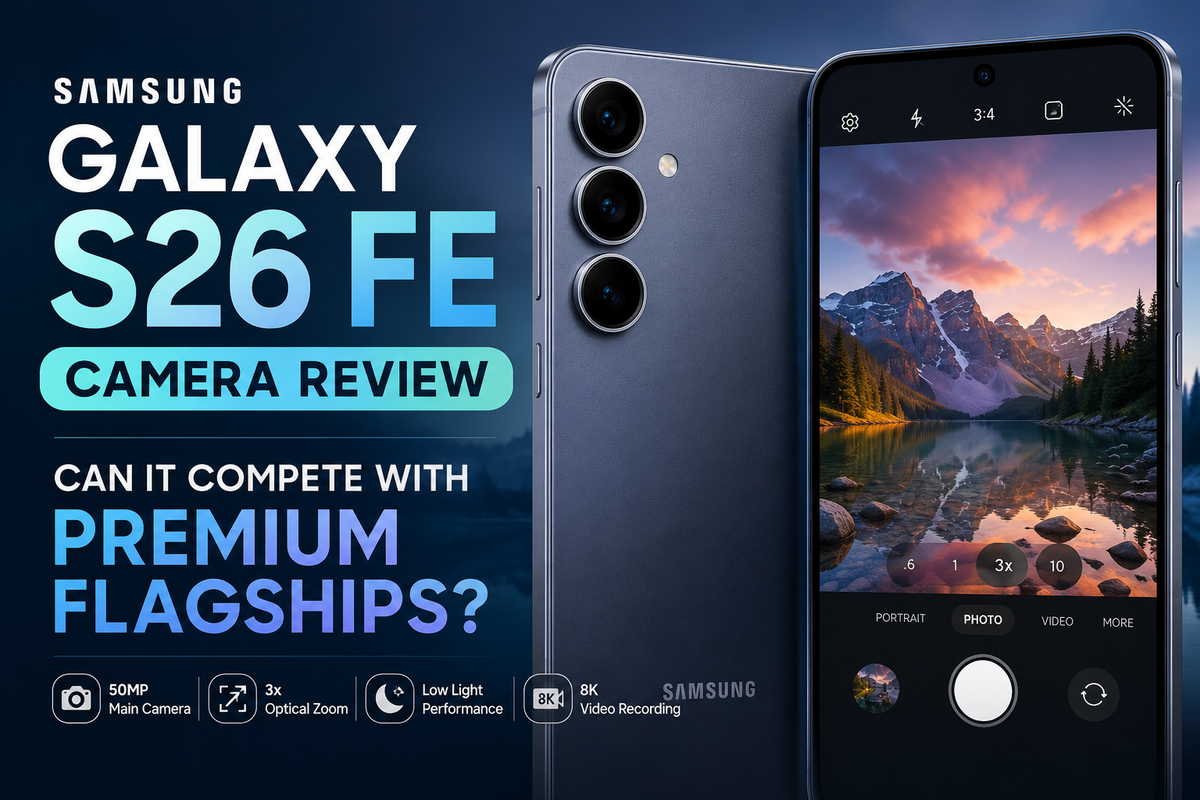
The Samsung Galaxy S26 FE arrives with a familiar promise. It aims to deliver many of the features people expect from Samsung's premium Galaxy S family while keeping the price below the company's most expensive flagship phones. One of the biggest questions, however, is whether the camera system can deliver a genuinely flagship-like experience.Samsung equips the Galaxy S26 FE with a triple rear camera system consisting of a 50MP main camera, 12MP ultra-wide camera and 8MP telephoto camera with 3x optical zoom. On the front is a 12MP selfie camera. The main and telephoto cameras also feature optical image stabilisation.Those specifications give the Galaxy S26 FE plenty of flexibility, but specifications alone do not determine image quality. So, can it really compete with premium flagships?
The 50MP Main Camera Is the Star
Most people take the majority of their photographs with the main camera, which makes the 50MP wide camera the most important part of the Galaxy S26 FE camera system.It uses an F1.8 aperture and optical image stabilisation, giving it a solid foundation for everyday photography.In good lighting, this is the camera you would expect to rely on for family photos, pets, landscapes, food, holidays and everyday moments. Samsung's image processing is designed to produce photographs that look attractive without requiring manual editing.The main camera is also where the S26 FE comes closest to the standard Galaxy S26. Both use a 50MP F1.8 wide camera, although sensor details and image-processing behaviour can still affect final results.For the average user, the main camera should therefore provide much of the premium Galaxy photography experience.
The Ultra-Wide Adds Useful Flexibility
The 12MP ultra-wide camera provides a 123-degree field of view.An ultra-wide camera is particularly useful for travel photography, landscapes, architecture and group photographs. Instead of stepping backwards to fit everything into the frame, you can switch cameras and capture a considerably wider perspective.It is also useful when photographing inside smaller spaces.The biggest difference between a premium flagship and a more affordable phone often becomes noticeable when lighting conditions become difficult. Ultra-wide cameras typically have smaller sensors than main cameras, meaning image quality may drop sooner as available light decreases.For daytime photography, however, having a dedicated 12MP ultra-wide camera gives the Galaxy S26 FE considerably more creative flexibility than relying on one camera alone.
A Real Telephoto Camera Is an Important Advantage
One of the strongest parts of the Galaxy S26 FE camera system is the inclusion of a dedicated telephoto camera.The 8MP telephoto offers 3x optical zoom with optical image stabilisation. Samsung also lists 2x optical-quality zoom through its Adaptive Pixel sensor technology and digital zoom up to 30x.This is important because cheaper smartphones often rely heavily on digital cropping when you zoom.A dedicated 3x telephoto camera gives you another optical focal length for portraits, travel photography and distant subjects.For example, instead of physically moving closer to a subject, you can use the telephoto camera to create a tighter composition. The longer focal length can also be useful for portraits because it can produce a more natural perspective than photographing someone from very close with an ultra-wide or wide camera.
Where Premium Flagships Still Have an Advantage
The Galaxy S26 FE can offer a versatile camera experience, but Samsung's highest-end models still have significant hardware advantages.The Galaxy S26 Ultra, for example, uses a 200MP F1.4 main camera, 50MP ultra-wide and 50MP telephoto camera.That difference becomes important for users who regularly push smartphone cameras to their limits.Larger or more advanced camera hardware can provide advantages when cropping photographs, capturing difficult low-light scenes and zooming over longer distances.The S26 FE's 8MP telephoto is useful, but it should not be confused with the more sophisticated zoom hardware available on Samsung's Ultra model.This is where the FE concept becomes clear. You are getting the versatility of wide, ultra-wide and telephoto cameras without receiving Samsung's absolute highest-end camera hardware.
How Good Is the Galaxy S26 FE at Night?
Low-light photography is one of the most challenging tests for any smartphone camera.When there is less light available, the phone needs to balance shutter speed, image stabilisation, noise reduction and computational processing.The Galaxy S26 FE's main camera benefits from its F1.8 aperture and optical image stabilisation. Samsung also highlights its ProVisual Engine and AI-powered camera capabilities as part of the S26 FE photography experience.For ordinary evening photographs, restaurants, illuminated streets and indoor scenes, the main camera should generally be the best choice.The telephoto and ultra-wide cameras may be more challenged in very dark environments because their apertures and sensor characteristics differ from the primary camera.Premium flagships can still have an advantage when the lighting becomes extremely difficult.
What About Portrait Photography?
Portrait photography is an area where the Galaxy S26 FE's multiple focal lengths can become genuinely useful.The 3x telephoto gives you the ability to photograph people from farther away, potentially creating a more flattering perspective.Samsung's computational photography can then help separate the subject from the background and create the blurred-background effect people associate with dedicated portrait camerasYou do not necessarily need a premium Ultra phone to take attractive portraits.Good lighting, composition and choosing the right focal length can often make a bigger difference than simply having the most expensive camera hardware.
The 12MP Selfie Camera Should Cover Everyday Needs
On the front, Samsung includes a 12MP F2.2 camera with an 85-degree field of view.This camera is intended for selfies, video calls, social media and everyday video recording.Interestingly, the standard Galaxy S26 also uses a 12MP F2.2 selfie camera, although Samsung lists autofocus on the S26 while the S26 FE specification lists no front-camera autofocus.For casual selfies and video calls, that difference may not matter much. Users who frequently create front-facing video content, however, may appreciate the additional camera capabilities offered by more premium models.
Video Recording Is Surprisingly Capable
The Galaxy S26 FE is not limited to casual Full HD video.Samsung lists support for recording up to 8K resolution at 30 frames per second. It also supports slow-motion options including Full HD at up to 240fps and UHD at 120fps.Most people will probably use lower resolutions for everyday recording because they are easier to store, edit and share.Still, having advanced recording options provides additional flexibility for users interested in mobile content creation.Optical image stabilisation on the main and telephoto cameras should also help when recording handheld footage.
AI Is Becoming Just as Important as Camera Hardware
Modern smartphone photography is no longer determined entirely by lenses and sensors.Software plays an enormous role.When you press the shutter button, the phone can analyse multiple frames, adjust exposure, reduce noise, improve dynamic range and process colours before presenting the final photograph.Samsung specifically promotes the ProVisual Engine and advanced camera AI as part of the Galaxy S26 FE experience.This computational processing is one reason a phone does not necessarily need the biggest sensor or highest megapixel count to produce an attractive everyday photograph.
Can It Really Compete With Premium Flagships?
The answer depends on what you mean by compete.For everyday photography, social media, travel, portraits and family photos, the Galaxy S26 FE offers an impressively complete camera system. You have a high-resolution main camera, dedicated ultra-wide, genuine 3x optical telephoto and a 12MP selfie camera.Where premium flagships pull ahead is at the extremes.If you regularly shoot at very long zoom distances, crop heavily, photograph challenging low-light scenes or simply want Samsung's most advanced camera hardware, the Galaxy S26 Ultra remains considerably more capable.But many users rarely operate at those extremes.