


































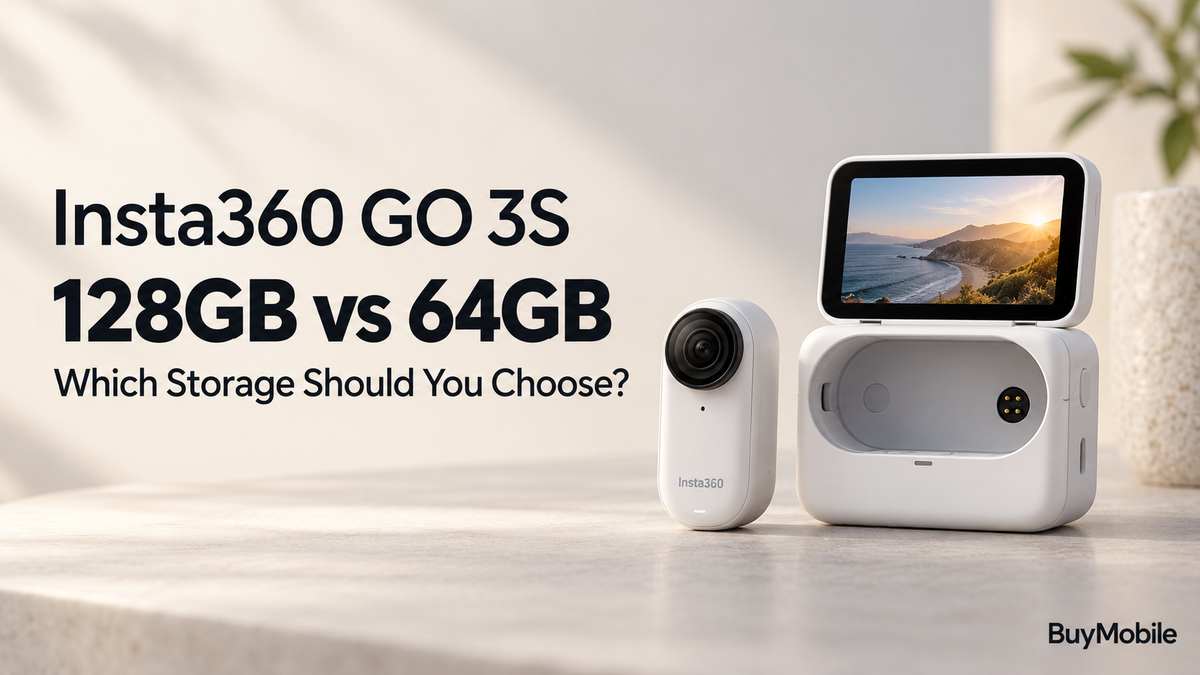
The Insta360 GO 3S makes hands-free filming appealing, whether you are exploring a city, cycling or capturing family moments. However, choosing between its 64GB and 128GB versions requires a little planning. Storage affects how much footage you can keep before transferring files, and the GO 3S uses built-in memory without a memory card slot. You cannot simply insert a larger card later.The best choice depends less on how often you press record and more on how much you record between backups. Here is how to decide which capacity fits your routine.
Does the 128GB version record better video?
Buying the 128GB model gives you more storage, rather than an upgrade to image quality. Both capacities belong to the same GO 3S camera platform, with its 4K recording, hands-free mounting options and FlowState stabilisation. Choose the larger version for room to keep footage, not because you expect sharper images.That distinction matters when budgeting. If your footage looks disappointing, changing lighting, mounting position or recording settings may help. Extra storage simply gives you more opportunities to shoot without stopping to clear space.Likewise, buying 128GB does not automatically improve battery endurance. Storage capacity and the time you can film on a charge are separate considerations.
How much usable storage do you get?
Insta360 lists approximately 59.6GB of usable space for the 64GB version and 119.2GB for the 128GB version. The difference between the advertised capacity and available space is expected; the camera does not present every advertised gigabyte as usable footage storage.In practical terms, the larger model offers roughly twice the room. If your recording settings remain the same, that means approximately twice as much footage before the storage fills.However, do not translate capacity into one universal recording-time figure. Insta360 says recording duration depends on the mode and settings. The camera displays an estimated remaining recording time, which is more useful than assuming every clip consumes space at an identical rate.
Who should choose the 64GB model?
The 64GB version makes sense if you capture short clips and regularly transfer them. Think of someone recording a morning walk, a few cycling highlights or brief behind-the-scenes moments for social media.If you review footage after each outing, save what matters and clear the camera before the next session, additional capacity may sit unused. A consistent routine can make the smaller version perfectly practical.It is also worth considering if the price difference is substantial. Money saved could go toward an appropriate mount or other accessory you will use frequently. Compare equivalent bundles, though, so an accessory difference does not confuse the storage comparison.
Who should choose the 128GB model?
The 128GB version is more attractive if you film frequently, keep several days of clips on the camera or dislike interrupting a trip to manage files.Travel is an obvious example. You might record sightseeing, meals, transport and evening activities across several days. Even if each clip is short, they accumulate when you are too busy to review and transfer everything.Extra room can also help creators who record multiple takes. Cooking demonstrations, product videos and daily vlogs often produce more raw footage than the finished edit suggests. The larger model gives you flexibility while you decide what to keep.
Does recording in 4K make 128GB necessary?
Not necessarily. Recording settings influence file sizes, but the right capacity still depends on the total amount you shoot before transferring.Someone taking a handful of carefully planned 4K clips may need less space than someone recording long sessions at a lower setting. Frequency alone does not tell the full story either: ten short clips and ten lengthy recordings are very different workloads.If possible, estimate your habits using footage from a similar outing. Check how much space the files occupy, then consider how many outings you want to store together. Leave spare capacity for unexpected moments rather than planning to fill every available gigabyte.
Is extra storage useful for holidays?
For a longer holiday, 128GB is generally the more convenient choice if you expect limited opportunities to transfer files. It reduces how often you need to stop and decide which clips to delete.Still, larger storage should not replace backups. Losing a camera with several days of footage means losing those memories too. Transfer important files when practical and verify that they open correctly before deleting the originals.Also consider where the footage will go. Your phone, computer or backup drive needs sufficient space. Choosing the larger camera version increases convenience during shooting, but it does not remove the need to organise files afterwards.
How should you compare prices?
Check current Australian prices for matching packages. Compare the same bundle, included accessories and warranty arrangements before deciding what the extra capacity costs.If the difference is modest and you expect regular use, 128GB provides useful breathing room. If the premium is large and you already transfer footage after every session, 64GB may represent better value.Choose 64GB for short recordings, disciplined transfers and a tighter budget. Choose 128GB for travel, frequent filming and fewer storage interruptions. Since the GO 3S cannot accept a memory card, buy enough capacity for your realistic shooting habits, with some room to grow.