



































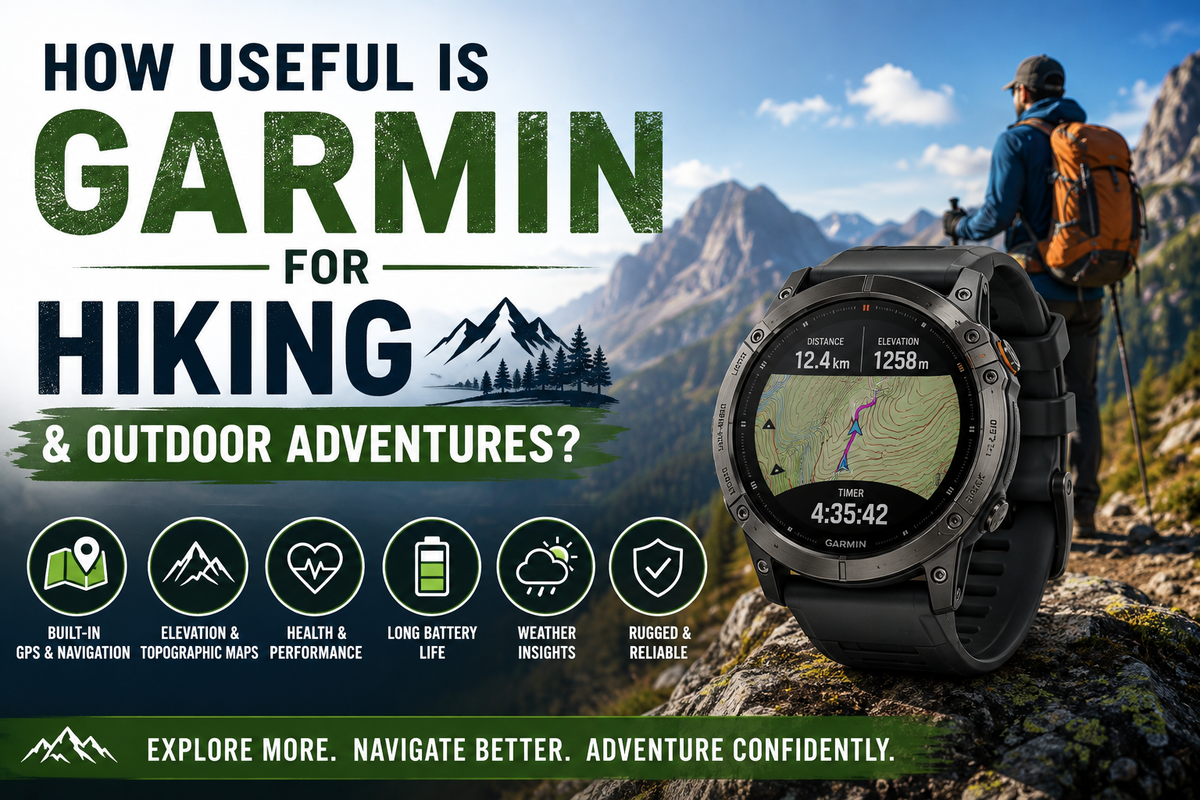
Hiking is one of those activities where a smartwatch can become much more useful than simply counting steps. When you leave familiar streets and start exploring trails, mountains or remote areas, information about your location, distance, elevation, weather and route can become genuinely valuable.Garmin has built a strong reputation around GPS technology and outdoor-focused wearables. Depending on the model, a Garmin watch can record hikes, provide navigation, track elevation, monitor your physical effort and offer long battery life for extended adventures.But how useful is Garmin when you actually head outdoors? For hikers, trail runners and adventure enthusiasts, the answer depends partly on the watch you choose and the type of activities you undertake.
GPS Tracking Is One of Garmin's Biggest Strengths
GPS is at the centre of the Garmin outdoor experience.When you start a hiking activity, a compatible Garmin watch can use satellite positioning to record your route. This allows it to calculate information such as distance travelled, pace and your movement across the course of the activity.For casual hikers, this can simply be an interesting record of where they went.For more serious outdoor users, location information becomes considerably more important.You may be walking through unfamiliar countryside, following a long trail or exploring an area where mobile reception is inconsistent. Having GPS capability directly on your wrist means you do not have to depend entirely on your smartphone for basic activity tracking.Garmin offers different levels of satellite technology across its range, so the exact positioning capabilities depend on the watch.
Navigation Can Make Hiking Much Easier
Tracking where you have been is useful, but navigation can be even more valuable.Selected Garmin watches provide navigation features that can help you follow a planned course. Higher-end outdoor models can offer detailed mapping directly on the watch, allowing you to see routes and surrounding geographical information without repeatedly taking out your phone.This becomes particularly useful at trail intersections.Instead of stopping, unlocking your smartphone and opening a navigation application every time you are uncertain about the direction, you can check your wrist.Models with advanced mapping are especially attractive for people who frequently explore unfamiliar areas.However, not every Garmin watch includes the same mapping functionality. If detailed maps are important to you, it is worth checking the exact features of the individual model before buying.
Garmin Can Help You Retrace Your Route
One of the most useful ideas for outdoor activities is being able to navigate back toward where you started.Compatible Garmin watches provide navigation features designed to help users retrace or return along a route.This can be useful if you have walked along several unfamiliar paths and want assistance finding your way back.It should not be treated as a replacement for proper outdoor preparation. A watch can lose power, satellite conditions can vary, and technology can fail.For remote adventures, carrying appropriate maps, emergency equipment and other navigation tools remains sensible.Garmin should be considered another useful layer of navigation rather than the only safety system you rely on.
Elevation Data Adds Context to Your Hike
Distance alone does not tell you how difficult a hike was.Walking ten kilometres across relatively flat terrain is very different from covering the same distance while repeatedly climbing steep hills.Many outdoor-oriented Garmin watches can track elevation-related information. Models equipped with a barometric altimeter can use changes in air pressure to help estimate altitude changes.Seeing elevation gain can provide a much clearer picture of the effort involved in a hike.It can also be motivating.You might discover that a relatively short trail involved considerably more climbing than expected, helping explain why the activity felt more demanding than a longer walk on flat ground.
Health Data Can Show How Hard You Are Working
Garmin watches are not only navigation devices.During a hike, wrist-based heart rate monitoring can provide information about how hard your body is working.Your heart rate may increase substantially during steep climbs even when your walking speed is relatively slow.This is why pace alone can sometimes be misleading during hiking.Garmin's fitness and recovery ecosystem can provide additional context before and after activities, depending on the model. Features such as Body Battery, recovery information and other wellness metrics can help users understand how activity fits into their broader physical condition.These measurements should not be viewed as medical diagnoses, but they can provide useful fitness insights.
Battery Life Is Important Away From Power Outlets
Battery life becomes much more important outdoors than it is during a normal day at home.A smartwatch that needs frequent charging may become inconvenient during long hikes, camping trips or multi-day adventures.Garmin watches are particularly attractive because many models are designed to provide extended battery life compared with conventional smartwatches.The actual endurance depends on the model and settings.Continuous GPS tracking consumes considerably more energy than ordinary smartwatch use. High display brightness, music playback, satellite modes and navigation can also affect battery consumption.Some Garmin outdoor watches offer solar-assisted charging capabilities as well. Solar does not necessarily mean you never need a charger, but under suitable conditions it can help extend operating time.For hikers spending several days away from reliable electricity, battery endurance can be one of the strongest reasons to consider an outdoor-focused Garmin.
Weather Information Can Be Useful Before You Start
Weather can change the entire hiking experience.Rain, extreme heat, strong winds or rapidly falling temperatures can turn an easy route into a much more difficult activity.Garmin watches can provide weather-related information when appropriately connected and configured, while certain outdoor models include sensors such as a barometer that can provide environmental data.However, a watch should never replace checking a reliable weather forecast before leaving.For serious outdoor adventures, understanding the expected conditions before beginning the route is essential.Think of the information on your Garmin as additional context rather than your only weather resource.
Garmin Is Useful for More Than Hiking
One advantage of buying a Garmin for outdoor adventures is that you are not limited to one activity.Depending on the model, Garmin watches can track trail running, cycling, swimming, skiing and numerous other sports.This makes them particularly appealing to people whose weekends are rarely the same.You might hike one week, go cycling the next and spend another weekend trail running. Instead of buying separate tracking devices, one Garmin can record multiple activities within the same ecosystem.Outdoor-oriented families such as Fenix are especially suited to users who want a broad collection of adventure and multisport capabilities.
Maps on Your Wrist Can Reduce Phone Dependence
Smartphones are excellent navigation devices, but constantly using one during a hike has disadvantages.Taking your phone out repeatedly can be inconvenient, especially in rain, cold weather or difficult terrain.The display can also consume significant battery power.A Garmin with suitable mapping and navigation features allows you to check basic route information from your wrist.That does not mean you should leave your smartphone behind. A phone remains valuable for communication, detailed maps, photography and emergency use.Instead, the Garmin can reduce how frequently you need to use it.Saving smartphone battery could become particularly valuable during longer outdoor trips.
Which Garmin Is Best for Hiking?
The answer depends on how serious your outdoor activities are.Someone who enjoys occasional local hikes may not need Garmin's most expensive adventure watch. A compatible running or fitness-focused Garmin with GPS and basic navigation could provide enough functionality.More adventurous users may benefit from a Fenix or another outdoor-focused Garmin family offering more sophisticated navigation, rugged construction and extended battery capabilities.Before buying, consider the environments where you will actually use the watch.If you mostly walk marked trails near populated areas, advanced topographic mapping may not be essential.If you regularly explore remote trails, mountains or unfamiliar routes, investing in stronger navigation and battery capabilities can make much more sense.
Is Garmin a Replacement for Outdoor Safety Equipment?
No.This is an important distinction.Even a highly capable GPS watch should not replace proper preparation, appropriate clothing, sufficient water, maps, emergency supplies and knowledge of the area.Electronic devices can run out of battery, become damaged or encounter conditions where features do not work as expected.Garmin can make outdoor navigation and activity tracking significantly more convenient, but responsible hiking still requires preparation beyond technology.