


































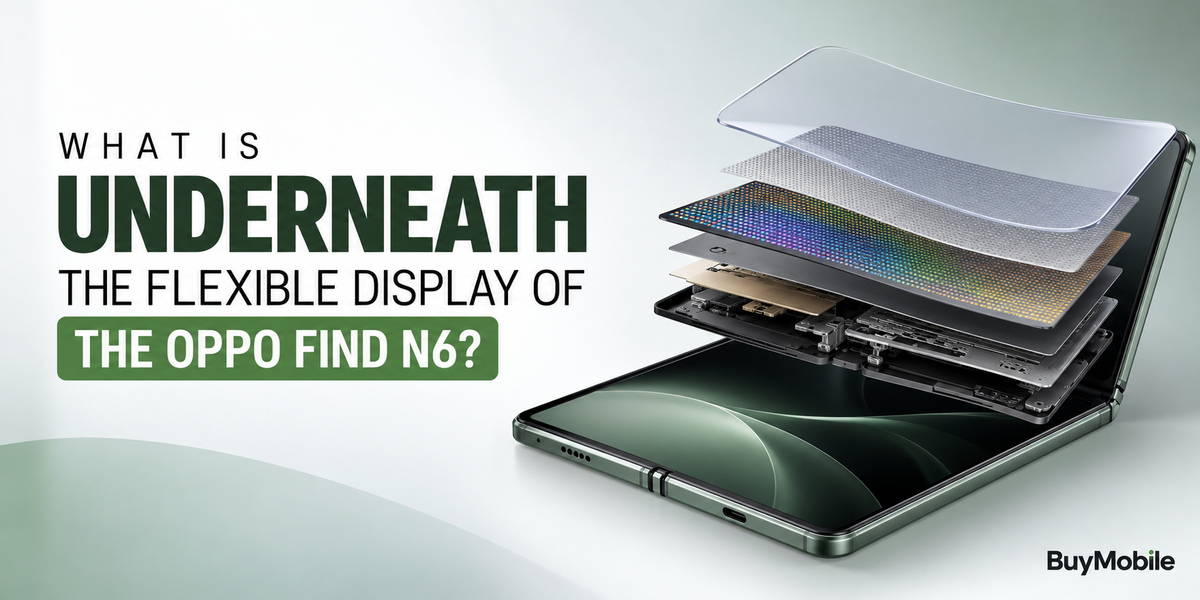
The OPPO Find N6 may look like a normal premium smartphone when it is closed, but opening it reveals one of the most technically challenging components in modern mobile technology: a large flexible display.A conventional smartphone screen is designed to remain flat throughout its life. A foldable display has a much harder job. It needs to produce a bright, detailed image while repeatedly bending around the hinge every time the phone is opened and closed.That raises an interesting question. What is actually underneath the flexible display of the OPPO Find N6?The answer is not simply another screen. A modern foldable display is better understood as a carefully engineered stack of flexible layers supported by mechanical components underneath. Each part has a different job, from producing the image and detecting touch to protecting the panel and supporting it while it folds.
The Flexible OLED Panel Creates the Image
At the heart of a foldable screen is a flexible OLED display panel.OLED technology is particularly suitable for foldable smartphones because individual pixels produce their own light. Unlike traditional LCD displays, an OLED panel does not require a separate rigid backlight sitting behind the screen.Removing that backlight helps manufacturers create thinner display assemblies that can be engineered to bend.The OLED panel contains millions of tiny pixels responsible for producing the colours and images you see. Electrical signals control these pixels as you browse websites, watch movies, play games or use applications.Making the panel flexible, however, requires more than simply putting an ordinary OLED screen on a hinge.The materials and supporting layers also need to tolerate repeated bending.
Flexible Materials Replace Conventional Rigid Layers
Traditional smartphone displays can rely heavily on rigid glass structures because they never need to fold in half.A foldable phone cannot use exactly the same construction across its folding area.Instead, flexible displays rely on extremely thin materials engineered to tolerate movement. Depending on the particular display design, manufacturers can use combinations of flexible substrates, protective films, thin glass and specialised adhesives.These layers need to move together.If one layer bends differently from another, repeated folding could create excessive stress. This is why engineering a foldable display is much more complicated than simply creating a flexible OLED panel.Every layer has to be considered as part of the complete folding system.
The Touch Layer Has to Bend Too
The screen does more than display an image. It also needs to detect your fingers.A touch-sensitive layer sits within the display assembly and identifies where you tap, swipe and scroll.On a normal smartphone, this system operates across a permanently flat surface.On the OPPO Find N6, the touch system has to continue operating across a display that repeatedly changes shape.When the phone is unfolded, a swipe needs to feel continuous even when your finger passes across the centre folding area.That means the touch-detection system must remain accurate despite the unusual mechanical requirements of the screen.It is an easily overlooked part of foldable engineering because users rarely think about it unless something goes wrong.
The Protective Surface Is More Complicated Than It Looks
The surface you physically touch is another important part of the display system.A conventional flagship smartphone can use relatively thick chemically strengthened cover glass. A foldable display needs a surface capable of bending.Modern foldables can use ultra-thin glass and additional protective materials designed to provide a smoother, more durable surface while maintaining flexibility.The challenge is balancing apparently conflicting requirements.The surface needs to be thin enough to fold but strong enough to survive everyday interaction. It needs to protect the delicate OLED underneath while maintaining good optical clarity and touch sensitivity.This is one reason the inner screen of a foldable should be treated differently from the rigid display of a conventional smartphone.
Why Does the Centre of a Foldable Screen Have a Crease?
The crease found on foldable smartphones is largely a consequence of repeatedly bending a multilayer display around the same area.Imagine repeatedly bending a thin flexible material at approximately the same point. Even when it does not break, the folding area experiences different mechanical forces from the rest of the material.A foldable display faces a much more sophisticated version of this problem.The display layers need to curve when the phone closes and return toward a flatter position when it opens.Manufacturers therefore spend considerable engineering effort controlling the bend radius and supporting the screen around the folding area.Reducing the visible crease is not simply a matter of changing the OLED panel. The hinge, supporting structure and display materials all contribute.
The Hinge Is Part of the Display Experience
Although the hinge is not technically part of the OLED panel itself, it plays an enormous role in protecting the flexible display.When you close a foldable smartphone, the screen should not simply form an extremely sharp fold.Instead, the hinge mechanism is designed to control how the display curves internally.A controlled curve can reduce the amount of concentrated stress placed on the flexible layers.This means the hinge and display need to be engineered together.If the hinge geometry changes, the way the display bends can change as well.That is why improvements to foldable hinges can result in thinner devices, less noticeable creases and potentially better long-term durability.
Support Structures Sit Beneath the Screen
A flexible OLED panel cannot simply float above the internal components.When the OPPO Find N6 is fully open, users expect the screen to feel sufficiently stable when tapping, typing or swiping.Supporting structures underneath the display help provide that stability.The challenge is the centre.A completely rigid support plate could prevent the device from folding, so engineers need a structure that provides support when open while still allowing movement around the hinge.Different manufacturers use sophisticated plates, flexible materials and mechanical structures to achieve this balance.The exact implementation can vary considerably between foldable designs.
Adhesives Are Surprisingly Important
One of the less obvious technologies inside a foldable display is adhesive.A modern screen contains multiple layers that need to remain connected while moving relative to the overall folding mechanism.Traditional adhesives could become problematic if they were too rigid.Flexible display assemblies therefore require bonding materials capable of maintaining their properties while the screen repeatedly bends and straightens.These adhesives also need to tolerate temperature changes.Your smartphone can become warmer during gaming, charging or navigation and cooler when used outdoors in cold conditions.Every layer of the display assembly needs to remain reliable through those changes.
What Happens Every Time You Fold the Find N6?
Closing the OPPO Find N6 starts a carefully controlled mechanical process.The hinge rotates, the central region of the display begins curving, and the flexible layers follow the geometry created by the hinge mechanism.When you open the phone again, the process reverses.The screen returns toward its open position while the underlying support system helps create a usable, relatively flat surface.This process may happen dozens of times during a normal day and potentially thousands of times over years of ownership.That repetition explains why foldable durability testing is such an important part of developing these devices.
Why Is Dust Such a Challenge for Foldable Phones?
Another challenge comes from the moving mechanical structure.Conventional smartphones can be tightly sealed because their bodies do not need to change shape.A foldable contains a hinge with moving components located close to a highly sophisticated flexible display.Small particles entering sensitive areas could potentially create additional mechanical challenges, which is why manufacturers put considerable effort into hinge protection and device sealing.Users should still treat a foldable as a sophisticated piece of mobile hardware rather than deliberately exposing its inner display or hinge to unnecessary dirt and debris.
Why Is Foldable Display Engineering So Difficult?
The biggest challenge is that everything needs to happen simultaneously.The display needs to be thin but durable.It needs to bend but feel stable when open.It needs to protect the OLED while remaining touch-sensitive.The hinge needs to control movement without making the phone excessively thick.The supporting layers need to tolerate thousands of folding cycles while maintaining consistent image quality.Solving one problem can create another.A thicker protective structure could improve resistance to certain types of damage but make folding more difficult. Making everything thinner could improve portability but place greater demands on structural engineering.This constant balancing act is what makes foldable smartphones technologically fascinating.