

































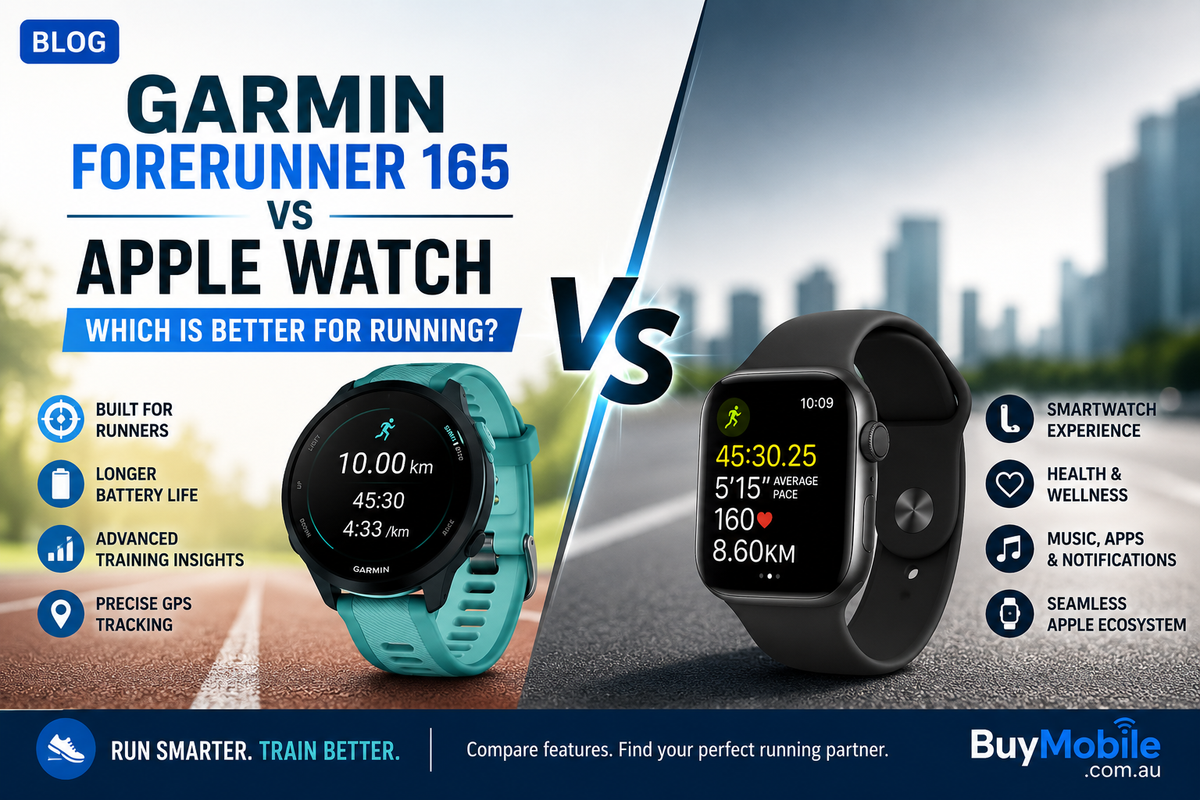
Choosing a smartwatch for running can be surprisingly difficult. Many modern watches can track distance, pace, heart rate and workouts, but the experience can differ significantly depending on whether the watch was primarily designed around running or around everyday smartwatch features.The Garmin Forerunner 165 and Apple Watch represent these two approaches particularly well.The Forerunner 165 is built around running and fitness. Apple Watch combines fitness tracking with communication, apps and deep integration with the iPhone.Both can accompany you from your first kilometre to serious training, but which one makes more sense if running is your priority?
Garmin Forerunner 165 Is Designed Around Runners
The biggest difference becomes obvious when you start exploring the Forerunner 165.Running is at the centre of the experience.The watch can track familiar information such as distance, pace, heart rate and time, but it also provides features designed to help you understand your training.Garmin offers Daily Suggested Workouts, recovery information, VO2 max estimates, race prediction, Garmin Coach support and other training tools. The Forerunner 165 can also provide wrist-based running dynamics such as cadence, stride length and ground contact time.This means the watch is not only interested in recording what happened.It tries to provide context around your running.For someone training several times each week, that distinction can become increasingly valuable.
Apple Watch Takes a Broader Approach
Apple Watch is not simply a running watch.It is designed to handle fitness while also operating as an extension of the iPhone.Depending on the model and configuration, you can receive notifications, make calls, reply to messages, use apps, listen to music, make payments and interact with numerous Apple services directly from your wrist.Running is one part of that wider experience.Apple's Workout app has become increasingly capable, offering useful running metrics and the ability to create structured workouts. Runners can monitor information such as pace, heart rate zones, cadence and other performance data.For many recreational runners, that is already more information than they will regularly need.The key question is whether you want your watch primarily to support running or to be a powerful smartwatch that also happens to be good at running.
Which Is Better for GPS Running?
GPS is fundamental to outdoor running because it allows a watch to estimate your route, distance and pace.The Garmin Forerunner 165 supports multiple satellite systems and Garmin's SatIQ technology. SatIQ can automatically determine the appropriate satellite mode with the goal of balancing positioning accuracy and battery consumption.Apple has also invested heavily in GPS performance across the Apple Watch range, although the exact GPS capabilities can vary between models.For everyday running through relatively open environments, both platforms can provide useful GPS tracking.The difference becomes more about what happens to that data afterwards.Garmin Connect provides runners with a substantial amount of training information and historical data. Apple presents workouts through its Fitness ecosystem and integrates health information into the broader Apple experience.If analysing running performance is a major part of your training, Garmin's running-first approach may be more appealing.
Pace Tracking Is Important for Both
Running by feel is valuable, but pace becomes particularly useful when you begin training for specific distances.The Forerunner 165 can show pace information during your run and provides tools that can help structure workouts around specific targets.Apple Watch also allows runners to monitor pace and configure workout goals.For a beginner completing easy runs, there may be little practical difference. Both watches can tell you whether you are running faster or slower than intended.The difference becomes more noticeable as training becomes structured.A runner preparing for a 10K or half marathon may appreciate having training recommendations, recovery information and race-oriented features gathered into Garmin's ecosystem.Someone who simply wants to run several times per week and monitor improvement may find Apple Watch perfectly capable.
Heart Rate Training Can Improve Your Understanding
Both watches can use wrist-based optical sensors to monitor heart rate during exercise.Heart rate can help runners understand workout intensity.For example, an easy run may be intended to remain relatively comfortable, while a tempo session deliberately places greater stress on the cardiovascular system.Watching heart rate alongside pace can help you understand the relationship between speed and effort.Garmin places this information within a broader collection of training metrics. The Forerunner 165 can estimate VO2 max and provide recovery-related information that can help runners understand how recent training affects their body.Apple Watch also provides heart rate zones and health information, making it useful for runners who want fitness tracking without moving away from Apple's ecosystem.Neither watch should replace professional medical advice, but heart rate data can provide useful context for everyday training.
Garmin Has the Advantage in Battery Life
Battery life can significantly affect the experience of owning a running watch.Garmin rates the Forerunner 165 for up to 11 days in smartwatch mode and up to 19 hours in GPS-only GNSS mode. Actual results depend on settings and usage.This is an important advantage for runners.You can wear the watch throughout the day, track sleep overnight and complete multiple workouts without necessarily thinking about charging every day.Apple Watch battery life varies considerably by model, but mainstream models generally require more frequent charging than the Forerunner 165.For someone running occasionally, regular charging may not be a major inconvenience.For runners training five or six days per week, travelling for races or wanting continuous sleep and recovery tracking, Garmin's longer battery endurance can become a significant advantage.
The AMOLED Display Makes the Garmin Feel Modern
Running watches were once known for practical displays rather than particularly attractive ones.The Forerunner 165 changes that perception with its bright AMOLED touchscreen.Maps are not the focus of this particular Garmin model, but workout information, notifications and everyday menus appear crisp and colourful.Apple Watch is also known for excellent displays, with responsive touch interfaces that make everyday smartwatch interactions feel polished.The difference is therefore not simply display quality.It is how you interact while running.Garmin includes five physical buttons in addition to the touchscreen. Buttons can be extremely useful when you are sweating, running in rain or simply want to control the watch without carefully tapping a display.Apple Watch combines its touchscreen with physical controls, but Garmin's button-heavy interface has long appealed to dedicated runners.
Garmin Provides More Training Guidance
This is probably the most important difference for runners who want to improve.The Forerunner 165 can offer Daily Suggested Workouts based on available training and recovery information. Garmin Coach can also provide adaptive training plans for supported goals.Recovery Time can help estimate how long it may take before you are ready for another demanding workout, while race-related features can help organise training around an upcoming event.These features do not mean the watch becomes a replacement for an experienced running coach.Instead, they provide structure.For a beginner who does not know whether today's run should be easy, long or fast, having guidance directly on the wrist can make training less confusing.Apple Watch provides excellent workout tracking and customisation, but Garmin still has a stronger identity as a dedicated training platform.
Apple Watch Wins for Everyday Smart Features
Running may occupy an hour of your day.What happens during the other 23 hours?This is where Apple Watch becomes particularly attractive.For an iPhone owner, the integration can be extremely convenient. Notifications, messages, calls, Apple Pay, Siri, apps and music all contribute to an experience that goes far beyond fitness tracking.The Apple Watch can feel like a miniature extension of your iPhone.The Forerunner 165 offers everyday smartwatch functions including notifications and Garmin Pay where supported, but its main strengths remain fitness and training.If you want the richest smartwatch experience outside your workouts, Apple Watch is likely to be more appealing.
What About Music?
There is an important distinction within the Garmin range.The standard Forerunner 165 and Forerunner 165 Music are separate versions.The Music edition can store compatible music directly on the watch, allowing you to connect Bluetooth headphones and potentially run without carrying your smartphone.Apple Watch also provides strong music integration, particularly for people already using Apple services and compatible streaming platforms.For runners who enjoy leaving their phone at home, music support is worth considering before choosing a specific model.
Which Is Better for Beginner Runners?
Both can be excellent.Apple Watch may be particularly appealing to someone who already owns an iPhone and wants one device for everyday smartwatch features, general health tracking and recreational running.The Forerunner 165 makes more sense if running itself is the reason you are buying the watch.Its training guidance can grow with you.You might begin by tracking basic 5K runs. Months later, you may be following structured workouts, monitoring recovery, examining VO2 max and preparing for your first half marathon.You do not need to understand every Garmin metric on day one.The advantage is that the additional information is available when your training becomes more serious.
Which Should Serious Runners Choose?
For someone whose main priority is running performance, the Forerunner 165 has a compelling advantage.Longer battery life, physical buttons, detailed training information, recovery tools and running-focused software make it feel like a device designed around the sport rather than a smartwatch with running added to it.That does not make Apple Watch unsuitable for serious runners.Many runners can train effectively with an Apple Watch, particularly if they value its wider smartwatch features or use third-party fitness applications.But the Forerunner 165 provides a more focused experience straight out of the box.