


































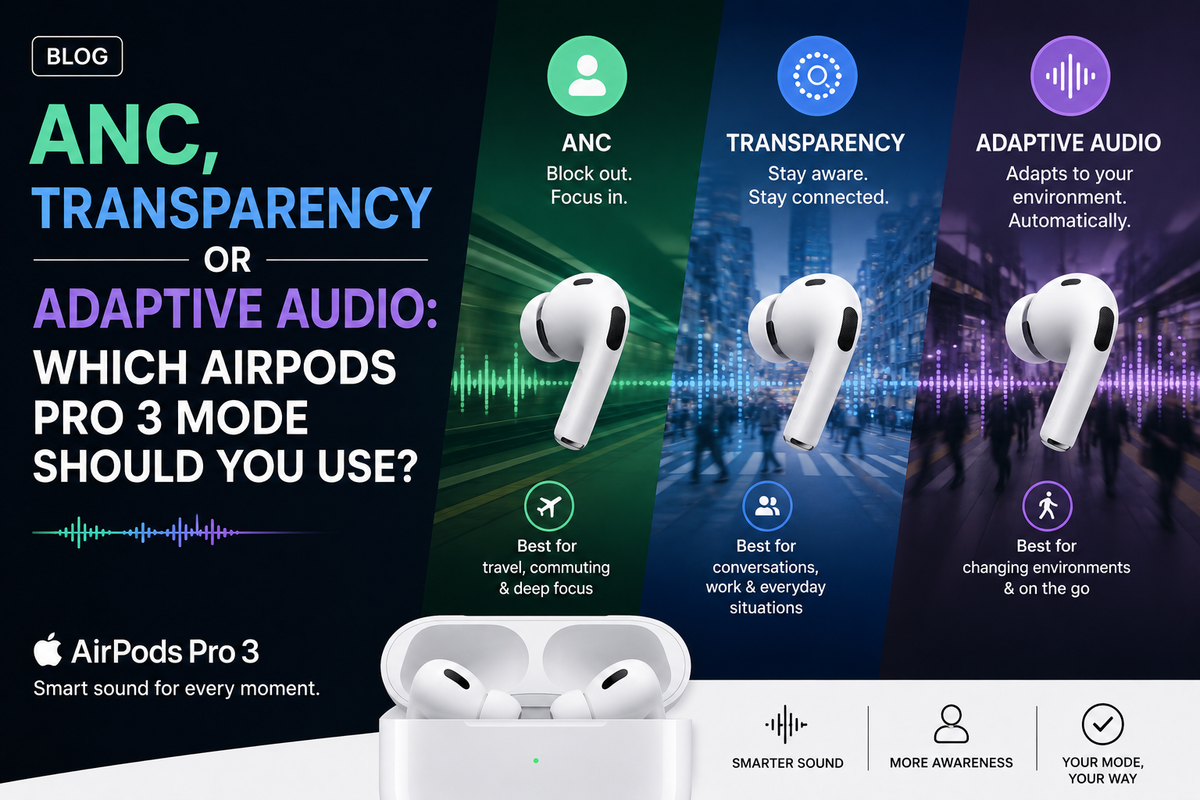
Apple AirPods Pro 3 are designed to do more than simply play music. One of their biggest advantages is the ability to control how much of the outside world you hear. Depending on where you are and what you are doing, you can choose Active Noise Cancellation, Transparency mode or Adaptive Audio.All three modes serve different purposes. Active Noise Cancellation is designed to reduce unwanted environmental noise. Transparency lets outside sounds through so you remain aware of your surroundings. Adaptive Audio sits between the two and automatically adjusts noise control as your environment changes.So which AirPods Pro 3 listening mode should you actually use?
What Does Active Noise Cancellation Do?
Active Noise Cancellation, usually called ANC, is the mode to choose when you want to separate yourself from distracting background noise.AirPods Pro 3 use microphones to detect sounds around you and generate anti-noise to reduce those sounds before you hear them. Inward-facing microphones also help detect unwanted sound inside your ear.Apple says AirPods Pro 3 can remove up to twice as much unwanted noise as AirPods Pro 2 and up to four times as much as the original AirPods Pro. The earbuds combine computational audio, ultra-low-noise microphones and redesigned foam-infused ear tips to improve isolation.ANC therefore makes the most sense when reducing distractions is your priority.
When Should You Use ANC?
Think about sitting on an aeroplane. You probably do not need to continuously hear the low-frequency sound of the engines. Turning on ANC can make music, movies and podcasts easier to enjoy without competing with as much environmental noise.The same principle applies to trains, buses and busy offices.ANC can also be useful when you are trying to concentrate. If you are working in a café or studying somewhere with constant background conversation, reducing those distractions may help create a more controlled listening environment.AirPods Pro 3 provide up to eight hours of listening time on a single charge with ANC enabled, according to Apple.ANC is therefore the mode to consider for flights, commuting, focused work and other situations where you want maximum isolation.
What Is Transparency Mode?
Transparency mode does almost the opposite.Instead of trying to remove your surroundings, it allows environmental sounds through so you can hear what is happening around you while continuing to wear your AirPods.Apple says the personalised Transparency experience on AirPods Pro 3 is designed to make your own voice and the voices of people around you sound more natural.This can make the earbuds feel less isolating when you need awareness.You might be listening to a podcast but still want to hear an announcement. You could be working at home while waiting for someone to knock on the door. Perhaps you are walking somewhere and want to remain aware of nearby activity.These are situations where Transparency can make more sense than ANC.
When Should You Use Transparency Mode?
Transparency is particularly useful whenever situational awareness matters more than isolation.If you are waiting at an airport gate, for example, completely blocking the environment might cause you to miss an announcement.Transparency is also useful when speaking to someone without wanting to remove your AirPods.Apple's Conversation Awareness feature can make this even easier. When you begin talking to someone, it automatically lowers your media volume and enhances voices in front of you. Once the conversation ends, the volume returns.Transparency can therefore be a strong choice for offices, airports, shops, casual conversations and other environments where you want audio without disconnecting completely from your surroundings.
What Is Adaptive Audio?
Adaptive Audio is arguably the most interesting option because it combines elements of ANC and Transparency.Instead of asking you to manually decide how much environmental sound should enter, Adaptive Audio responds to changing noise conditions around you. Apple describes Adaptive mode as blending Active Noise Cancellation and Transparency while automatically controlling how much noise you hear.You can also customise Adaptive Audio to allow more or less ambient sound.This makes it particularly useful when your environment keeps changing.Imagine leaving your quiet home, walking along a street, entering a busy station and then boarding a train. The ideal amount of noise cancellation is different at every stage.Adaptive Audio is designed to handle these transitions without requiring constant manual switching.
Adaptive Audio Is Excellent for Commuting
Commuting is probably one of the clearest examples of where Adaptive Audio makes sense.Your surroundings can change rapidly.One moment you are walking along a relatively quiet street. Minutes later you are standing beside traffic. Then you enter a noisy railway station before sitting inside a train.Keeping ANC permanently enabled may isolate you more than you want in some of those situations. Transparency may let through more environmental noise than you need in others.Adaptive Audio provides a middle ground.Apple specifically recommends Adaptive mode for environments where sound levels vary or are unpredictable, such as city traffic or commuting.
Which Mode Is Better for the Office?
That depends on what you are doing.If you need uninterrupted concentration while completing an important task, ANC will probably be the better choice because its purpose is to reduce distractions.If you need to remain available to colleagues, Transparency can make more sense.Adaptive Audio can be the most convenient option in a mixed environment. You may spend part of the day concentrating, part of it walking around and part talking to coworkers. Instead of continuously changing listening modes, Adaptive Audio can respond automatically.Conversation Awareness adds another layer of convenience by lowering your media when you begin speaking.
What Should You Use While Travelling?
For long flights, ANC is likely to be the first choice for many users.Continuous aircraft noise is exactly the type of environment where strong noise cancellation can improve the listening experience.Travel does not always mean sitting on a plane, however.Walking through an airport is different because announcements and nearby activity may be important. Transparency or Adaptive Audio may therefore be more suitable while moving through the terminal.Once you are seated on the aircraft, switching to ANC makes more sense.This highlights why there is no single "best" AirPods Pro 3 mode. The right setting depends on your environment.
What About Walking and Outdoor Use?
Awareness should be an important consideration outdoors.Transparency allows you to hear more of what is happening around you, while Adaptive Audio can balance environmental awareness with noise control.Apple's Hearing Protection guidance recommends Transparency when situational awareness is important and Adaptive mode when surrounding noise is unpredictable.No listening mode should replace paying attention to your surroundings, particularly around roads, bicycles or other potential hazards.
Do You Need to Keep Switching Modes Manually?
Not necessarily.AirPods Pro 3 let you switch between Noise Cancellation, Transparency and Adaptive listening modes, and you can customise which modes are included when using the press-and-hold controlIf you dislike constantly changing settings, Adaptive Audio may become your default everyday mode.You can then manually switch to ANC when you specifically want stronger isolation or Transparency when maximum awareness is more important.That approach keeps things simple.
So Which AirPods Pro 3 Mode Should You Use?
Choose Active Noise Cancellation when you want maximum focus and fewer distractions. It makes the most sense for flights, trains, busy offices and concentrated listening.Choose Transparency when hearing your surroundings is important. It is useful for conversations, airports, offices and situations where environmental awareness matters.Choose Adaptive Audio when your surroundings frequently change and you want the AirPods to automatically balance isolation with awareness. It is particularly convenient for commuting and general everyday use.