



































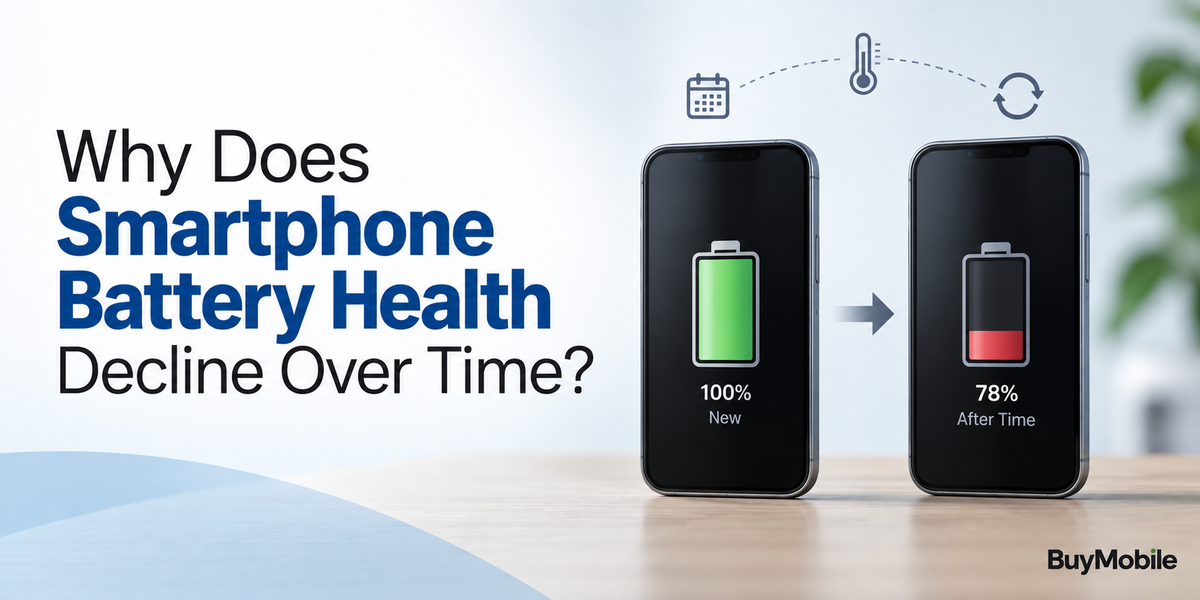
When a smartphone is brand new, its battery can often feel impressive. You charge it in the morning, use apps throughout the day, watch videos, browse the internet and still have power remaining in the evening. After a few years, however, the same phone may need to be charged much earlier.This does not necessarily mean something is wrong with the smartphone. Battery ageing is a normal part of owning almost any modern mobile device.Most smartphones use lithium-ion or related lithium-based rechargeable batteries. These batteries are designed to be charged and discharged repeatedly, but the chemical processes happening inside them gradually change their ability to store energy.So why exactly does smartphone battery health decline over time?
Battery Health Is Different From Battery Percentage
Battery percentage and battery health are two different things.The percentage displayed on your smartphone tells you approximately how much usable charge remains at that moment. Battery health refers to how much energy the battery can store compared with when it was new.Imagine a new battery that can hold its full original capacity. As the battery chemically ages, its maximum usable capacity gradually decreases.The phone can still show 100 percent after charging, but that 100 percent now represents a smaller amount of stored energy than it did when the battery was new.This is why an older smartphone can reach 100 percent normally but discharge considerably faster.
Chemical Ageing Happens Every Time You Use the Battery
Inside a rechargeable lithium-ion battery, lithium ions move between electrodes as the battery charges and discharges.These reactions are designed to be reversible, which is what allows the battery to be recharged hundreds of times.However, the process is not perfectly reversible forever.Tiny chemical and structural changes occur inside the battery during normal operation. Over many charging cycles, these changes gradually reduce the amount of energy the battery can effectively store and deliver.This process is known broadly as chemical ageing.You cannot completely prevent it. Even a carefully maintained smartphone battery will eventually lose some capacity.The goal is therefore not to stop battery ageing but to avoid conditions that unnecessarily accelerate it.
Charging Cycles Gradually Wear the Battery
Battery lifespan is often discussed in terms of charge cycles.A charge cycle does not necessarily mean plugging your phone into a charger once.Instead, it generally represents using an amount equivalent to 100 percent of the battery's capacity.For example, if you use 50 percent of your battery today, recharge it and then use another 50 percent tomorrow, that usage roughly adds up to one complete cycle.As the number of cycles increases, battery capacity gradually declines.Heavy smartphone users naturally accumulate charging cycles more quickly than light users because they consume more energy each day.Gaming, navigation, video recording and other demanding activities can result in more frequent charging and therefore faster accumulation of battery cycles over the long term.
Heat Is One of the Biggest Enemies of Battery Health
Temperature plays an important role in lithium-ion battery ageing.Smartphone batteries naturally become somewhat warmer during certain activities, particularly fast charging, gaming, video recording and demanding applications.The problem occurs when a battery regularly spends extended periods at unusually high temperatures.Heat can accelerate chemical reactions inside the battery, including unwanted reactions that contribute to long-term degradation.This is why repeatedly leaving a smartphone in a hot car, charging it under direct sunlight or running extremely demanding applications while fast charging can be undesirable for long-term battery health.Modern smartphones include thermal management systems that can reduce charging speeds or performance when temperatures become excessive.These protections help, but avoiding unnecessary heat is still beneficial.
Fast Charging Can Generate More Heat
Modern fast charging is extremely convenient.Depending on the smartphone, a short charging session can provide enough energy for hours of additional use.Higher charging power, however, can create additional heat and place greater demands on the battery.This does not mean you should stop using fast charging.Modern smartphones use sophisticated battery management systems to control charging current, voltage and temperature. Charging speeds are often automatically reduced as the battery approaches full capacity or becomes too warm.If maximum charging speed is unnecessary, slower charging can sometimes reduce heat. But convenience matters too, and occasional fast charging is a normal part of how modern smartphones are designed to operate.
Why Charging Slows Near 100 Percent
You may have noticed that a smartphone can charge rapidly at lower battery percentages but takes considerably longer to move from around 80 percent to 100 percent.This behaviour is intentional.Charging a lithium-ion battery becomes more demanding as it approaches its upper voltage limit. Smartphones therefore reduce charging power during the later stages of the process.This helps manage temperature and battery stress.It also explains why manufacturers often advertise charging performance using figures such as reaching a particular percentage in a short period rather than focusing exclusively on the time required to reach a completely full battery.
Staying at 100 Percent for Long Periods Can Increase Battery Stress
A battery experiences different levels of stress depending on its state of charge.Keeping a lithium-ion battery at a very high state of charge for extended periods, particularly when combined with high temperature, can accelerate ageing.This is why many modern smartphones now include optimised charging or battery protection features.A phone may learn your normal charging schedule, temporarily pause charging at a lower level and finish charging closer to when it expects you to unplug the device.Some phones also offer charging limits that can prevent the battery from remaining fully charged for long periods.You do not need to panic every time your phone reaches 100 percent. The issue is long-term repeated behaviour rather than an occasional full charge.
Frequently Reaching Extremely Low Levels Can Also Add Stress
Keeping a smartphone constantly at maximum charge is not ideal, but repeatedly allowing it to become extremely depleted is not necessarily better.Modern battery management systems are designed to prevent the cells from reaching truly damaging voltage levels, even when the phone displays zero percent.Still, repeatedly running the battery very low can create unnecessary inconvenience and additional cycling.For everyday use, you do not need to follow an exact charging percentage at all times.Charging when convenient and avoiding regular extremes is generally a more practical approach.
Using Your Phone While Charging Can Increase Temperature
There is a common belief that using a smartphone while charging automatically damages the battery.The situation is more complicated.Light activities such as checking messages or reading a webpage are unlikely to create a major issue on a properly functioning smartphone.The concern is heat.Playing graphically demanding games, recording high-resolution video or performing other intensive tasks while simultaneously fast charging can make the device considerably warmer.The processor generates heat from the workload while the charging process produces additional heat.If this happens frequently, the elevated temperature can contribute to faster battery ageing.
Batteries Age Even When They Are Not Heavily Used
Charging cycles are only one part of battery ageing.Lithium-ion batteries also experience calendar ageing.This means chemical changes continue gradually simply because time passes, even if the battery is not constantly being charged and discharged.Temperature and state of charge can influence how quickly this happens.It explains why an old smartphone that has spent years sitting in a drawer may not have battery performance comparable with a new device, even if it was rarely used.Battery age therefore depends on both how the device is used and how much time has passed.
Why Older Batteries Can Affect Smartphone Performance
Battery degradation does more than shorten runtime.As batteries age, their ability to provide power under demanding conditions can also change.Smartphones require sudden bursts of energy during activities such as launching demanding apps, using the camera or gaming.Battery and power-management systems need to ensure that the device remains stable when these demands occur.Depending on the phone and battery condition, software may adjust performance or other behaviour to maintain reliability.A severely degraded battery can therefore affect the overall ownership experience, not just the number of hours between charges.
Can You Slow Smartphone Battery Ageing?
You cannot keep a battery new forever, but sensible habits can help reduce unnecessary degradation.Avoid exposing your smartphone to extreme heat whenever possible. Do not leave it in a hot vehicle or direct sunlight for extended periods.Use battery protection or optimised charging features if your phone provides them.You can also avoid making a habit of performing extremely demanding tasks while the phone is already hot and fast charging.Most importantly, do not become obsessed with maintaining a perfect battery percentage.A smartphone is designed to be used.The objective is simply to reduce unnecessary stress while still enjoying the device normally.
When Should You Consider Replacing the Battery?
Eventually, battery degradation can become noticeable enough that replacement makes sense.You may find yourself charging several times each day, experiencing unexpectedly rapid battery drops or struggling to complete normal activities without carrying a charger.A battery replacement can potentially extend the useful life of an otherwise perfectly functional smartphone.If the battery becomes swollen, unusually hot or physically damages the phone, stop using the device and seek appropriate professional service rather than continuing to charge it.