



































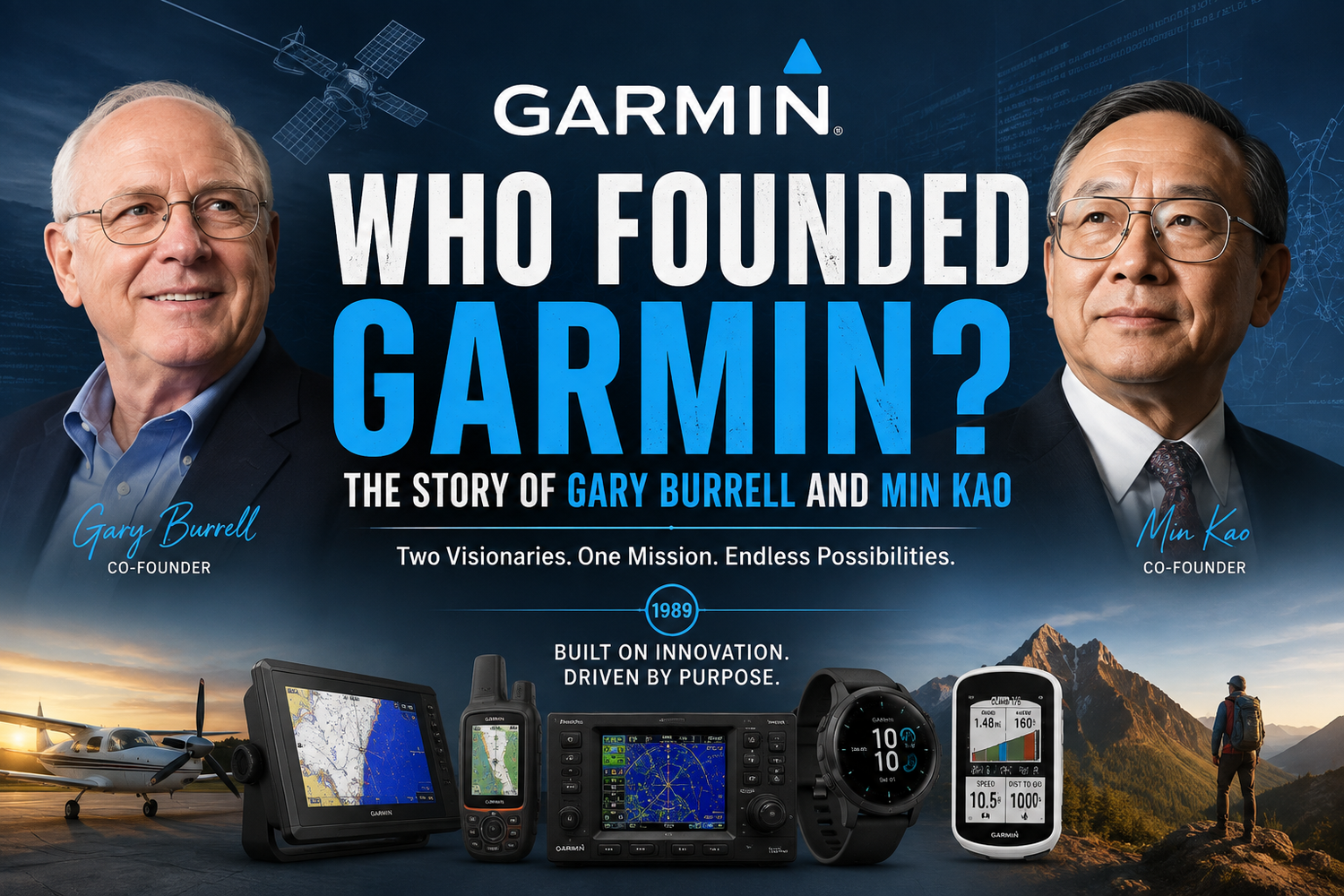
Today, the name Garmin is closely associated with GPS running watches, cycling computers, outdoor navigation, aviation technology and marine electronics. Millions of people use Garmin products to track workouts, navigate unfamiliar routes and understand their daily activity.But Garmin existed long before smartwatches became mainstream.The company's story began in 1989, when two engineers Gary Burrell and Dr. Min Kao shared a belief that an emerging satellite technology called the Global Positioning System could eventually transform navigation for ordinary consumers as well as professionals.They were right.What started with a small group of engineers in Kansas would eventually become a global technology company spanning aviation, marine, automotive, outdoor and fitness markets. And even the name Garmin tells the story of the two people behind it.
Who Were the Founders of Garmin?
Garmin was co-founded by Gary Burrell and Dr. Min Kao in 1989.The company name combines parts of their first names:GARy + MIN = GARMIN.It's an unusually simple origin for a brand that would eventually become recognized around the world.But the partnership worked because the two founders brought extensive engineering experience to the business.They weren't entrepreneurs who simply spotted GPS as a fashionable new technology. Both had already spent years working with navigation, communications and aviation electronics.That technical background became fundamental to Garmin's early identity.
Gary Burrell: The Aviation Engineer
Gary Burrell had a long career in aviation and marine electronics before Garmin existed.According to Garmin, he held leadership positions at companies including Lowrance Electronics, King Radio Corporation and AlliedSignal. He became known for his work in integrated avionics and had helped develop navigation and communications technology for general aviation. This experience helped shape Garmin's philosophy.Rather than creating technology simply because it was technically impressive, Burrell focused on making complicated navigation systems genuinely useful.That idea remains visible throughout Garmin's history.GPS technology could be extraordinarily sophisticated behind the scenes, but the device in someone's hand or aircraft cockpit needed to make navigation simpler.Burrell also became known within Garmin for a leadership philosophy the company describes as servant leadership, emphasizing the impact decisions had on employees and customers. Garmin CEO Cliff Pemble, one of Burrell's early hires, later credited that leadership style with influencing Garmin's culture.
Min Kao: The GPS Specialist
If Burrell brought extensive aviation and product experience, Dr. Min Kao brought deep expertise in GPS engineering.Born in Taiwan, Kao studied electrical engineering at National Taiwan University before earning master's and doctoral degrees in electrical engineering from the University of Tennessee. His early career included research connected with NASA and the U.S. Army. His experience became increasingly focused on navigation.At Teledyne Systems, he worked with inertial and radio-navigation systems. At Magnavox Advanced Products, he designed algorithms for GPS equipment. He later worked at King Radio Corporation and AlliedSignal, where Garmin says he led development of the first GPS navigator to receive FAA certification. Kao therefore wasn't simply predicting that GPS would become important.He understood the technology at an engineering level.Garmin credits him with breakthrough GPS software design and engineering that formed the foundation of the company's original products.
The Big Idea: GPS Would Become Much Bigger
In the late 1980s, GPS was nothing like the invisible everyday technology we know today.Modern users barely think about satellite positioning. Your phone uses location information for maps, ridesharing, weather and countless applications. A running watch can record a route automatically.Burrell and Kao saw that potential much earlier.While working together, the two engineers recognized that GPS could eventually benefit far more than military and specialist navigation applications. They envisioned bringing GPS-based products into aviation, marine, automotive and consumer markets. When their employer was reducing research and development spending, the pair decided to pursue that opportunity themselves.In October 1989, they founded the company that would become Garmin. Starting With a Small Team in KansasGarmin didn't begin with enormous offices and thousands of employees.Burrell and Kao assembled a small engineering team and established operations in Lenexa, Kansas. The company later moved its global headquarters to Olathe, Kansas.The founders also established an important connection with Taiwan.In 1990, Garmin opened its first manufacturing facility in New Taipei City, initially employing only around a dozen people. This combination of engineering, manufacturing and product development became important to Garmin's business model.Rather than outsourcing every stage of production, Garmin developed a vertically integrated approach that gave the company greater control over development and manufacturing. Garmin has repeatedly identified that philosophy as an important part of its growth.
Garmin's First Product
The next challenge was turning GPS technology into something customers could actually use.In 1991, Garmin introduced its first product, the GPS 100.It was designed to work across multiple environments, including land, marine and aviation applications. Garmin describes it as an early portable consumer navigation device distinguished by its battery life, usefulness and versatility. The product established a pattern Garmin would repeatedly follow.Instead of restricting GPS to a single specialist market, the company looked for different places where location and navigation technology could solve problems.That approach would eventually take Garmin everywhere from aircraft cockpits to runners' wrists.
Aviation Became a Major Part of Garmin's Identity
Garmin's aviation roots were especially important during its early development.In 1994, the company introduced the GPS 155, which Garmin says became the world's first GPS receiver certified by the FAA for certain instrument-navigation applications. Then came another major product.In 1998, Garmin launched the GNS 430, integrating GPS navigation, mapping and communications into a colour-display avionics system. It became one of Garmin's most significant general-aviation products. Burrell and Kao's contributions to aviation would eventually receive major recognition. In 2024, both founders were inducted into the National Aviation Hall of Fame for their contributions to aviation and aeronautics.
From GPS Navigation to Garmin Watches
Someone discovering Garmin through a Fenix, Forerunner or Venu smartwatch might assume fitness technology has always been the company's main business.It hasn't.Garmin gradually expanded GPS technology across different categories, including automotive navigation and outdoor handheld devices.Then came a product that helped connect Garmin's navigation expertise with fitness.In 2003, Garmin introduced the Forerunner 201, an early wrist-based GPS training device. The concept reportedly developed after a Garmin engineer experimenting with a lightweight GPS navigator realized that attaching the technology to the wrist could track a runner's speed and distance.That idea would eventually grow into an enormous ecosystem of running watches, cycling devices and multisport wearables.Modern Garmin watches can monitor far more than location. Depending on the model, users can access heart-rate information, sleep insights, training metrics, recovery information and other wellness features.Yet GPS the technology Burrell and Kao originally believed could change navigation—remains central to many of them.
Garmin Goes Public
By the end of the 1990s, Garmin was far removed from the small Kansas startup it had been a decade earlier.In 2000, Garmin began publicly trading on the NASDAQ at $14 per share. The company later transferred its listing to the New York Stock Exchange in 2021. Growth continued across multiple industries.That diversification would prove particularly important as smartphones began replacing the dedicated car-navigation devices that had once been enormously popular.Garmin wasn't dependent on only one type of GPS product.Its technology had already spread into aviation, marine, outdoor and fitness categories.
What Happened to Garmin's Founders?
Gary Burrell retired in 2002 and remained co-chairman until 2004, when he became Chairman Emeritus. He died on June 12, 2019, aged 81. Garmin remembered him not only for his engineering and entrepreneurship but also for the jobs and company culture he helped create. Dr. Min Kao continued playing an important role in Garmin's leadership. He remains Executive Chairman, supporting strategic planning and business development while serving as chairman of Garmin's board. Their influence therefore extends well beyond the company's name.