


































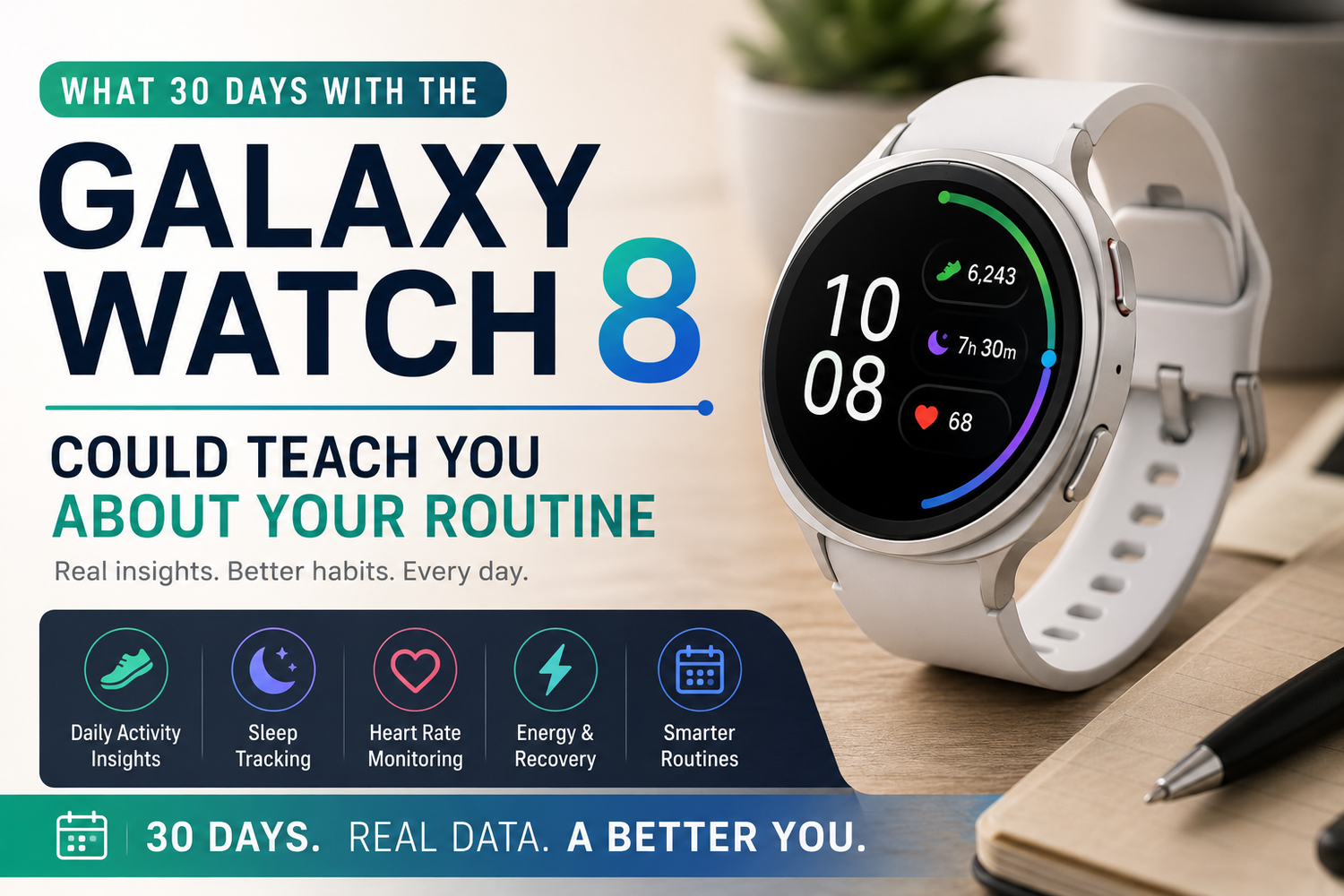
Most people have a general idea of how they spend their days. You know whether you exercise regularly, roughly how much sleep you get and whether you've been sitting at your desk for too long.But perception and data aren't always the same thing.That's where a smartwatch such as the Samsung Galaxy Watch8 can become interesting. Wear it consistently for 30 days and you're no longer looking at information from a single workout or one bad night's sleep. You can start seeing patterns across your daily activity, exercise, sleep and general routine.The real value isn't collecting more numbers. It's understanding which numbers might help you make more informed everyday decisions.So, what could a month with the Galaxy Watch8 teach you?
Week One: You Discover Your Actual Activity Level
During the first few days, one of the most obvious things you'll notice is how much or how little you move.Many people assume they're reasonably active because their days feel busy. But answering emails, attending meetings, driving and doing household tasks don't necessarily involve much sustained movement.Daily activity information can provide a clearer picture.You might discover that your weekday routine involves considerably less movement than your weekends. Perhaps Tuesdays are particularly sedentary because they're filled with meetings, while Saturdays naturally involve more walking.The goal doesn't have to be chasing a perfect number.Instead, the watch can make previously invisible patterns easier to notice.That might encourage something as simple as taking a short walk during lunch or choosing the stairs more often.
Your Step Count Becomes Context, Not a Competition
Steps are among the easiest smartwatch measurements to understand.But after 30 days, the interesting part isn't necessarily your highest daily total.It's consistency.Suppose you walk considerably more on days when you commute to work than when you work from home. That insight could encourage you to deliberately add movement to home-working days.Alternatively, you might discover that you're already more active than you thought.This is why longer-term tracking can be more useful than obsessing over individual days.One unusually active Saturday doesn't define your lifestyle, and neither does one lazy Sunday.Patterns matter more.
Week Two: Sleep Starts Telling a Bigger Story
Sleep tracking becomes more interesting when you have multiple nights to compare.One night of poor sleep could happen for countless reasons. But if the same pattern appears repeatedly, it becomes something worth paying attention to.The Galaxy Watch8's sleep-related features can help you examine your overnight routine and supported sleep insights.After a couple of weeks, you may start asking useful questions.Do you sleep differently on weekends? Are you consistently going to bed later than you realized? Does your routine become irregular during busy work periods?The smartwatch can't magically solve those problems.What it can do is make your habits more visible.Sometimes simply seeing an inconsistent bedtime across several weeks is enough to encourage a more predictable evening routine.
You May Discover That Bedtime Isn't the Whole Story
People often focus entirely on when they go to bed.But a good routine involves more than simply getting under the covers at a particular time.How consistently you sleep, how long you remain asleep and how your schedule changes throughout the week can all provide useful context.After wearing the Galaxy Watch8 for a month, you might notice that your Sunday-to-Thursday routine is reasonably consistent, but Friday and Saturday shift dramatically.Or perhaps your bedtime looks good, but you're regularly waking earlier than expected.The important point isn't to diagnose yourself from smartwatch data.Use the information as a prompt to think about your habits and, if you have genuine health concerns, speak with an appropriate healthcare professional.
Week Three: Exercise Consistency Becomes Obvious
By the third week, your workout history starts revealing another pattern: what you actually do rather than what you intended to do.Perhaps you planned to exercise four times each week but averaged two.That's useful information.It doesn't mean you've failed. It means your original plan may not fit your routine.You could also discover that certain activities are easier to maintain than others.Maybe you regularly complete evening walks but keep skipping early-morning gym sessions. Perhaps cycling on weekends happens naturally while weekday runs constantly get postponed.A month of tracking can help you identify the activities that fit your life.And consistency is often more useful than creating an ambitious routine you can't maintain.
Heart Rate Adds Context to Exercise
During supported activities, heart-rate information can provide another layer of insight into your workouts.Over time, you may begin noticing how different activities feel compared with what the watch records.A relaxed walk and a challenging run obviously place different demands on your body, but seeing those differences can help you better understand workout intensity.The important thing is not to become obsessed with every fluctuation.Consumer wearables provide useful wellness and fitness information, but they aren't replacements for professional medical equipment.For everyday users, trends and context are usually more valuable than trying to interpret every individual reading.
Week Four: Your Energy Patterns May Become Clearer
By the final week, you may start connecting different parts of your routine.Samsung's supported wellness and energy-related insights are designed to bring multiple signals together to provide additional context about your day.Even without focusing on a single score, a month of data may encourage you to compare how you feel with what you've been doing.Did a late night coincide with a sluggish morning?Do you feel better on days when you've moved more?Are certain parts of the week consistently more tiring?These aren't necessarily scientific conclusions from 30 days of smartwatch use.They're observations.And useful observations can help you make small adjustments.
You Might Learn How Often You Check Your Phone
The Galaxy Watch8 isn't only a fitness device.Notifications, calls, messages, timers, calendar information and other connected features can put basic information on your wrist.After a month, you might realize you're taking your phone out of your pocket less frequently.A quick glance can tell you whether an incoming notification deserves attention.That's particularly useful during work, meals or walks when you don't want every vibration to turn into five minutes of scrolling.Of course, the opposite can also happen.Too many wrist notifications can become distracting.Thirty days gives you enough time to decide which alerts deserve your wrist and which should be switched off.
You'll Learn Whether You Actually Need a Smartwatch
Perhaps the most valuable lesson is surprisingly simple.After 30 days, you'll know whether wearing a smartwatch genuinely improves your routine.Some people love having activity, sleep, workouts and notifications available on their wrist. They enjoy checking trends and find the information encourages better habits.Others may discover that they rarely look at the dataThat's useful knowledge too.A smartwatch only provides value when its features fit naturally into your life.If you constantly forget to wear or charge it, or ignore the information it collects, a simpler watch may suit you better.
Charging Becomes Part of the Experiment
To learn anything meaningful over 30 days, you need consistent data.That makes charging habits important.If you want overnight sleep information, charging the watch while you're sleeping obviously isn't ideal. You may prefer topping it up while showering, getting ready for work or sitting at your desk.After several weeks, you'll probably develop a charging routine without thinking much about it.This seemingly small detail matters.The easier a wearable is to keep charged and on your wrist, the more complete your long-term picture becomes.
Don't Chase Perfect Numbers
Smartwatch ownership can easily become a game of trying to make every number look better.More steps. More workouts. Better sleep. Higher scores.That isn't necessarily the healthiest way to use the information.Your routine changes. Travel happens. Work gets busy. Some weekends are active, while others involve spending an entire afternoon watching movies.Rather than trying to achieve perfect numbers every day, use the Galaxy Watch8 to identify broader patterns.Ask what changed and why.That mindset turns tracking into information rather than pressure.
What Could You Learn After 30 Days?
By the end of a month, you could have a clearer picture of your everyday habits.You may understand which days you're most active, whether your sleep schedule is consistent and how often you're actually exercising.You could also discover practical things that have nothing to do with fitness such as which notifications you need, when you're most likely to forget charging and whether having information on your wrist reduces unnecessary phone checking.None of these insights requires you to become an athlete.They're simply observations about how you live.