



































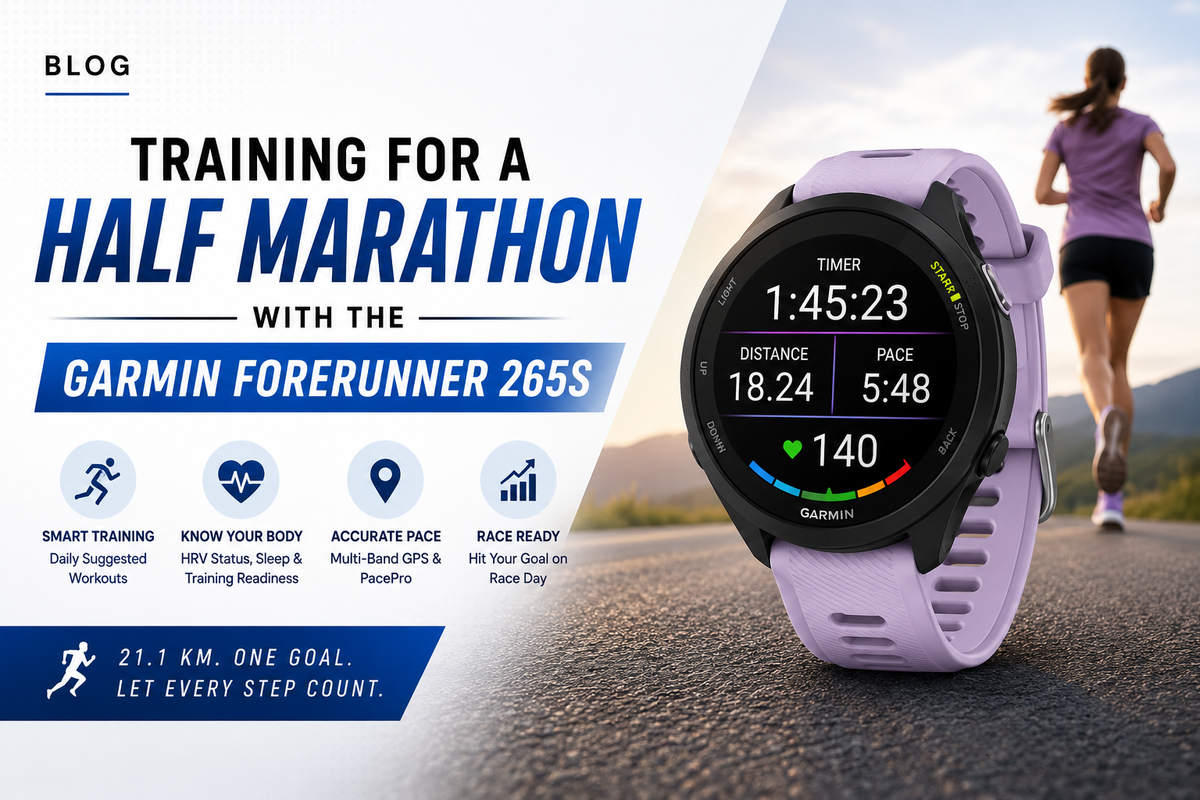
Training for a half marathon is about much more than simply running farther every week. Covering 21.1 kilometres comfortably requires endurance, sensible pacing, recovery and enough consistency to arrive at race day healthy rather than exhausted.This is where a running watch such as the Garmin Forerunner 265S can become particularly useful. Instead of only recording how far you run, it provides training information that can help you understand workload, recovery, pace, heart rate and overall fitness.The Forerunner 265S includes multi-band GPS, wrist-based running dynamics, Training Readiness, HRV Status, VO2 max estimates, Daily Suggested Workouts, PacePro and race-focused features. Garmin rates the smaller 42mm model for up to 15 days in smartwatch mode and up to 24 hours in GPS-only GNSS mode. So, how can you use all of these features while preparing for a half marathon?
Start by Adding Your Half Marathon
One of the smartest first steps is adding your half marathon to the Garmin Connect calendar.Once the event is saved and synchronised with the Forerunner 265S, the watch can display your primary race information. Depending on the available event data, this can include a countdown, predicted finish time, weather information, elevation information and PacePro options. More importantly, the race can influence your Daily Suggested Workouts.Instead of treating every run as an isolated activity, the watch can begin looking towards a specific goal and date. That makes the Forerunner 265S much more useful than simply starting the Run activity three or four times each week.You have given the watch a destination. Now your training data has context.
Let Daily Suggested Workouts Provide Structure
One of the biggest challenges for first-time half marathon runners is deciding what to do each day.Should today be an easy run? Should you run intervals? Is it time for a longer session?Garmin's Daily Suggested Workouts can provide guidance based on factors including your training habits, recovery time and VO2 max. Suggestions update as these factors change. You can also look ahead at upcoming suggested sessions rather than seeing only today's workout. That adaptability is useful because half marathon preparation rarely goes perfectly according to plan.You may sleep poorly, miss a workout or have an unexpectedly demanding week. A static plan printed months earlier does not automatically understand those changes.The Forerunner 265S has access to your recent training data, allowing its recommendations to respond to how your training is progressing.That does not mean you should blindly follow every suggestion. Work commitments, illness, injuries and how you actually feel still matter. Think of the watch as a training assistant rather than an unquestionable coach.
Do Not Turn Every Run Into a Race
A common mistake during half marathon training is running too hard too frequently.It is easy to assume that faster training always creates faster racing, but endurance development requires a mixture of intensities.Garmin's Training Load Focus separates training into low aerobic, high aerobic and anaerobic categories. The watch can show whether your recent training is concentrated too heavily in one area and provide targets for balancing your workload. Garmin notes that low aerobic activity helps build a foundation, while high aerobic training can contribute to improvements in lactate threshold, VO2 max and endurance.For a half marathon runner, this can be a useful reminder that an easy day really can be easy.Longer comfortable runs help develop endurance. Faster tempo-style sessions can prepare you for sustained effort. Intervals can develop speed and aerobic capacity.The goal is not to make every workout difficult. It is to combine different types of training intelligently.
Use GPS to Understand Your Pace
Pacing becomes increasingly important as your runs become longer.The Forerunner 265S supports multi-band GPS and Garmin's SatIQ technology, which Garmin designed to provide positioning accuracy while managing battery consumption. During training, accurate distance and pace information can help you understand whether you are running at the intended intensity.This is especially important for beginners who often start too quickly.The first few kilometres of a long run may feel easy, making it tempting to increase your speed. The problem often appears later when the pace becomes unsustainable.Using your watch to maintain a controlled pace can teach you patience.Over several weeks, you can also compare pace with heart rate and perceived effort. If you eventually run the same pace with a lower effort, or run faster at a similar effort, that may indicate improving fitness.
Pay Attention to Training Readiness
Training does not make you fitter while you are running. Your body also needs time to recover from the stress created by running.The Forerunner 265S includes a Training Readiness score designed to help indicate whether it may be a better day for a demanding workout or an easier session. Garmin says the score considers factors including sleep quality, recovery and training load. This can become particularly valuable halfway through a training block.During the first few weeks, motivation is often high and fatigue relatively low. As long runs become longer and harder sessions accumulate, recovery becomes increasingly important.If your watch is repeatedly showing poor readiness while your legs feel heavy and your performance is falling, that information is worth considering.One additional recovery day is often less disruptive than forcing a difficult session and struggling through several days afterwards.
Use HRV and Sleep as Supporting Information
The Forerunner 265S can track heart rate variability during sleep and provide HRV Status. Its Morning Report can also present information including sleep, HRV status, weather and the day's training outlook.For half marathon preparation, the value comes from looking at patterns rather than becoming obsessed with one night's number.Training places stress on the body. So do poor sleep, travel, work pressure and illness.If several recovery indicators move in an unusual direction at the same time, it may provide additional context for how you are feeling.The watch cannot know your body better than you do, but it can show information that is easy to overlook when motivation is telling you to complete the workout regardless.
Long Runs Are Where the Watch Becomes Especially Useful
Long runs are a fundamental part of preparing for 21.1 kilometres.As your long-run distance gradually increases, the Forerunner 265S can record pace, heart rate, cadence, distance and other running information. Garmin also supports wrist-based running dynamics such as stride length and ground contact time.However, avoid turning every metric into a target.During long runs, the most useful information may simply be pace, heart rate, distance and elapsed time.The objective is usually to build endurance without making every weekend session feel like race day.Long runs are also an excellent opportunity to practise your race routine. Test the shoes, clothing, hydration and nutrition strategy you intend to use during the event. Race day should not be the first time you discover that something does not work.
PacePro Can Help With Race Strategy
As race day approaches, your focus begins moving from building fitness to using that fitness intelligently.PacePro can provide grade-adjusted pacing guidance for supported courses or distances. If course information is available for your race, the Forerunner 265S can incorporate PacePro into your race preparation. This can be useful because maintaining exactly the same pace throughout a hilly half marathon may not be realistic.More importantly, having a pacing plan can discourage one of the most common race-day mistakes: starting much faster than you trained for because excitement makes the opening kilometres feel effortless.Twenty-one kilometres gives you plenty of time to regret an overly ambitious start.
Do Not Forget to Enjoy the Training
The Forerunner 265S provides an enormous amount of information, but your half marathon should not become an exercise in constantly checking numbers.Some runs will feel excellent. Others will feel strangely difficult despite apparently good recovery data.That is normal.Use Garmin's metrics to identify trends, add structure and make better-informed decisions, but continue paying attention to your body.The real advantage of the Forerunner 265S is not that it runs the half marathon for you. It helps turn months of training into understandable information.From the first easy run to long-run progression, recovery monitoring, pacing and finally race day, the watch can provide a consistent picture of how your preparation is developing.When you eventually reach the start line, the goal is not simply to have collected months of Garmin data. It is to arrive confident that those kilometres, recovery days and carefully controlled workouts have prepared you to cover 21.1 kilometres.And when the finish line finally appears, pressing Stop on the Forerunner 265S may become one of the most satisfying button presses of your entire training journey.