































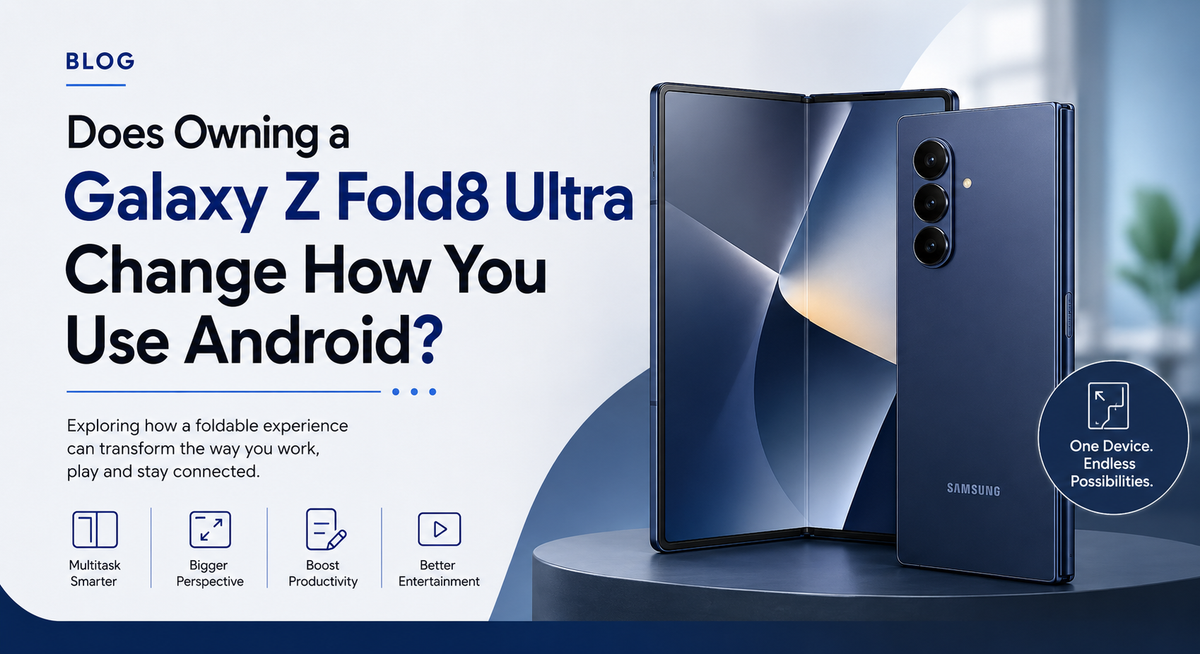
For most people, using Android follows a familiar pattern. You unlock your smartphone, open one app, complete a task and move on to the next. Even powerful flagship phones are largely designed around this single-app experience because their screens only provide so much space.A device such as the Samsung Galaxy Z Fold8 Ultra changes that basic idea. Instead of being limited to a conventional smartphone display, a large foldable gives you an outer screen for quick interactions and an expansive inner display when you need more room.The important question is not simply whether a larger screen looks better. Does owning a Galaxy Z Fold8 Ultra actually change the way you use Android?For many users, it could. The biggest difference comes from treating Android less like a collection of individual full-screen apps and more like a flexible mobile workspace.
You Start Choosing a Screen for the Task
A traditional smartphone gives you one display for almost everything. Foldables introduce another decision into everyday use.Quickly replying to a message, checking the weather or changing a song may make more sense on the outer display. There is no need to unfold the device for every small interaction.But when you want to read an article, work on a document, look through photographs or watch a video, opening the Fold can give you significantly more space.Over time, this could change your habits.Instead of automatically using the same screen for every activity, you begin choosing the display that suits the task. The outer screen becomes the quick-access smartphone, while the inner screen becomes the place for longer and more involved activities.That distinction is one of the biggest differences between using Android on a foldable and using it on a conventional phone.
Multitasking Becomes Much More Natural
Android has supported multitasking for years, but using two applications simultaneously on a narrow smartphone display can feel cramped.A large foldable changes the usefulness of that feature.Imagine researching a holiday. On a conventional phone, you might repeatedly switch between a browser, maps and your messaging app. On a Fold, multiple compatible apps can share the larger display, allowing you to compare information without constantly moving backwards and forwards.The same idea applies to work.You might read an email while looking at your calendar, reference a webpage while writing notes or participate in a video call while checking a document.The individual applications are not necessarily doing anything new. What changes is how easily you can use them together.That can make Android feel less like a phone operating system and more like a compact productivity environment.
Drag and Drop Starts Making More Sense
One benefit of having multiple apps visible at once is that information can move between them more naturally.Suppose you are planning a trip and find an address online. Rather than memorising it, copying it, switching applications and pasting it elsewhere, compatible Android apps may allow content to be moved directly between windows.Images, text and other supported information can become easier to transfer when both the source and destination are already visible.This type of interaction is familiar on desktop computers, where several windows can remain open simultaneously.On a normal smartphone, there often is not enough screen space for the experience to feel natural. On a large foldable, it becomes much more practical.That seemingly small difference can change how you think about completing tasks on Android.
You May Spend Less Time Switching Between Apps
App switching is such a normal part of smartphone use that most people barely notice it.Open your email. Find some information. Switch to the browser. Search for something. Return to your email. Open the calendar. Go back again.Every switch takes only a moment, but those moments accumulate.A foldable does not eliminate app switching, but a larger workspace can reduce how frequently it is necessary.For example, a student could keep lecture material beside a note-taking app. A shopper could compare products across different windows. A traveller could view maps while checking accommodation details.The advantage is not necessarily completing each individual task faster. It is reducing the friction between tasks.That is an important distinction because it explains why a large foldable display can feel more useful than its dimensions alone suggest.
Android Apps Begin to Feel Different
The experience depends heavily on how applications respond to a larger display.A well-optimised Android app can use the additional space to show more information rather than simply stretching a smartphone interface.An email application might display the inbox and selected message together. A file manager could show navigation controls alongside files. A productivity application might provide additional toolbars without covering the content you are working on.This is where foldables can reveal a side of Android that conventional smartphones rarely show.Instead of treating every application as a tall vertical column, Android can behave more like a tablet interface.Not every app will take equal advantage of the available space, however. Some applications may still look like enlarged phone apps, while others may provide genuinely useful adaptive layouts.Software optimisation therefore remains an important part of the foldable experience.
Entertainment Becomes More Immersive
The inner display also changes Android when work is finished.Watching YouTube, streaming movies, viewing photographs and playing games on a larger screen can feel considerably different from doing the same thing on a standard smartphone.The improvement is not always as simple as saying everything becomes dramatically larger. Video aspect ratios can create unused space depending on the content, and games need appropriate interface scaling.But the larger canvas can still make entertainment feel more immersive.Reading is another strong example. Websites, ebooks, magazines and long articles have more room to breathe. You may find yourself using the phone for activities that you previously preferred doing on a tablet.That could eventually reduce the need to carry a separate entertainment device.
Photography Can Become a Two-Screen Experience
Foldable hardware can also change how Android photography works.With screens on different sides of the device, photography no longer has to follow the conventional arrangement of photographer on one side and subject on the other with only the photographer able to see the preview.Foldable-specific camera features can allow the outer display to become useful while the device is open, giving the person being photographed an opportunity to see the framing.The form factor can also create more flexibility for positioning the device at different angles.This demonstrates an important point about foldables: the second screen is not merely extra display area. It can create interactions that are difficult to reproduce on an ordinary smartphone.
Your Phone May Start Replacing Other Devices
Perhaps the biggest behavioural change comes from what you stop using.If the Fold8 Ultra can provide a large screen for reading, multitasking, entertainment and light productivity while still folding into a phone-sized device, you may reach for a tablet less often.For some people, even certain laptop tasks could move to the Fold.Email management, document review, online research, video meetings and basic editing do not always require a traditional computer. Pairing a large foldable with accessories and cloud-based applications can expand those possibilities further.A Fold is unlikely to replace a laptop for everyone, particularly users who depend on specialist desktop software. But reducing the number of times you need another device can still be meaningful.
The Outer Screen Still Matters
Interestingly, owning a large foldable does not necessarily mean constantly using the large display.The convenience of the outer screen is essential to making the entire concept work.You might spend much of the day performing quick tasks without opening the phone at all. The value of the foldable design appears when the task becomes complex enough to justify more space.This creates an unusual relationship with Android.Instead of one interface serving every situation, the device can adapt physically to what you are doing.Check a notification while folded. Open the phone to answer a detailed email. Close it again and put it in your pocket.The hardware itself becomes part of the interface.
Does the Galaxy Z Fold8 Ultra Really Change Android?
Potentially, yes, but not because Android suddenly becomes a completely different operating system.The real change is behavioural.A large foldable encourages you to multitask more often, keep related information visible simultaneously and choose between quick interactions and larger-screen experiences. Activities that once felt awkward on a phone, such as comparing documents, reading long articles or working across several apps, can become more practical.The Galaxy Z Fold8 Ultra concept therefore represents something bigger than simply putting a larger display into your pocket.It changes the relationship between hardware and software.On a traditional smartphone, Android largely asks you to move from one app to another. On a large foldable, it can become a workspace where applications coexist and the screen adapts to what you need.And that may be the most important advantage of owning a premium foldable: it does not just give Android more screen. It can give you a different way to use Android altogether.