


































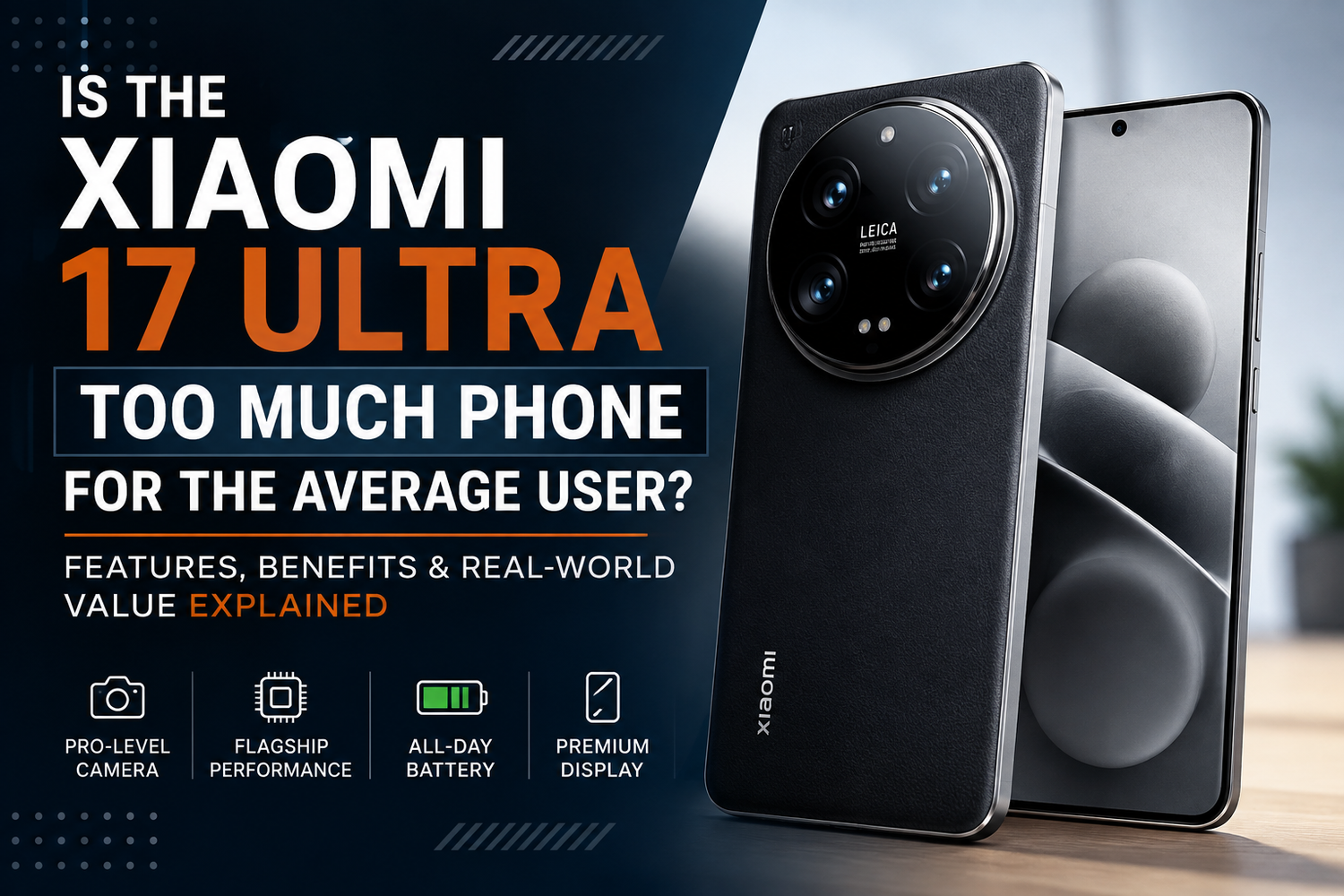
The Xiaomi 17 Ultra represents the type of smartphone designed to demonstrate just how much technology can fit into your pocket. It brings together flagship performance, an ambitious camera system, a premium display, a large battery and fast charging in a device aimed at demanding users.All of that sounds impressive.But it also raises an important question: does the average smartphone user actually need this much phone?For someone whose daily routine consists mainly of messaging, browsing social media, taking occasional photos, watching videos and making calls, many of the Xiaomi 17 Ultra's capabilities could be excessive.That doesn't necessarily make it a bad purchase. It simply means understanding whether you'll genuinely benefit from what you're paying for.
What Does the Average Smartphone User Actually Need?
Think about what you did with your phone yesterday.Perhaps you checked WhatsApp, answered emails, watched YouTube, browsed Instagram, used Google Maps, took a few photographs and ordered something online.None of these activities requires the most powerful smartphone available.Modern mid-range phones have become remarkably capable. They can open applications quickly, stream high-resolution video, capture good photographs and comfortably handle normal multitasking.The Xiaomi 17 Ultra therefore isn't designed around simply meeting these basic requirements.It's about going considerably further.
Performance Is Probably More Than You Need
One of the biggest attractions of an Ultra-class smartphone is performance.The Xiaomi 17 Ultra has the processing power expected from a modern premium Android flagship. That makes it suitable for demanding games, intensive applications, heavy multitasking and other workloads that can challenge less powerful phones.But everyday applications don't suddenly become dramatically different because you have flagship hardware.WhatsApp won't become a completely new experience.Netflix doesn't require extreme processing power.Checking your bank balance won't suddenly feel revolutionary.Where performance becomes more valuable is when you're playing demanding games at high settings, editing videos, processing large files or constantly switching between resource-intensive applications.For ordinary use, you're mostly buying performance headroom.The advantage is that this additional power could help the phone remain responsive as applications become more demanding over time.
The Camera May Be the Best Reason to Buy It
The camera system is where the Xiaomi 17 Ultra becomes easier to justify.Ultra smartphones increasingly behave like compact photography systems rather than simply phones with cameras attached.Different focal lengths give you more flexibility when photographing landscapes, people, buildings, food and distant subjects.For someone who loves photography, this versatility can be enormously valuable.Imagine travelling.Instead of carrying a dedicated camera and several lenses, you have a device already sitting in your pocket.You can take a wide landscape photograph, switch to the main camera for street photography and then use telephoto capability to capture something farther away.That convenience can be worth paying for.But there's another side to the argument.If you take photographs mainly for social media and rarely move beyond automatic camera mode, you might not fully appreciate what an advanced camera system can offer.A good mid-range phone may already satisfy your photography requirements.
Do You Need That Much Zoom?
Zoom capability is one of the features that helps distinguish premium camera phones.It can be extremely useful.Travel photographers can capture architectural details from a distance. Parents can photograph children during sporting events. Wildlife enthusiasts may appreciate additional reach.However, think about how frequently you currently zoom when taking photographs.If the answer is "almost never," an advanced telephoto system may become one of those features you demonstrate to friends during the first week and rarely use afterward.That's the challenge with premium phones.The specifications are impressive, but value comes from using those specifications.
The Display Is Excellent, but Good Screens Are Everywhere
Flagship smartphones usually offer excellent displays, and the Xiaomi 17 Ultra is no exception to the premium-screen trend.A high-quality OLED display can provide excellent contrast, vibrant colours and smooth motion.That improves everything from scrolling through websites to watching movies.However, displays have improved enormously across the smartphone market.You no longer need to buy the most expensive model to get a bright OLED screen with a high refresh rate.The difference between a budget display and a flagship display can still be obvious.The difference between a good mid-range display and an Ultra-class display may be considerably less dramatic for an average user.
Battery Life Is Something Everyone Can Appreciate
You don't need to be a technology enthusiast to appreciate good battery life.This is one area where premium hardware can benefit almost anyone.A large battery gives you additional confidence when travelling, navigating, photographing, gaming or spending long periods away from a charger.Fast charging adds another layer of convenience.If you've forgotten to charge your phone overnight, being able to recover a substantial amount of battery during a short morning routine can be genuinely useful.Unlike advanced camera modes or gaming performance, battery benefits don't require specialist knowledge.Everyone understands the frustration of a phone reaching 5% at the wrong moment.
Fast Charging Can Change Your Routine
Fast charging sounds like another specification until you actually start relying on it.Traditional charging habits often revolve around leaving a phone connected overnight.With sufficiently fast charging, you may instead plug it in while showering, preparing breakfast or getting ready for work.That flexibility can make battery anxiety less significant.Still, if you already charge your phone overnight and comfortably make it through every day, extremely fast charging may not transform your life.Again, it depends on your habits.
The Size and Weight Matter
Powerful flagship phones need somewhere to put all their technology.Large displays, advanced camera hardware and substantial batteries can result in devices that feel bigger and heavier than simpler smartphones.That matters because you interact with your phone hundreds of times each day.A large display is excellent for movies and gaming but can be less convenient when using the phone with one hand.A prominent camera module may provide excellent photographic capability while also making the device less comfortable in certain pockets.Specifications can't tell you whether a phone feels good in your hand.Whenever possible, physically handle a large flagship before buying it.
Are You Paying for Features You'll Never Use?
This is perhaps the most important question.Premium smartphones frequently include features that sound fantastic in advertisements.Advanced manual photography controls.High-end video recording.Extreme gaming performance.AI tools.Fast wireless connectivity.Professional-style camera options.Sophisticated display technologies.None of these features is pointless.But they may be pointless for you.If you never play demanding games, gaming performance isn't particularly valuable.If you never record serious video, professional video options won't matter.If you rarely photograph distant subjects, powerful zoom isn't essential.Buying a smartphone should be about matching features with your actual routine rather than collecting the largest specification numbers.
Could a Cheaper Xiaomi Make More Sense?
For many people, yes.Xiaomi produces devices across numerous price categories, and its less expensive phones can cover most everyday smartphone tasks extremely well.The money saved could potentially be spent on something that makes a bigger difference to your technology setup, such as wireless earbuds, a smartwatch, tablet or laptop.There's also the question of replacement cycles.Would you rather buy an extremely expensive flagship and keep it for several years, or purchase a more affordable model and upgrade sooner?There isn't one correct answer.
Who Actually Needs the Xiaomi 17 Ultra?
The Xiaomi 17 Ultra makes the most sense for people who know why they want it.
Photography enthusiasts are obvious candidates.Mobile gamers can benefit from flagship processing performance.Content creators may appreciate the combination of camera flexibility, performance and display quality.Heavy users who constantly multitask can benefit from the additional performance.Technology enthusiasts may simply enjoy owning advanced hardware, and that's a perfectly valid reason too.You don't need to professionally exploit every feature to enjoy a premium product.
Who Should Consider Something Cheaper?
If your smartphone is primarily a communication and entertainment device, you probably don't need an Ultra phone.Someone who mostly uses messaging, social media, maps, web browsing and streaming can find excellent alternatives for significantly less money.Likewise, if you rarely take photographs beyond casual snapshots, the Xiaomi 17 Ultra's sophisticated camera hardware may offer limited practical value.The key word is need.You might still want it.And those are two different buying decisions.
Could Buying an Ultra Phone Save Money Long Term?
Potentially.A powerful smartphone with premium hardware may remain satisfying for longer.Instead of upgrading every two years because your phone feels slow or lacks important capabilities, you might keep an Ultra model considerably longer.However, future-proofing has limits.Batteries naturally degrade.Accidents happen.Software requirements change.New features arrive.Buying the most expensive phone today doesn't guarantee you'll never want another one.The smarter approach is to buy enough capability for your current needs with reasonable room for future requirements.