


































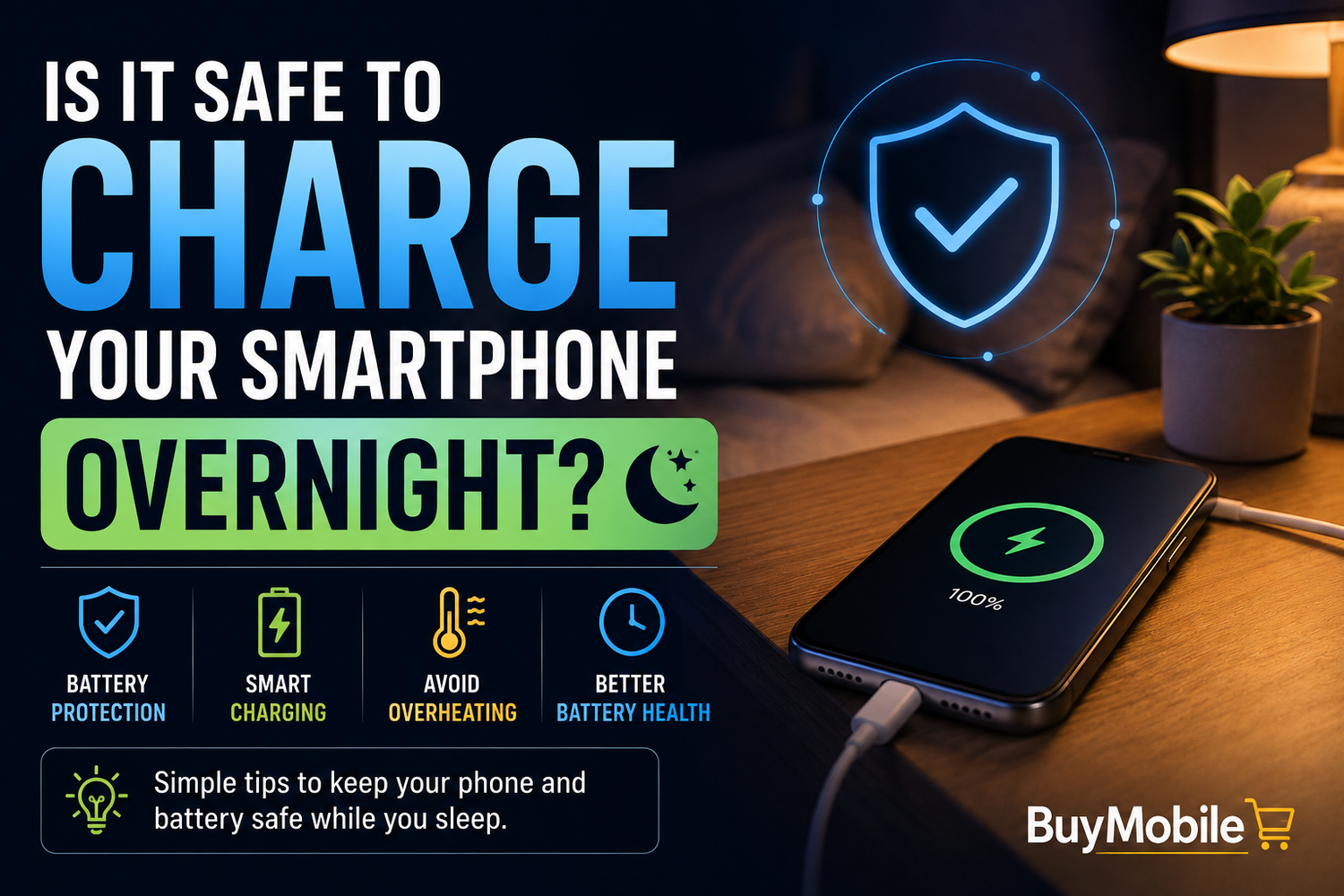
Charging your smartphone overnight is one of the easiest ways to make sure you start the day with a full battery. Plug it in before bed, leave it on the bedside table and wake up several hours later ready to go.But this convenient habit has also created plenty of questions.Can overnight charging damage your battery? Will your phone keep charging after reaching 100%? Can it overheat? And does leaving it plugged in every night shorten its lifespan?The short answer is reassuring: for modern smartphones, overnight charging is generally safe when you're using appropriate charging equipment and the phone can dissipate heat normally.However, there's a difference between something being safe and something being ideal for long-term battery health.Here's what you should know.
What Happens When Your Phone Reaches 100%?
One of the biggest misconceptions about overnight charging is that electricity continues pouring uncontrollably into the battery after it reaches 100%.Modern smartphones don't work like that.Phones contain charging-management systems that control how the battery receives power. Once the battery reaches its target charge level, the device manages or stops active charging rather than simply continuing to force energy into a full battery.If the battery level later falls slightly while the phone remains connected, the charging system can manage the power accordingly.So your smartphone doesn't simply keep "overcharging" all night in the way people sometimes imagine.That doesn't mean leaving a battery at a very high charge level for long periods has no effect on battery ageing, however.That's a separate issue.
Why Smartphone Batteries Age
Most modern smartphones use lithium-ion or related lithium-based rechargeable batteries.These batteries naturally degrade over time.Every charging cycle contributes to chemical ageing, but charging cycles aren't the only factor. Temperature, charging behaviour, usage patterns and the amount of time a battery spends at very high or very low states of charge can also influence long-term health.Eventually, the battery won't hold as much energy as it did when new.You might notice that a phone that once comfortably lasted all day needs charging by early evening after several years.That's normal battery ageing.The goal isn't to prevent degradation completely—that isn't realistic.Instead, good charging habits can potentially reduce unnecessary stress.
Is Keeping Your Phone at 100% Bad?
This is where overnight charging becomes more complicated.Reaching 100% occasionally isn't something you need to panic about.Your phone was designed to be charged.However, lithium-based batteries generally experience more stress when spending extended periods at very high states of charge, particularly when combined with elevated temperatures.If your phone reaches full charge at 1:00 AM and remains plugged in until 7:00 AM, its charging-management system is protecting it from uncontrolled overcharging.But the battery may still spend several hours sitting close to full capacity.Manufacturers have recognised this issue, which is why many modern phones now include optimised or adaptive charging features.
What Is Optimised Battery Charging?
Optimised charging attempts to balance convenience with battery longevity.Instead of charging immediately to 100% and remaining there for most of the night, a compatible smartphone may learn or use your charging routine and delay the final stage of charging.For example, your phone might charge relatively quickly to around 80%, pause or slow the process, and then finish charging closer to the time you normally wake up.The exact behaviour depends on the manufacturer, device and software settings.Some smartphones also offer battery-protection options that can limit the maximum charge level.These features are useful if you regularly leave your phone connected for long periods.Check the battery or charging section of your phone's settings to see which options are available.
Heat Is a Bigger Concern Than Overnight Charging Itself
If there's one battery factor worth paying close attention to, it's heat.Batteries don't particularly like high temperatures.Charging naturally generates some heat, and demanding activities can generate even more.Problems can arise when that heat can't escape effectively.For example, charging a phone underneath a pillow, blanket or other insulating material is a bad idea.The material can trap heat around the device.Your smartphone should ideally be charged on a firm, open surface where air can circulate around it.If the phone becomes unusually hot while charging, disconnect it and investigate the possible cause.
Should You Charge Your Phone Under Your Pillow?
No.Even if it's convenient to keep the phone close to you, don't charge it underneath a pillow, duvet or bedding.The issue isn't simply battery longevity.It's heat management.Electronic devices and chargers should be able to dissipate the heat they produce. Covering a charging phone can interfere with that process.A bedside table, desk or another stable and ventilated surface is a much better location.It's also sensible to keep charging equipment away from liquids and obvious physical hazards.
Does Fast Charging Make Overnight Charging Worse?
Fast charging is designed to deliver higher charging power when the phone and charger support itModern phones typically regulate charging speed depending on factors such as battery level and temperature.Charging may be fastest when the battery is relatively low and slow as it approaches full capacity.If you're plugging your phone in for seven or eight hours overnight, maximum charging speed isn't particularly important.You have plenty of time.Some users therefore prefer slower overnight charging, while others simply rely on their phone's adaptive charging system.The most important thing is using suitable, reputable charging equipment rather than obsessing over charging speed.
Can You Use Any Charger Overnight?
A charger isn't something worth taking unnecessary risks with.Use a charger and cable that are appropriate for your device and comply with relevant safety standards.Extremely cheap, poorly manufactured or damaged charging accessories may not provide the same protections as reputable equipment.Inspect your cables occasionally.If you notice exposed wiring, damaged connectors, severe bending or unusual heat, replace the accessory.The same applies to chargers that make unusual noises, smell strange or show signs of physical damage.Overnight charging means the equipment may operate while you're asleep, so using trustworthy hardware is particularly important.
What About Wireless Charging Overnight?
Wireless charging can also be convenient overnight.Place the phone on a charging pad and pick it up in the morning.However, wireless charging can produce noticeable heat because energy transfer isn't perfectly efficient.That doesn't automatically make it unsafe. Compatible smartphones and certified wireless chargers include systems designed to manage power and temperature.Still, placement matters.Make sure the phone is correctly aligned with the charger and isn't covered by bedding or other objects.If your phone consistently becomes very hot during wireless charging, consider checking the charger, case, alignment and charging environment.
Should You Follow the 20–80% Rule?
You've probably encountered advice telling you to keep your smartphone battery between 20% and 80%.There's some logic behind avoiding prolonged extremes of charge if your priority is maximising battery longevity.But treating 20% and 80% as strict boundaries can make owning a smartphone unnecessarily stressful.Charging to 100% when you need maximum battery life is perfectly reasonable.Likewise, occasionally dropping below 20% isn't a disaster.Think of partial charging as a useful long-term habit rather than a rule that must never be broken.If you're staying near a charger all day, limiting maximum charge can make sense.If you're about to spend 12 hours travelling, using the full battery capacity is far more practical.
Is It Bad to Charge Your Phone Every Night?
Not necessarily.Charging every night can be perfectly sensible if that's what your routine requires.Battery ageing depends on many factors, not simply how many times you connect a charging cable.Someone who finishes each day at 60% and tops up overnight has a very different charging pattern from someone who regularly drains the phone close to empty.Modern battery-management features are designed partly because manufacturers know users value convenient charging routines.Instead of worrying about connecting the phone every night, focus on avoiding excessive heat and using battery-protection features when appropriate.
What If Your Phone Gets Hot Overnight?
A little warmth during charging can be normal.Excessive or unusual heat isn't something to ignore.If your smartphone becomes very hot, stop charging it and allow it to cool.Check whether:
-
The phone is covered or poorly ventilated.
-
The charging cable or adapter is damaged.
-
A demanding application is running in the background.
-
The charger is appropriate for the device.
-
The phone or battery shows signs of physical damage.
If the battery appears swollen or the phone's casing begins separating, stop using and charging the device and seek professional service.A swollen battery should never be punctured or compressed.
How Can You Charge Safely Overnight?
You don't need a complicated bedtime charging routine.Use reputable charging equipment, place the phone on a stable and ventilated surface, keep it uncovered and enable any optimised charging or battery-protection features your device provides.Also keep the charging port and cable in good condition.If you're particularly concerned about long-term battery health, consider using a charge-limit feature if your phone offers one.These small habits are more useful than constantly unplugging the phone the moment it reaches a particular percentage.