


































Apple Watch has evolved far beyond counting steps and displaying notifications. Modern models can monitor heart rate, track sleep, record workouts, organise overnight health metrics and provide alerts when certain measurements appear unusual. Depending on the model and region, features can also include ECG, wrist temperature, sleep apnoea notifications and other health tools.That sounds impressive, but most people are not professional athletes or health experts.So how useful is all this information for an ordinary Apple Watch owner?For everyday users, the biggest benefit is not having hundreds of measurements available. It is the watch's ability to collect information quietly in the background and turn it into understandable patterns that can encourage healthier decisions.
Heart Rate Tracking Happens Throughout Everyday Life
Heart rate is one of the most useful measurements Apple Watch can provide.You can manually check your current heart rate, while the watch also collects readings in the background. Apple Watch can provide notifications for unusually high or low heart rates and, on supported devices and in supported regions, irregular rhythm notifications.For an everyday user, the value is often found in trends.You might notice how your heart rate changes during walking, exercise, stressful periods or rest. Over weeks and months, resting heart rate information can provide another way to observe how your body responds to your lifestyle.You do not need to understand complicated medical charts to find that useful.
Activity Rings Make Movement Easy to Understand
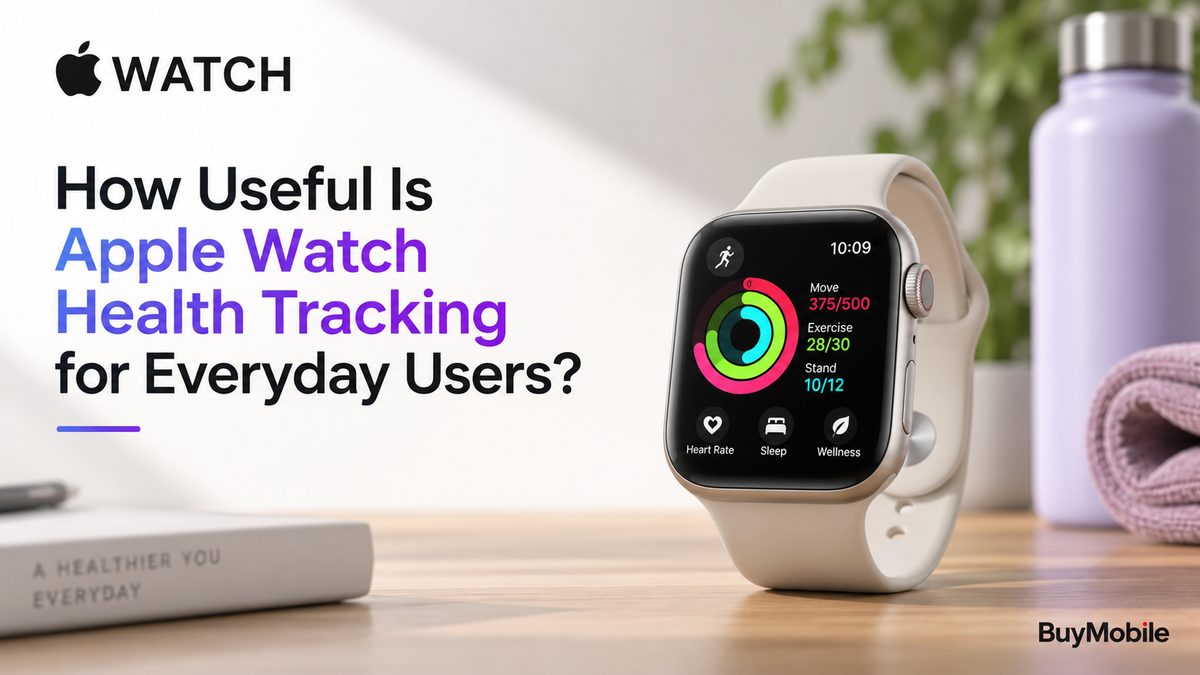
One reason Apple Watch health tracking works well for ordinary users is that it simplifies activity into understandable goals.The familiar Move, Exercise and Stand rings encourage users to move throughout the day rather than focusing only on formal workouts.That matters because not everyone goes to a gym.Walking around a shopping centre, taking the stairs, going for an evening walk or spending time doing physical activities can all contribute to a more active lifestyle.Apple allows Activity goals to be customised and even paused for rest days.For many people, seeing that an Activity ring is nearly complete can provide just enough motivation to go for another short walk instead of remaining on the sofa.
Workouts Provide More Context
If you do exercise regularly, Apple Watch becomes considerably more useful.The Workout app can track many types of activities and provide information such as heart rate and calories, with additional metrics available for activities including running, cycling, swimming and hiking.You do not have to be training for a marathon to benefit.Someone who walks for fitness can track how often they exercise. A beginner runner can observe improvements over time. Someone cycling on weekends can record routes and workout information.Instead of relying on memory, you begin building a history.That can make gradual progress easier to recognise.
Sleep Tracking Adds Information About the Other Half of Your Day
Health does not stop when you go to bed.Apple Watch can track sleep and provide information about time spent in Core, REM and Deep sleep, as well as periods when you may have been awake. Current Apple Watch software also offers a sleep score designed to make sleep quality easier to understand.This can be particularly useful for everyday users because sleep is something almost everyone can relate to.You might discover that you consistently sleep less during the working week. Perhaps your bedtime changes dramatically at weekends. You may notice that certain routines appear alongside better or worse nights.The watch cannot automatically tell you exactly why you slept badly, but it gives you information that would otherwise be difficult to observe.
Vitals Can Make Overnight Information Easier to Read
Collecting lots of health measurements creates another problem.What are you supposed to do with them?Apple's Vitals app attempts to make overnight information easier to interpret. Depending on your Apple Watch model and available features, it can bring together measurements including heart rate, respiratory rate, wrist temperature, blood oxygen and sleep duration.Rather than expecting you to interpret every individual number, Vitals establishes typical ranges based on your own measurements.If multiple metrics fall outside those typical ranges, the watch can provide a notification with additional context.For everyday users, this personalised baseline is potentially much more useful than constantly comparing themselves with someone else.
Some Apple Watches Can Track Wrist Temperature
Compatible Apple Watch models can also collect wrist-temperature information while you sleep.Apple explains that the measurement is related to body temperature but is specifically a wrist-temperature reading. After roughly five nights of sleep tracking, compatible watches can establish a baseline and display changes from it.This is another example of why long-term trends can be more useful than obsessing over one number.Wrist temperature can naturally vary because of factors such as exercise, sleep environment, alcohol consumption, menstrual cycles and illness.For supported users, temperature information can also contribute to Cycle Tracking features, including retrospective ovulation estimates and improved period predictions.
Heart Health Features Go Beyond Basic Fitness
Compatible Apple Watch models offer more advanced cardiovascular features.The ECG app can generate a single-lead electrocardiogram and check for signs of atrial fibrillation. Apple Watch can also provide high and low heart-rate notifications and irregular rhythm notifications where supported.These features should not turn users into their own doctors.Instead, their practical value is awareness.If a supported feature repeatedly identifies something unusual, the information may give a user a reason to discuss it with a qualified healthcare professional.Availability also depends on the Apple Watch model, country and regulatory approval, so not every feature is available to every owner.
Sleep Apnoea Notifications Add Another Layer
Compatible Apple Watch models can also look for signs associated with sleep apnoea.The feature uses the accelerometer to detect small wrist movements associated with interruptions to normal respiratory patterns during sleep. Apple says the watch analyses breathing-disturbance information over 30-day periods and can notify users if the data shows consistent signs of moderate to severe sleep apnoea.In India, Apple announced availability of sleep apnoea notifications in May 2026.This does not mean Apple Watch diagnoses sleep apnoea.Instead, it can provide information that may encourage an appropriate conversation with a doctor.That distinction is important whenever using consumer health technology.
Trends Are More Valuable Than Individual Readings
One of the easiest mistakes with wearable health tracking is worrying about every unusual number.Your body changes throughout the day.Heart rate varies. Sleep quality changes. Activity levels fluctuate. Wrist temperature can move away from its normal baseline.One unusual reading does not necessarily tell you very much.Apple's Health app becomes more valuable when you use it to examine longer-term patterns. The app organises information such as activity, sleep, medications and heart-related data and provides charts and trend analysis.For everyday users, this is arguably where wearable health tracking becomes most meaningful.Instead of asking, "Was today's number good?", you can ask, "How has this changed over the past three months?"
It Can Encourage Better Habits Without Becoming Complicated
Apple Watch does not physically make you healthier.It cannot exercise for you, improve your diet or put you to bed earlier.What it can do is make your behaviour more visible.If you have barely moved all afternoon, your Activity rings make that obvious.If your sleep schedule has become inconsistent, sleep history can reveal the pattern.If your fitness improves over time, workout and heart-rate information can help you see the progress.That feedback loop can make health goals feel more tangible.For many ordinary users, this motivation may be more valuable than the watch's most technically sophisticated sensor.
Privacy Matters When Tracking Health
Health information is extremely personal, so privacy is an important part of the experience.Apple says health data is encrypted on the device and protected by the user's passcode, Touch ID or Face ID. Health information synchronised through iCloud is encrypted both while being transferred and while stored.Users should still understand what information they choose to share with apps and services.Installing a fitness or health application does not mean it automatically needs access to every category of health information.Checking permissions periodically is a sensible habit.
Apple Watch Is Not a Replacement for Medical Care
This is perhaps the most important limitation.Apple Watch can provide useful health and wellness information, but a wearable should not replace professional medical advice, diagnosis or treatment.Sensors can provide measurements and algorithms can identify patterns, but those measurements need appropriate context.If you feel unwell, experience symptoms or have concerns about your health, apparently normal smartwatch readings should not be used as a reason to ignore them.Likewise, an unusual reading does not automatically mean you have a medical condition.The strongest role for Apple Watch is often awareness rather than diagnosis.
Do You Need to Check Your Health Data Every Day?
Not necessarily.In fact, constantly checking every measurement can make wearable technology feel more stressful than useful.Many everyday users may benefit more from letting Apple Watch collect information quietly and reviewing broader trends occasionally.Activity information can be useful daily because it encourages movement.Sleep information might be reviewed each morning or across a week.Long term health trends become more meaningful over months.You can choose how involved you want to be.That flexibility is part of the appeal.
For an everyday user who wants to become more aware of their habits without turning health tracking into a full-time hobby, that can make Apple Watch surprisingly useful.