



































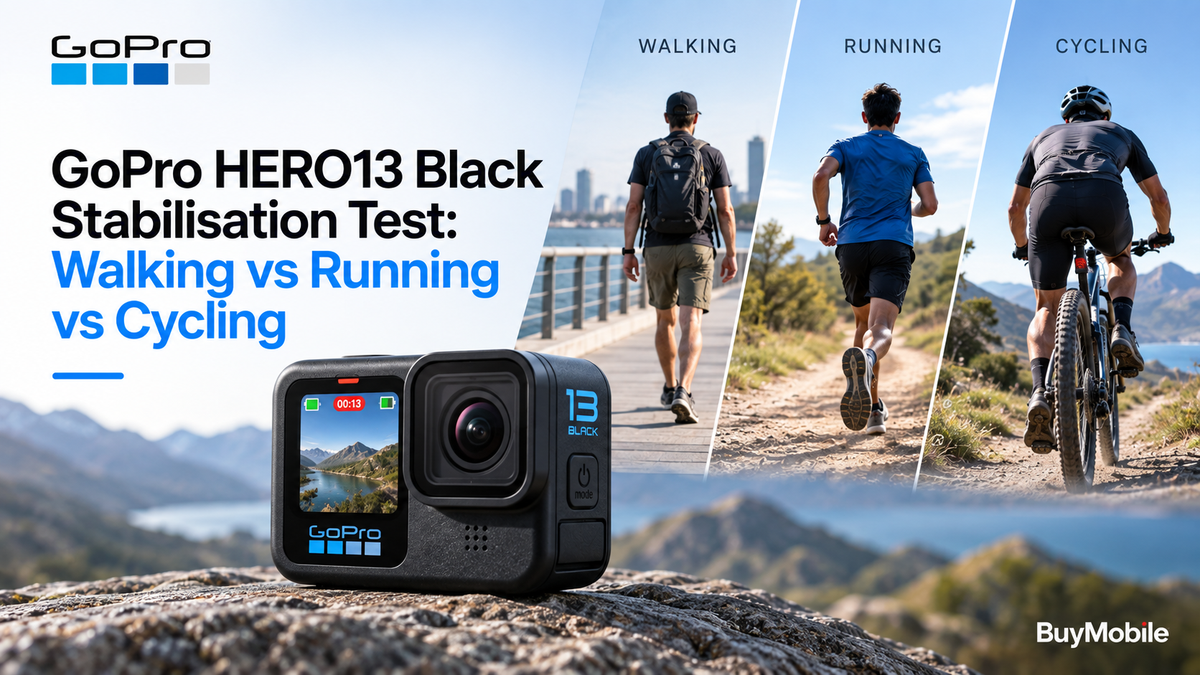
Smooth footage is one of the biggest reasons people buy an action camera. Whether you are walking through a city, running along a trail or cycling down a rough road, unwanted camera movement can quickly make otherwise impressive footage difficult to watch.The GoPro HERO13 Black is built specifically for these situations. It features GoPro's HyperSmooth 6.0 in-camera video stabilisation, designed to reduce the bumps, shakes and sudden movements common in action footage. GoPro describes HyperSmooth 6.0 as its Emmy-winning stabilisation technology, and the HERO13 Black combines it with high-resolution recording options including 5.3K at 60fps.But stabilisation faces very different challenges depending on what you are doing.Walking produces relatively gentle movement. Running introduces repeated vertical impacts. Cycling combines vibration, speed, corners and unpredictable bumps.So how useful is HERO13 Black stabilisation across these three everyday situations?
How Does HyperSmooth 6.0 Work?
Electronic stabilisation essentially gives the camera room to compensate for movement before producing the final frame.Instead of allowing every small movement of your hands or body to appear directly in the video, stabilisation analyses motion and adjusts the image to create smoother footage.The result can make handheld footage look considerably more controlled without requiring a traditional mechanical gimbal.This is particularly useful for an action camera because carrying a gimbal while running, cycling or hiking would often defeat the purpose of having a small rugged camera.The HERO13 Black keeps the stabilisation inside the camera.
Walking: The Easiest Test
Walking is generally the least challenging of these three activities.When holding the HERO13 Black while walking, most movement comes from the natural rise and fall of your body and smaller movements from your hands.HyperSmooth 6.0 is particularly well suited to correcting this type of shake.For travel videos, walking tours and everyday vlogging, the result should generally appear significantly smoother than unstabilised handheld footage.That does not mean your walking technique becomes irrelevant.If you aggressively swing your arm while holding the camera, the video may still contain visible movement. Holding the camera reasonably steadily or using a short grip can give the stabilisation system a cleaner starting point.For casual users, however, there is little need to imitate the careful movements of a professional camera operator.That is precisely the convenience HyperSmooth is intended to provide.
Walking Is Excellent for Travel Videos
Imagine walking through a market, along a beach or around a new city.These situations often involve continuously changing your direction while trying to capture the environment around you.A conventional camera may require careful handling or additional stabilisation equipment.The HERO13 Black is much easier to carry.Its compact design and stabilisation mean you can start recording and concentrate more on the experience rather than constantly thinking about camera shake.This makes walking one of the situations where GoPro stabilisation feels especially practical rather than simply impressive technology.
Running: A Much Harder Challenge
Running creates considerably more movement.Every time your foot hits the ground, an impact travels through your body. Your torso moves vertically and your arms move backwards and forwards.If the camera is handheld, all of those movements can potentially reach it.This is where the difference between basic electronic stabilisation and more advanced action-camera stabilisation becomes noticeable.HyperSmooth 6.0 works to reduce these repeated impacts and make the footage appear much smoother.You should still expect running footage to look more energetic than footage recorded while walking. Stabilisation is not supposed to make every activity look as though the camera were completely stationary.Instead, the goal is to remove distracting shake while retaining the feeling of movement.
Mounting Position Matters When Running
How you mount the HERO13 Black can dramatically change the result.Holding the camera in your hand gives you control over framing, but your arm movements can introduce additional motion.A chest mount creates an immersive point-of-view perspective and leaves your hands free, although it also receives movement directly from your torso.A head-mounted position can provide another immersive perspective, but rapid head movement can influence framing.The best option depends on the video you want to create.For a running vlog, a handheld grip may be more useful.For trail running, a body-mounted perspective can make the footage feel faster and more immersive.Regardless of mounting position, HyperSmooth helps reduce the small rapid movements that would otherwise make action footage uncomfortable to watch.
What About the Horizon?
Camera shake is only part of the stabilisation problem.A tilted horizon can also make footage look unstable.GoPro offers Horizon Lock functionality with compatible shooting configurations and lens options. With the HERO13 Black's Ultra Wide Lens Mod, for example, GoPro says Horizon Lock can keep footage level even when the camera rotates through a full 360 degrees, with stabilised modes available up to 4K60.This can be particularly valuable during activities where the camera changes angle frequently.The viewer sees a more controlled horizon even when the person recording is moving aggressively.
Cycling: Where Stabilisation Gets Serious
Cycling is arguably the most interesting test.A bicycle can transfer continuous vibrations from the road or trail into the camera. Small imperfections in the surface create rapid movements, while larger bumps introduce much stronger shocks.Then there are corners, braking, acceleration and changes in body position.This creates a complicated combination of movement for an action camera to manage.GoPro specifically promotes the HERO13 Black and HyperSmooth 6.0 for riding and powersports, with mounting options including handlebar and seatpost mounts.On a relatively smooth road, stabilisation can make cycling footage appear impressively controlled.Move onto rougher terrain and the challenge becomes significantly greater.
Road Cycling vs Mountain Biking
Not all cycling footage places the same demands on the camera.Road cycling generally produces smaller, faster vibrations from the road surface. Large bumps can still occur, but the overall movement may remain reasonably predictable.Mountain biking is different.Roots, rocks, jumps and uneven trails can create violent and unpredictable camera movement.HyperSmooth can remove a significant amount of distracting shake, but physical mounting remains extremely important.A loose mount can introduce additional vibration that software then has to correct.Making sure the camera is securely attached can therefore improve the final result before electronic stabilisation even begins working.
Does a Wider View Help?
Wide fields of view are extremely useful for action footage.They make it easier to capture the surrounding environment while also giving the footage an immersive feeling.The optional Ultra Wide Lens Mod expands the HERO13 Black's field of view to as much as 177 degrees. GoPro says it is 36 percent wider and 48 percent taller than the standard configurations used for its comparison, while also enhancing HyperSmooth performance.This can be particularly useful for cycling.A wider view can include the handlebars, trail and surrounding landscape simultaneously, creating a stronger sense of speed.It is also useful when running because precise framing becomes less critical.
Walking vs Running vs Cycling: Which Looks Smoothest?
In general, walking provides the easiest conditions for stabilisation.The movements are slower and less aggressive, allowing HyperSmooth to create very controlled-looking footage.Running comes next.The repeated vertical impacts create a tougher challenge, but the HERO13 Black's stabilisation can make footage much more watchable than raw unstabilised video.Cycling varies the most.Smooth-road cycling may look exceptionally stable, while rough mountain-bike trails can create some of the most demanding conditions an action camera encounters.Interestingly, an expert roundup published by GoPro cited testing in both running and cycling situations and praised the smoothness of HyperSmooth 6.0 even through tight turns.The important point is that the camera does not need to make all three activities look identical.Good stabilisation preserves the sensation of action while removing movement that distracts the viewer.
Do You Still Need a Gimbal?
For most casual action-camera users, probably not.A mechanical gimbal can still be useful for particular cinematic movements, especially when deliberately creating extremely controlled camera motion.But it adds weight, complexity and another battery-powered device to carry.That is not ideal when running or cycling.The strength of the HERO13 Black is that useful stabilisation is available inside a tiny action camera.You can mount it to a bike, carry it on a grip or attach it to your body without building a complicated camera rig.
How to Get Smoother HERO13 Black Footage
Even excellent stabilisation benefits from good shooting technique.Make sure mounts are properly tightened before cycling or running. A loose connection creates unnecessary movement.Avoid violently moving a handheld camera when it is not necessary.Use a wide field of view when capturing unpredictable action so you have more room in the frame.Lighting also matters. Very dark environments can make smooth action footage more difficult because cameras need to balance shutter speed and exposure.If you want maximum immersive stabilisation, the Ultra Wide Lens Mod is worth considering. It is designed specifically to expand the field of view while maximising HyperSmooth performance.