



































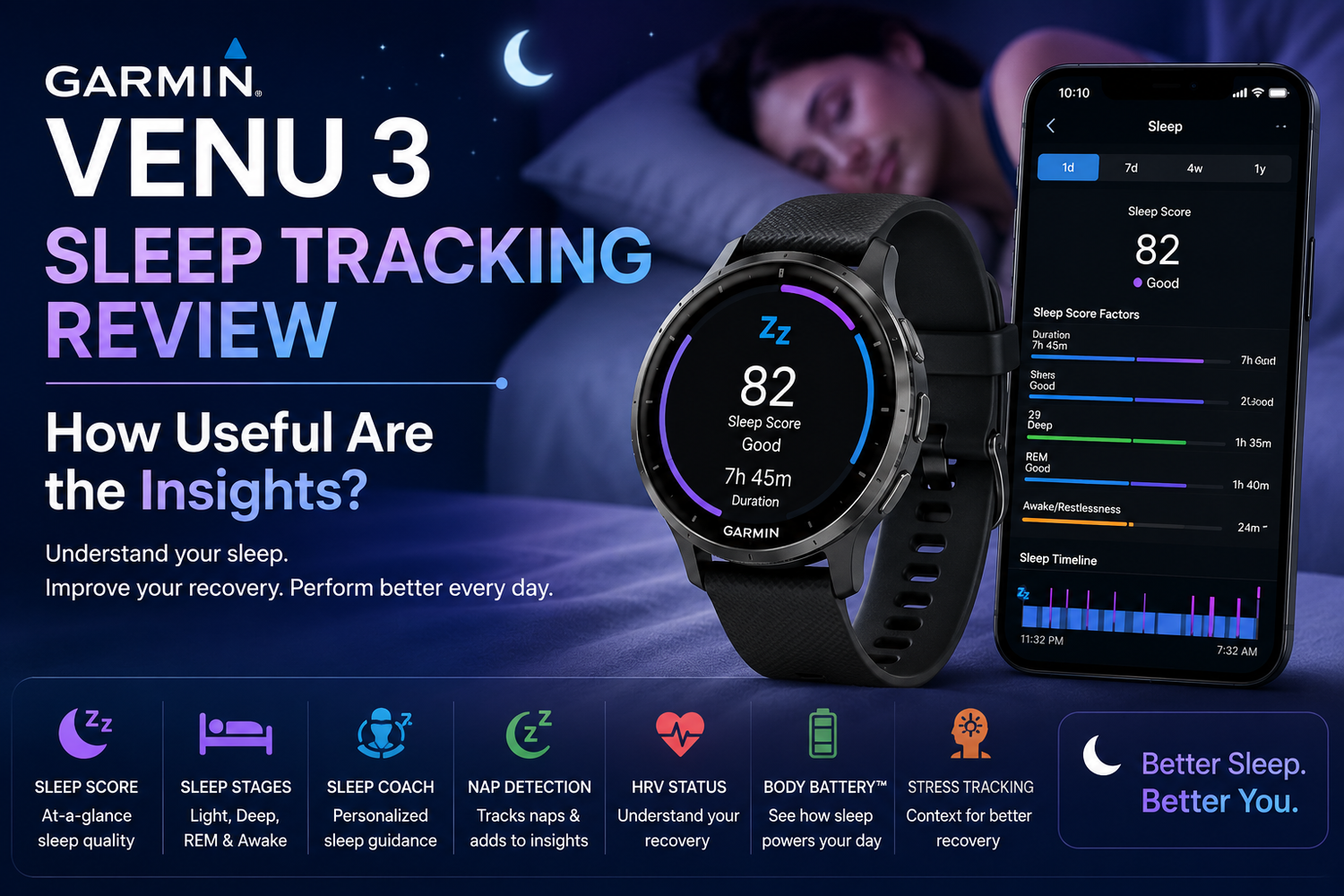
Getting enough sleep is one thing. Understanding the quality of that sleep is another. Modern smartwatches are increasingly designed to provide a clearer picture of what happens overnight, and the Garmin Venu 3 puts sleep and recovery insights at the heart of its health-tracking experience.Instead of simply telling you when you went to bed and woke up, the Venu 3 combines multiple measurements to help you understand your sleep habits, recovery, and overall readiness for the day.But how useful is all that information in everyday life?Here’s a closer look at Garmin Venu 3 sleep tracking and whether its insights can genuinely help you build better habits.
1. Automatic Sleep Tracking Keeps Things Simple
One of the biggest advantages of the Garmin Venu 3 is convenience.You don't need to manually start a sleep-tracking session every night. Wear the watch to bed, and Garmin can automatically monitor your sleep based on information collected by its sensors and algorithms.After waking, you can review your overnight information on the watch and explore more detail through the Garmin Connect app.Automatic tracking matters because sleep monitoring is most useful when it becomes part of your normal routine.If you had to remember to activate a special mode every evening, missing nights would be easy. With automatic tracking, the goal is to make sleep monitoring something that happens quietly in the background.
2. Sleep Stages Provide More Detail
The Venu 3 doesn't simply record a block of time labelled "sleep."Garmin estimates different sleep stages, including light, deep and REM sleep, along with periods when you're awake.These stages can give you a more detailed picture of how your night was structured.Instead of seeing only that you slept for seven hours, for example, you can examine how your estimated sleep stages were distributed throughout that period.It's important to keep expectations realistic.A consumer smartwatch isn't the same as a clinical sleep study. Sleep-stage information should therefore be treated as an estimate rather than a medical measurement.Its greatest value comes from looking at patterns over time rather than becoming concerned about one unusual night.
3. Sleep Score Makes the Data Easier to Understand
Health data can quickly become overwhelming.That's why Garmin's Sleep Score can be particularly useful.Instead of expecting you to interpret every individual measurement, the watch provides a score designed to summarize the quality of your sleep.This gives you a quick indication of how your night went.You can then explore the underlying information if you want to understand why the score was higher or lower.Perhaps you slept for less time than usual. Maybe your night was particularly restless. Looking beyond the score can help you identify factors that may have influenced the result.The score is most valuable as a trend indicator rather than something you need to maximize every single morning.
4. Sleep Coach Adds Practical Context
Collecting data is easy. Turning it into something useful is harder.Garmin's Sleep Coach is designed to help bridge that gap by providing personalized guidance around how much sleep you may need.Recommendations can respond to factors within Garmin's broader health and activity ecosystem.This makes the feature more useful than simply repeating the standard advice that everyone should aim for the same amount of sleep every night.Your needs may vary according to your lifestyle and recent activity.For someone who exercises regularly, seeing sleep as part of the recovery process can be particularly valuable.The goal isn't necessarily to follow every recommendation perfectly. Instead, Sleep Coach can provide another reference point when deciding whether you're consistently giving yourself enough time to recover.
5. Nap Detection Provides a More Complete Picture
Not everyone gets all their sleep in one uninterrupted overnight period.That's why the Venu 3's ability to account for naps can be useful.A short daytime nap might affect how rested you feel later, and ignoring it would leave part of the recovery picture missing.Nap information can feed into Garmin's broader understanding of your rest and recovery.This is particularly relevant for shift workers, frequent travellers, parents, athletes, or anyone whose schedule doesn't always fit a traditional nighttime sleep pattern.As with overnight tracking, automatic nap detection won't necessarily be perfect in every situation. But having naps represented within your daily health data can make the overall picture more meaningful.
6. HRV Status Adds Another Recovery Signal
The Garmin Venu 3 can also use overnight heart rate variability, commonly known as HRV, as part of its broader health insights.HRV describes variations in the time between heartbeats.Rather than focusing on a single number from one night, Garmin's approach is more useful when enough data has been collected to establish your personal baseline.Changes from your normal pattern can be influenced by numerous factors, including training, stress, recovery, sleep, alcohol, illness and lifestyle.HRV shouldn't be interpreted as a diagnosis.Instead, it can provide another piece of context alongside your sleep and activity information.For users interested in fitness and recovery, this combination can be more valuable than looking at sleep duration alone.
7. Body Battery Connects Sleep With Your Day
One of Garmin's most recognizable wellness features is Body Battery.The idea is straightforward: Garmin estimates your available energy throughout the day using information that can include activity, stress, rest and sleep.A good night's sleep will generally give your body more opportunity to recharge, while poor recovery can contribute to a lower energy estimate.This makes sleep information feel more connected to everyday life.Instead of thinking, "I slept badly last night," you can examine how overnight recovery relates to your energy pattern the following day.Over time, this may help you identify behaviours associated with feeling better or worse.
8. Stress Tracking Adds Useful Context
Have you ever slept for what seemed like enough hours but still woken up feeling exhausted?
Sleep duration alone doesn't tell the complete story.Garmin's stress-related measurements can provide additional context about how your body behaved throughout the day and night.If your body appears to remain under elevated stress when it would normally be recovering, that information may help explain why a seemingly long sleep didn't feel particularly restorative.Many factors can influence these readings, so they shouldn't be interpreted too literally.Their value lies in identifying recurring patterns.For example, you might notice differences after late meals, intense evening exercise, travel, stressful workdays, or changes in your normal routine.
9. Garmin Connect Makes Trends Easier to Explore
A smartwatch screen is convenient for checking your morning summary, but the Garmin Connect app is where longer-term information becomes particularly useful.Rather than judging your health based on yesterday alone, you can review trends across longer periods.This is important because sleep naturally varies from night to night.One poor night isn't necessarily meaningful. A repeated pattern of short sleep over several weeks is much more useful informationLooking at trends can help you ask better questions.Are you consistently going to bed too late? Does your sleep appear different after certain activities? Are weekends dramatically different from weekdays?Those are the kinds of insights that can lead to practical changes.
10. Battery Life Helps Make Sleep Tracking Practical
Sleep tracking only works if you're actually wearing the watch overnight.This is where battery life becomes an important part of the experience.A smartwatch that needs frequent overnight charging can create gaps in sleep data.The Venu 3 is designed for multi-day smartwatch use, although actual battery endurance depends on settings and features such as display behaviour, GPS usage, music and other activities.Longer battery intervals make it easier to find convenient charging opportunities during the day rather than automatically putting the watch on a charger every night.That can make continuous sleep and wellness tracking much easier to maintain.
How Useful Are the Sleep Insights?
The Garmin Venu 3's sleep information is most useful when you treat it as guidance rather than a verdict.Don't panic because your Sleep Score suddenly drops one morning. Don't assume that an estimated sleep stage is perfectly accurate down to the minute.Instead, look for patterns.If the watch repeatedly indicates short sleep and you regularly feel tired, you may decide to adjust your bedtime. If certain lifestyle choices repeatedly coincide with poorer recovery, you can experiment with changing them.The data becomes valuable when it encourages better awareness and habits.
Who Will Benefit Most?
The Venu 3's sleep features should appeal to people who want to understand the relationship between sleep, exercise, stress, recovery and daily energy.Fitness enthusiasts may appreciate how overnight information fits into Garmin's wider wellness ecosystem.Busy professionals can use trends to become more aware of inconsistent sleep routines, while casual users may simply appreciate receiving a clear morning summary.Anyone with serious or persistent sleep concerns, however, should remember that smartwatch data isn't a replacement for professional medical assessment.