


































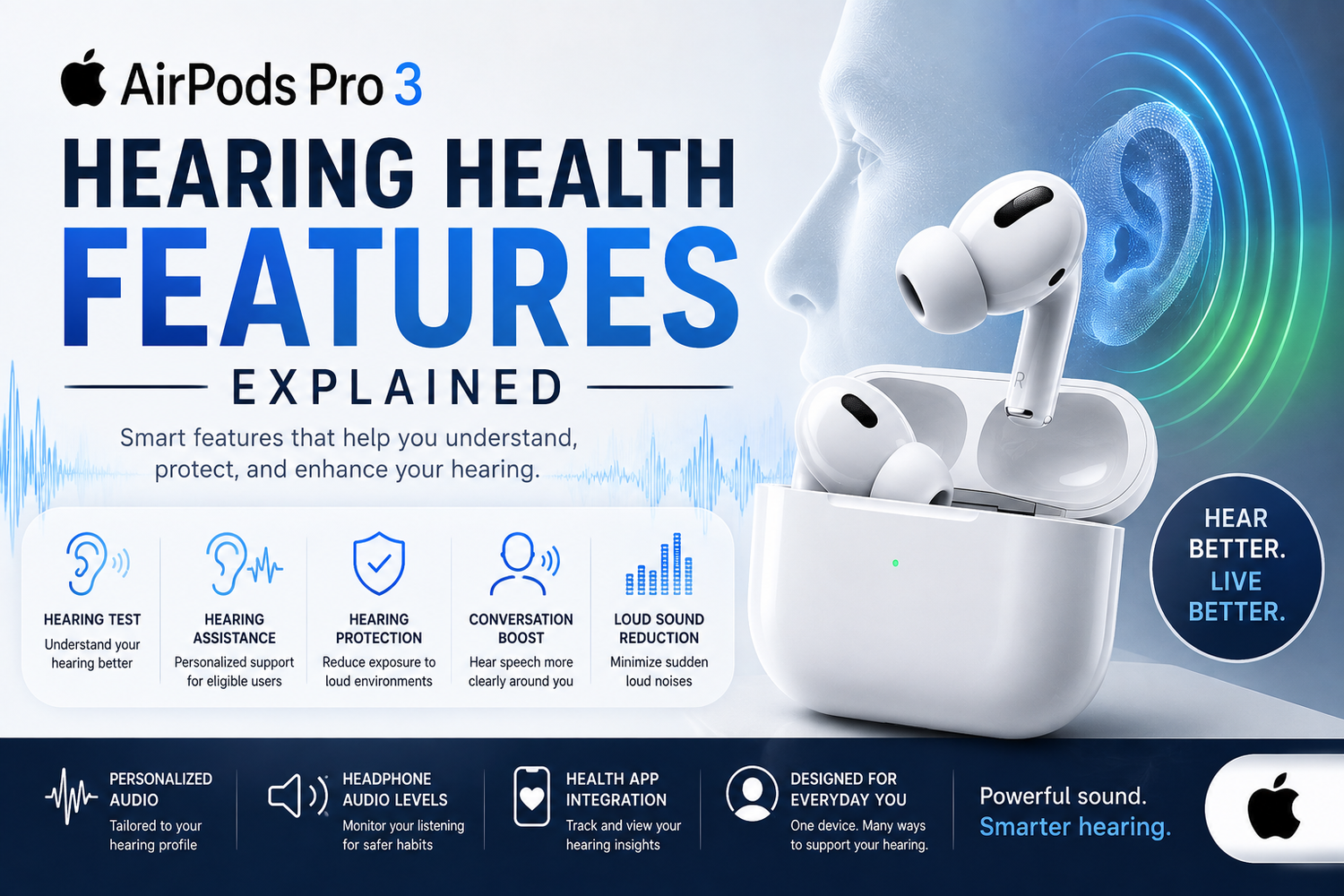
Wireless earbuds are usually judged by sound quality, comfort, battery life, and noise cancellation. With the Apple AirPods Pro 3, however, hearing health has also become an important part of the experience.Apple has expanded AirPods beyond entertainment by offering features designed to help users understand their hearing, reduce exposure to excessively loud environments, and, where supported, receive assistance for certain levels of hearing loss.These capabilities make the AirPods Pro 3 more than a pair of premium earbuds. But what exactly do the hearing-health features do, and who can benefit from them?Here's a closer look at the Apple AirPods Pro 3 hearing health features and what you should know before using them.
1. Hearing Test Helps You Understand Your Hearing
One of the most significant hearing-health capabilities available with compatible AirPods is Apple's Hearing Test.The feature is designed to provide insight into your hearing from the convenience of compatible Apple devices and AirPods.During the test, users respond to a series of tones at different frequencies and volume levels. The results can provide information about hearing ability in each ear.This can be useful for people who have wondered whether their hearing has changed but haven't previously taken a hearing test.The convenience is a major advantage. Instead of hearing health being something people think about only during an appointment, compatible AirPods can make it easier to engage with hearing information.However, availability and requirements vary by country or region, and an AirPods-based test shouldn't be treated as a substitute for professional medical evaluation when you have hearing concerns.
2. Hearing Aid Functionality Can Assist Eligible Users
Another major feature is Apple's hearing assistance functionality.For eligible adults with perceived mild to moderate hearing loss, compatible AirPods can provide a hearing-aid experience where the feature has received the necessary regulatory authorization and is available.The system can use hearing information to personalize amplification.Rather than simply making every sound louder, hearing assistance is intended to improve the user's ability to hear sounds according to their individual needs.This represents an important change in what people may expect from consumer earbuds.Someone could potentially use the same AirPods for listening to music, taking calls, watching movies, and receiving hearing assistance.However, users should pay careful attention to eligibility requirements, regional availability, setup instructions, and Apple's health-related guidance.
3. Hearing Protection Helps Reduce Exposure to Loud Sounds
Hearing health isn't only about identifying hearing loss. Prevention is also important.Repeated exposure to excessively loud environments can potentially damage hearing over time.AirPods Pro include features designed to help reduce the impact of loud environmental noise while maintaining awareness of what's happening around you.This can be useful in situations such as busy urban environments, sporting events, concerts, commuting, or other noisy locations.The goal isn't necessarily to create complete silence.Instead, hearing-protection functionality can help reduce exposure to certain loud sounds while allowing users to continue interacting with their surroundings.It's an example of how the AirPods' microphones and audio-processing technology can serve a purpose beyond music playback.
4. Loud Sound Reduction Works in Everyday Environments
Transparency-style listening is useful because it allows outside sound to reach your ears while you're wearing AirPods.But some environmental sounds can suddenly become uncomfortable.Apple's audio processing can reduce certain loud noises while maintaining a more natural sense of your surroundings.Imagine walking near heavy traffic or being somewhere with sudden bursts of loud noise. Rather than removing all environmental audio, the system can manage certain high-level sounds.This is particularly useful for people who like wearing AirPods throughout the day but don't always want full Active Noise Cancellation.It creates a middle ground between complete isolation and completely unfiltered environmental sound.
5. Conversation Boost Can Make Speech Easier to Hear
Following a conversation in a noisy environment can sometimes be difficult.Conversation Boost is designed to help compatible AirPods focus on a person speaking in front of you.This can make face-to-face speech easier to hear in certain situations.Restaurants, cafés, family gatherings, and other environments often contain competing background sounds. Improving the prominence of nearby speech can make conversations more comfortable for some users.It's also a useful example of how directional microphones and computational audio can improve everyday communication.Conversation Boost isn't something every AirPods owner will need, but for users who find speech difficult to follow in busy environments, it can be a valuable accessibility feature.
6. Personalized Hearing Settings Improve the Experience
Hearing isn't identical from person to person.That's why personalization is an important part of Apple's approach.Compatible hearing features can use hearing-related information to tailor the listening experience to the individual.Personalization can affect how certain frequencies and sounds are presented, potentially making speech, entertainment, and environmental audio clearer for users who benefit from those adjustments.This is particularly relevant because hearing changes aren't always uniform across frequencies.A personalized approach can therefore be more useful than simply increasing overall volume.Users should follow Apple's setup instructions carefully to ensure that supported hearing features are configured correctly.
7. The Health App Can Keep Hearing Information Organized
Apple's broader Health ecosystem provides a place for users to review supported hearing information.Keeping health-related data in one organized location can make it easier to understand changes over time.This is useful because hearing health isn't necessarily something you evaluate once and then forget.Repeated information may help users become more aware of their listening habits and hearing.Apple's integration between compatible AirPods, iPhone, and the Health app is therefore an important part of the overall experience.It's not just about what the earbuds can do while they're in your ears. It's also about making relevant information easier to access afterward.
8. Headphone Audio Levels Can Encourage Safer Listening
Many people listen to music at higher volumes than they realize.An iPhone can provide information about headphone audio exposure and help users understand whether their listening levels may be too high.This becomes particularly useful when combined with AirPods because the system can provide greater awareness of listening habits.If you frequently increase the volume while commuting or exercising, monitoring headphone audio levels can encourage healthier behaviour.The simplest hearing-health feature may ultimately be one of the most valuable: helping users become more conscious of how loudly and how long they listen.Reducing unnecessary exposure today could help protect hearing in the future.
9. Noise Cancellation Can Help You Avoid Excessive Volume
Active Noise Cancellation is usually marketed as a convenience feature, but it can also influence listening behaviour.In a noisy environment, people often turn up their music simply to hear it over the background sound.Effective noise cancellation reduces surrounding noise, meaning you may be able to enjoy content clearly without pushing the volume as high.That doesn't automatically make every listening session safe—you still need to manage volume responsibly.But reducing competition from external noise can make comfortable listening at lower levels easier.For commuters and frequent travellers, this can be an overlooked advantage of good ANC.
10. Hearing Features Fit Naturally Into Everyday Earbuds
Perhaps the most interesting thing about Apple's hearing-health strategy is that these features exist inside a product people already use every day.There's no need to carry a separate consumer device simply to access many of these capabilities.You can listen to Apple Music in the morning, take a work call later, use noise cancellation on your commute, and access supported hearing features using the same pair of earbuds.That convenience may encourage more people to pay attention to their hearing.It also demonstrates how wearables are increasingly becoming part of broader personal health technology rather than remaining simple entertainment accessories.
Important Limitations to Understand
AirPods Pro 3 hearing-health features shouldn't be viewed as universal replacements for professional hearing care.Some functionality is intended only for eligible users, and feature availability varies according to country, region, device compatibility, software version, age, and regulatory approval.If you experience sudden hearing loss, persistent ringing, pain, dizziness, discharge, or another significant change in hearing, seeking appropriate medical care is more important than relying on an earbud-based feature.Similarly, people with known hearing conditions should follow guidance from qualified healthcare professionals.Apple's tools can provide useful information and assistance, but understanding their intended purpose and limitations is essential.