


































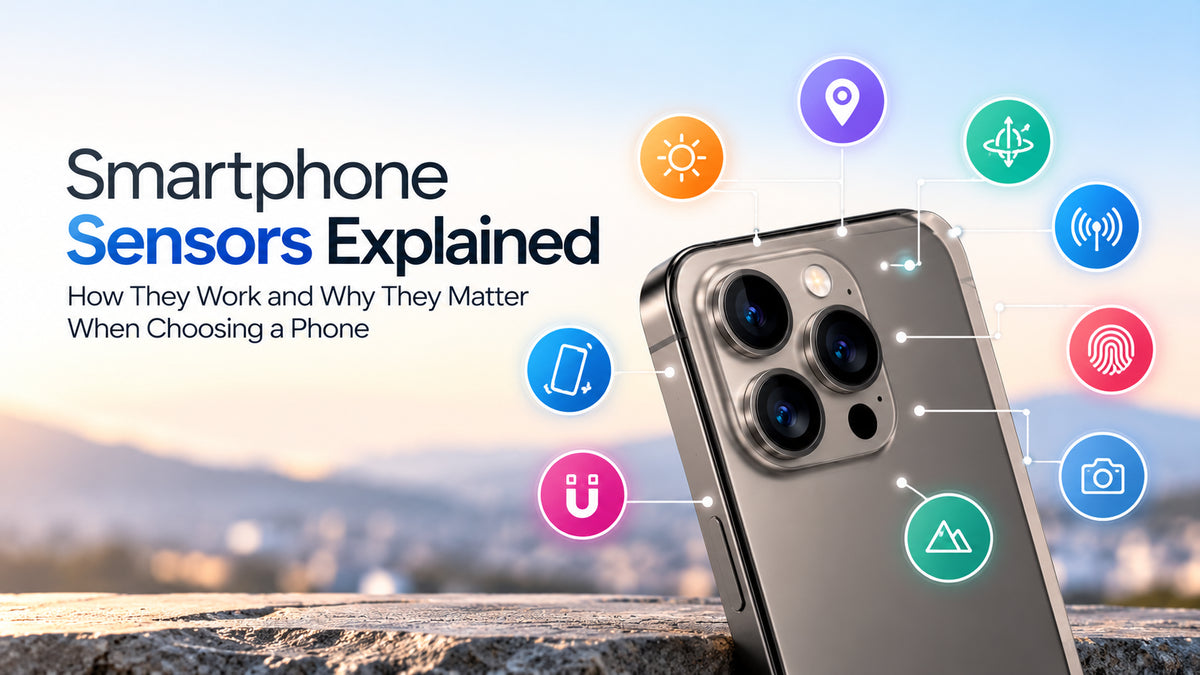
Modern smartphones do much more than make calls, send messages and take photographs. They can track movement, recognise faces, adjust screen brightness, provide navigation and monitor physical activity. Many of these features are powered by small components called smartphone sensors.Although sensors are rarely the first specifications buyers consider, they play an important role in everyday smartphone performance.Understanding how smartphone sensors work can help you choose a device that offers better navigation, photography, gaming, security and convenience.
What Are Smartphone Sensors?
Smartphone sensors are electronic components that detect changes in the surrounding environment or the device itself.They measure information such as movement, orientation, light, distance, pressure and magnetic fields.The smartphone's operating system processes this information to perform specific actions automatically.For example, a proximity sensor detects when you hold your phone near your ear, while an accelerometer helps determine whether the device is moving.Different smartphones include different sensor combinations, depending on their price, design and intended features.
1. Accelerometer: Detecting Movement and Orientation
An accelerometer measures acceleration along multiple axes, allowing a smartphone to detect movement and changes in orientation.One of its most familiar uses is automatic screen rotation.When you turn your phone sideways, the accelerometer helps the operating system recognise the movement and adjust the display.It also supports step counting, fitness applications and motion-controlled games.Some camera applications use accelerometer data to improve orientation detection.Why it matters: A responsive accelerometer improves everyday usability, fitness tracking and gaming experiences.
2. Gyroscope: Improving Motion Tracking
A gyroscope measures rotational movement and helps determine how a smartphone turns or tilts.It works alongside the accelerometer to provide more accurate motion tracking.Gyroscopes are particularly useful in mobile gaming, augmented reality and camera stabilisation.For example, compatible shooting games allow players to aim by physically moving their phones.Augmented reality applications also use gyroscope information to position virtual objects more accurately.In photography, motion data can assist electronic image stabilisation.Why it matters: Gamers, content creators and augmented reality users should consider phones with reliable gyroscope performance.
3. Proximity Sensor: Preventing Accidental Touches
A proximity sensor detects when an object is close to the smartphone.Its most common function is turning off the screen during phone calls.When you hold your phone against your ear, the sensor helps prevent accidental touches that might interrupt the call.Some smartphones use dedicated optical proximity sensors, while others rely on virtual proximity detection using additional hardware and software.Virtual solutions can behave differently depending on device design and calibration.Why it matters: Reliable proximity detection is especially important for people who make frequent voice calls.
4. Ambient Light Sensor: Automatic Brightness Adjustment
An ambient light sensor measures the amount of light surrounding the smartphone.The operating system uses this information to adjust display brightness automatically.In bright outdoor conditions, the screen can become brighter for improved visibility.In darker environments, brightness can decrease to improve viewing comfort and reduce unnecessary power consumption.Some premium smartphones use advanced light sensors to improve colour and brightness adjustments.Why it matters: Accurate automatic brightness helps improve screen comfort and can contribute to better battery efficiency.
5. Magnetometer: Supporting Digital Compass Features
A magnetometer measures magnetic fields and helps determine the smartphone's orientation relative to Earth's magnetic field.It is commonly used in digital compass applications.Navigation applications can combine magnetometer information with GPS and motion sensors to estimate the direction you are facing.This is particularly helpful when walking through unfamiliar streets or following map directions.However, nearby metal objects and electronic equipment can interfere with magnetic readings.Why it matters: A reliable magnetometer improves compass functionality and orientation-based navigation.
6. Barometer: Measuring Air Pressure
A barometer measures atmospheric pressure.Some smartphones use this information to estimate changes in altitude.For example, a barometer may help fitness applications identify elevation changes while hiking or climbing stairs.It can also support location systems by providing additional altitude-related information.However, atmospheric pressure changes with weather conditions, so barometer readings are not always exact altitude measurements.Not every smartphone includes a dedicated barometer.Why it matters: Outdoor enthusiasts and hikers may benefit from smartphones equipped with barometric pressure sensors.
7. Fingerprint Sensor: Improving Smartphone Security
Fingerprint sensors recognise distinctive patterns on a user's finger.They are commonly used to unlock smartphones, authorise payments and access protected applications.There are several fingerprint sensor technologies.Capacitive sensors detect electrical differences across the fingerprint surface.Optical sensors capture an image of the fingerprint, while ultrasonic sensors use sound waves to create a detailed representation.Each technology has advantages and limitations involving speed, placement and reliability.Why it matters: Buyers should consider fingerprint recognition speed, accuracy and convenience when comparing smartphones.
8. Camera Sensors: Capturing Photos and Videos
Camera sensors convert incoming light into electrical signals that are processed into digital images.They are among the most important sensors for smartphone photography.Common smartphone camera sensors use CMOS technology.Image quality depends on several factors, including sensor size, pixel characteristics, lens quality and image processing.Larger sensors can generally collect more light under comparable conditions, helping improve low-light photography.However, a higher megapixel count does not automatically guarantee better photographs.Computational photography also plays a major role in modern smartphone cameras.Why it matters: Photography enthusiasts should compare real camera results rather than focusing only on megapixel specifications.
9. GPS and GNSS: Understanding Location Technology
GPS is often discussed alongside smartphone sensors, although it is technically a satellite navigation system rather than a conventional environmental sensor.Smartphones use GNSS receivers to process signals from satellite systems such as GPS, Galileo, GLONASS and BeiDou.These signals help determine geographic location.Location services may also combine satellite data with Wi-Fi, cellular networks and motion sensors.This improves positioning in certain environments.Dual-frequency GNSS support can improve positioning accuracy under suitable conditions.Why it matters: Travellers, delivery professionals and navigation users should consider location accuracy and supported satellite technologies.
10. Advanced Sensors: LiDAR and Depth Detection
Some premium smartphones include advanced depth-sensing technology.LiDAR measures distance using reflected light and helps create spatial information about surrounding objects.It can improve certain augmented reality experiences, room-scanning applications and depth-related camera functions.Other smartphones use time-of-flight sensors or alternative depth-detection methods.However, these technologies are not essential for every user.Why it matters: Advanced depth sensors are most useful for specialised photography, augmented reality and spatial measurement applications.