



































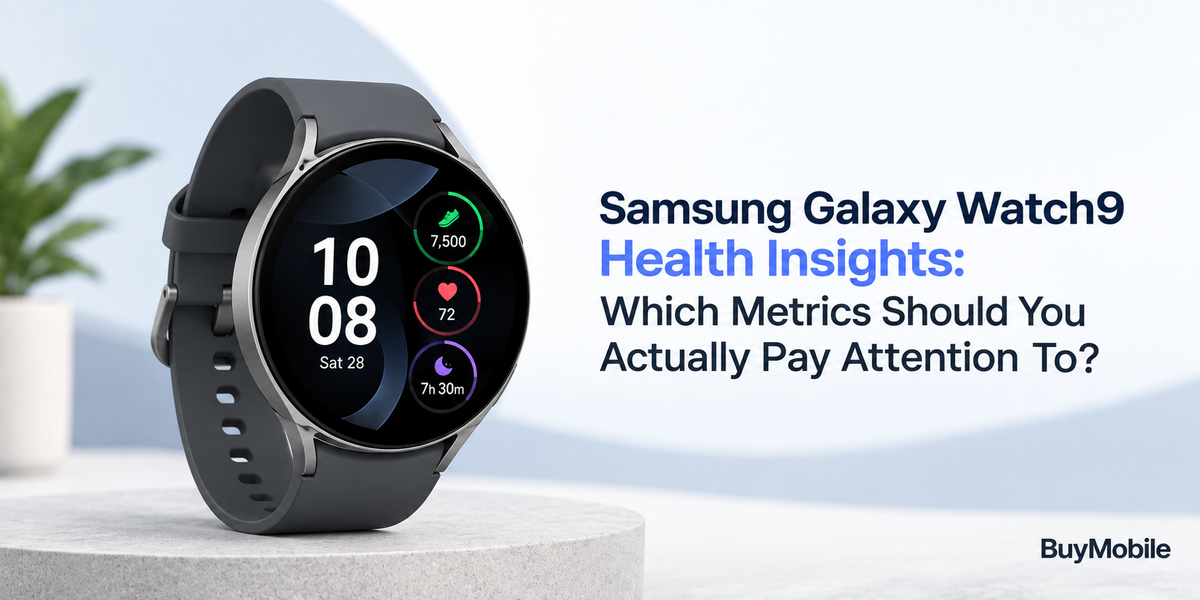
Smartwatches can collect an enormous amount of health and fitness information. Heart rate, sleep, activity, stress, recovery and workout statistics can quickly fill your screen with numbers. The Samsung Galaxy Watch9 continues Samsung's health focused approach, but having more data does not automatically make that data useful.The real value comes from understanding which Samsung Galaxy Watch9 health insights deserve regular attention and which should simply provide additional context. For most everyday users, tracking long term patterns is more useful than worrying about every individual reading.So which metrics should you actually pay attention to?
Should You Monitor Your Daily Heart Rate?
Heart rate is one of the most useful smartwatch measurements because it provides context for both everyday activity and exercise.Instead of concentrating on a single reading, look at your broader heart rate trends. Your resting heart rate can be particularly interesting because it shows how your heart behaves when you are relatively inactive.During workouts, heart rate information can help you understand exercise intensity. A relaxed walk should generally produce a different response from a demanding run or cycling session.Over time, these patterns can help you better understand how your body responds to different activities.However, a smartwatch is not a replacement for professional medical assessment. Unexpected or concerning readings should be discussed with an appropriate healthcare professional rather than diagnosed from the watch alone.
How Important Is Sleep Tracking?
Sleep may be one of the most practical Samsung Galaxy Watch9 health metrics for everyday users.People often know when they slept badly, but they may not recognise patterns affecting their routine. Wearing the watch consistently can help build a broader picture of sleep duration and overnight trends.The important number is not necessarily one night's sleep score.Look at several nights together.If your sleep duration repeatedly becomes shorter during busy workdays, for example, that pattern may be more useful than whether Tuesday's score was slightly higher than Wednesday's.Sleep tracking becomes most valuable when it encourages better habits rather than turning sleep into another competition.
Should You Pay Attention to Energy and Readiness Insights?
Samsung's recent Galaxy Watch generations have increasingly combined different health signals into simplified daily insights such as Energy Score. If similar health and readiness tools are available on your Galaxy Watch9 configuration, they can provide a convenient overview.The idea is simple.Rather than making you independently interpret several measurements, the software combines relevant information to provide a broader picture of your condition.This can be useful when deciding whether today feels appropriate for a demanding workout or whether a lighter session might suit you better.However, readiness style scores should not completely control your schedule.How you actually feel still matters. If a watch suggests you are ready for an intense workout but you feel unusually tired, the number should not override common sense.Treat these insights as additional information rather than instructions.
Does Stress Tracking Really Matter?
Stress tracking can be useful when viewed as a pattern.A single elevated stress reading does not necessarily tell you very much. You may have been rushing to catch a train, concentrating on work or simply moving around.Repeated patterns are more interesting.If stress indicators consistently rise during certain parts of the day, the Galaxy Watch9 may help you recognise routines that deserve attention.Perhaps work meetings are consistently associated with higher readings. Maybe you rarely take breaks during the afternoon.The watch cannot explain why something is happening, but it can encourage you to notice patterns you might otherwise overlook.
Are Daily Steps Still Worth Tracking?
Steps may seem basic compared with sophisticated smartwatch health insights, but simplicity is exactly why they remain useful.A daily step count provides an easy way to see how active you have been.Someone working at a desk can quickly discover how little movement occurs during a typical office day. That awareness can encourage small behavioural changes such as taking a lunchtime walk or choosing stairs more frequently.There is no need to become obsessed with reaching exactly the same target every day.The more useful goal is consistency.If your average activity gradually increases over several weeks, that trend can be more meaningful than whether you hit a specific number on one particular day.
How Useful Are Workout Metrics?
Workout data becomes increasingly useful when you exercise regularly.The Galaxy Watch9 can help users review metrics associated with activities such as walking, running, cycling and gym sessions, depending on the supported workout mode.Heart rate, duration, pace and other activity specific measurements can show how your performance changes over time.For runners, comparing similar routes can be particularly informative. If you can maintain a similar pace with a different heart rate response over time, the information may provide useful context around your training.The key is comparing similar activities rather than treating every workout as directly comparable.A difficult hill run and a relaxed flat run naturally produce different results.
Should You Track Calories Burned?
Calories burned can be useful as an estimate, but they should be interpreted cautiously.Smartwatches calculate calorie expenditure using sensor information alongside personal data and algorithms. The result is not the same as directly measuring exactly how much energy your body has used.For everyday fitness, calorie estimates can still provide useful context.They may help you compare the relative demands of different workouts or understand how activity contributes to your overall routine.Problems arise when users treat estimated calories as perfectly precise.It is better to think of calorie information as another trend rather than an exact accounting system.
What About Body Composition?
Samsung's Galaxy Watch family has offered body composition measurements that can provide estimates related to areas such as body fat and skeletal muscle.If body composition tools are available on your Galaxy Watch9, consistency is especially important.Measurements can vary depending on hydration, time of day and other factors. Comparing readings taken under very different conditions can therefore create unnecessary confusion.Taking measurements under similar conditions can make long term trends easier to interpret.Again, the direction of change may be more informative than focusing on a tiny difference between two individual readings.
How Important Is GPS Data?
GPS is primarily considered a fitness feature, but it can add useful context to your health and activity information.For outdoor running, walking and cycling, GPS allows the watch to record distance, route and pace information.This makes it easier to understand how your fitness changes on familiar routes.Instead of simply knowing that you exercised for 30 minutes, you can see how far you travelled and how your pace changed.For runners and cyclists, this can make GPS one of the most useful Galaxy Watch9 fitness metrics.For someone whose exercise mostly happens indoors, it will naturally matter much less.
Which Health Metric Matters Most?
There is no single answer because different users have different goals.Someone trying to become more active may benefit most from steps and activity trends. A runner may care more about heart rate, pace and GPS. Someone trying to improve their routine may find sleep information particularly valuable.The mistake is assuming that every metric deserves equal attention.Choose a small number that relate directly to your goals.That makes the information easier to understand and prevents the Samsung Galaxy Watch9 from becoming a screen full of numbers you never actually use.
Frequently Asked Questions
Should I check my Galaxy Watch9 health data every day?
You can, but long term trends are generally more useful than constantly analysing individual readings. Weekly patterns can provide better context.
Is sleep score the most important sleep metric?
Not necessarily. Sleep duration, consistency and broader trends can be just as useful as a single overall score.
Are smartwatch calorie estimates exact?
No. They should be treated as estimates rather than precise measurements of energy expenditure.
Can the Galaxy Watch9 replace medical equipment?
No. Smartwatch health information can support general wellness awareness but should not replace professional medical evaluation, diagnosis or treatment.
Which metrics should beginners focus on?
For many beginners, daily activity, heart rate trends, sleep and regular workout tracking provide a manageable starting point.