


































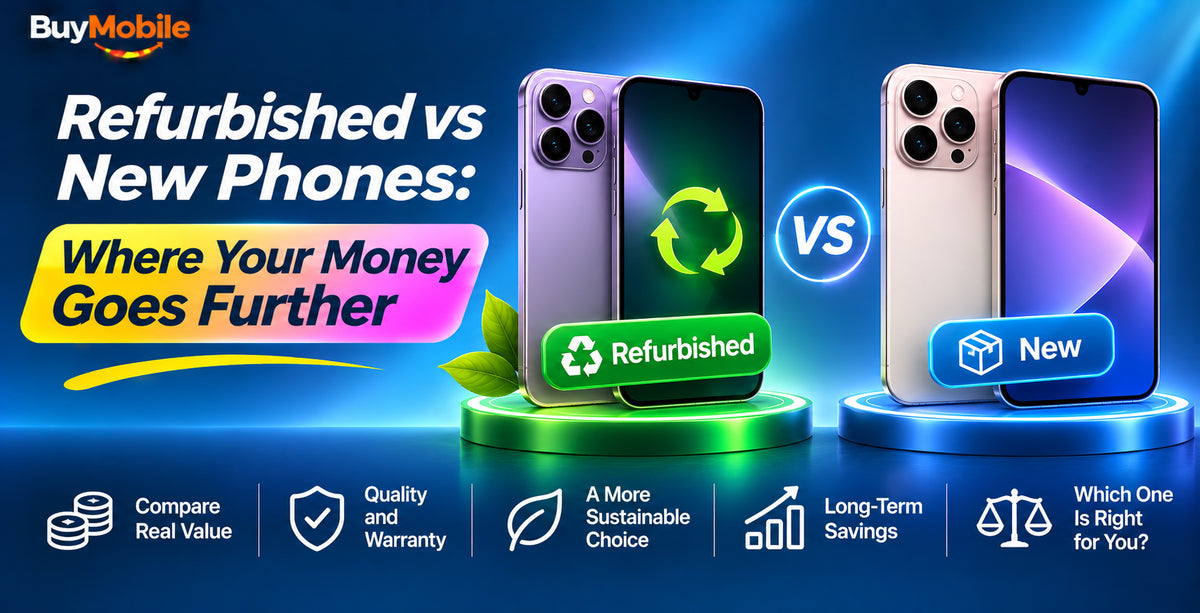
Choosing between a refurbished vs new phone comes down to one question: where does each dollar actually go? A refurbished phone buys you a higher-end model for less money, while a new phone buys you certainty, a fresh battery and the full software support window. Neither is automatically the smarter buy.
In this guide we break down the real costs, the hidden risks and the situations where each option makes sense for Australian buyers. We also look at a third path many people overlook: buying a brand-new, last-generation flagship.
What "Refurbished" Really Means
Refurbished is not a single standard. The term can cover anything from a factory-restored handset with a new battery and housing to a used phone that has simply been wiped and cleaned. Most sellers use a grading system, but grades are not regulated and vary between businesses.
- Manufacturer refurbished: restored by the brand itself, usually with genuine parts and a fresh battery.
- Seller refurbished: tested and repaired by a third party, with parts and standards that depend on the business.
- Cosmetic grades: labels like "Excellent", "Good" or "Fair" usually describe scratches and scuffs, not battery health.
Before buying, ask exactly what was tested, what was replaced and whether the battery health is guaranteed above a certain level.
Where Your Money Goes With a New Phone
When you buy new, part of the price pays for things you can't see in the box but will benefit from for years.
- A battery at 100% health. Lithium-ion cells wear with every charge cycle, so a new battery gives you the longest possible useful life.
- The full update window. Software support is counted from the model's launch, not from your purchase date. A newer phone simply has more years of updates ahead of it.
- Known history. No previous drops, water exposure or third-party repairs.
- Warranty. BuyMobile phones come with a one-year Australian seller warranty, and the Australian Consumer Law gives you consumer guarantees on top of that.
Where Your Money Goes With a Refurbished Phone
The appeal of refurbished is obvious: a premium phone at a mid-range price. For many people that is a great deal, but it pays to know what you are trading.
- Older hardware: you are usually buying a model that is one to three years old, with fewer years of updates left.
- Battery uncertainty: unless the battery has been replaced, capacity may already be reduced.
- Parts questions: non-genuine screens or batteries can affect brightness, touch response or features like water resistance.
- Shorter warranties: cover can be shorter than on a new device, so check the terms.
Refurbished vs New: A Quick Comparison
| Factor | New phone | Refurbished phone |
|---|---|---|
| Upfront cost | Higher | Lower for the same model |
| Battery health | 100% | Varies, check the guarantee |
| Update years remaining | Full window | Reduced by the phone's age |
| Condition | Sealed, no history | Graded, history often unknown |
| Water resistance | As rated | May be compromised after repair |
The Middle Ground: New Last-Generation Flagships
Here is the option many shoppers skip. When a new flagship launches, the previous model often stays available brand new, usually for less than it launched at. You get a sealed phone, a fresh battery and full warranty, with flagship cameras and performance that are still excellent.
The Samsung Galaxy S25 Ultra and Apple iPhone 17 Pro Max are good examples. Both are a generation behind the newest models, yet both still have years of software support ahead and none of the unknowns of a second-hand device.
When a New Mid-Range Phone Beats a Refurbished Flagship
A three-year-old flagship can still feel quick, but a current mid-ranger may outlast it. Modern mid-range phones offer large batteries, 120Hz screens, IP-rated bodies and long update promises. The Samsung Galaxy A37 and Google Pixel 10a are new phones built to last several years, which often makes them better long-term value than an ageing refurbished flagship.
If budget is the main driver, browse our range of cheap phones before settling on a refurbished unit.
How to Decide
- Work out how long you'll keep it. If it's four years or more, the extra update years on a new phone matter a lot.
- Compare like for like. Put a refurbished price next to a new last-generation model and a new mid-ranger.
- Check the battery promise. A cheap refurbished phone that needs a battery replacement soon is no longer cheap.
- Confirm network support. With 3G switched off in Australia, any phone needs VoLTE and the right 4G and 5G bands for your carrier.
FAQ
Is a refurbished phone the same as a used phone?
Not always. Refurbished should mean tested and restored, but standards vary. Ask what was actually done.
Do refurbished phones get software updates?
Yes, until the manufacturer's support window for that model ends. That date is based on launch, not purchase.
Are new phones always better value?
No. If you upgrade every year or two, a quality refurbished phone can be very sensible. For long-term ownership, new usually wins.
Conclusion
Refurbished phones stretch your budget further on day one, while new phones stretch it further over the years. For most Australians planning to keep a phone for a long time, a new mid-range model or a new last-generation flagship offers the best balance of price, battery life and peace of mind.
Shop at BuyMobile: Samsung Galaxy A37 | Samsung Galaxy S25 Ultra | Cheap Phones