



































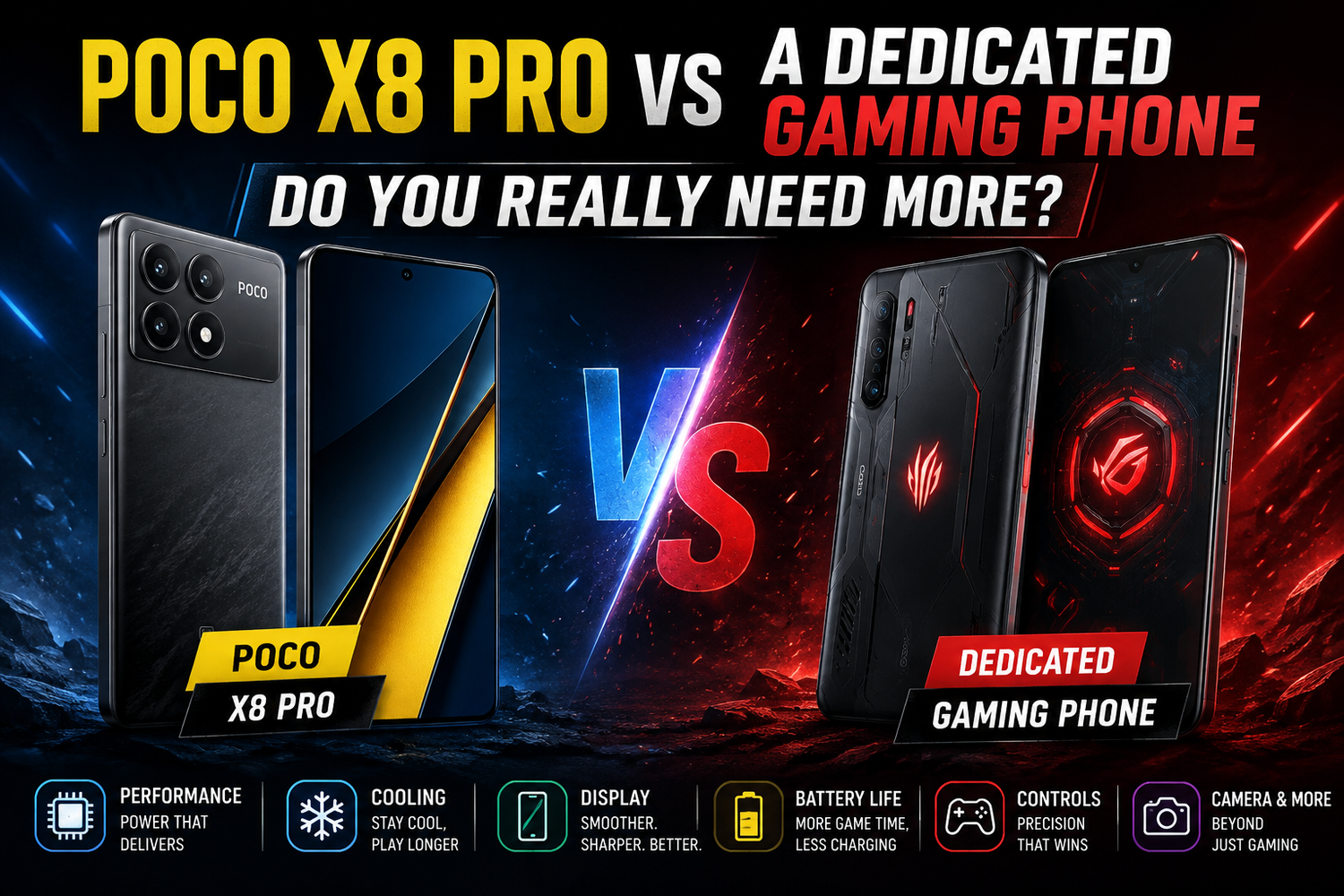
Mobile gaming has reached a point where you no longer need a console or gaming PC to enjoy visually impressive games. Titles such as PUBG Mobile, Call of Duty Mobile and Genshin Impact can demand serious processing power, making smartphone performance increasingly important for gamers.That creates an interesting buying decision. Should you choose a performance-focused mainstream phone such as the Xiaomi POCO X8 Pro, or spend more on a dedicated gaming phone designed specifically for long gaming sessions?Gaming phones can offer specialized cooling, shoulder triggers, aggressive performance modes and other enthusiast features. But those extras aren't necessarily essential for everyone.If the POCO X8 Pro delivers the performance you need while remaining practical as an everyday smartphone, do you really need more?
POCO's Performance-First Philosophy
POCO has traditionally appealed to buyers looking for strong performance without paying the prices associated with ultra-premium smartphones.That philosophy makes the POCO X8 Pro particularly relevant to gamers.For most players, the important questions aren't about having the most powerful smartphone available. They are much more practical:Can the phone maintain smooth gameplay? Does it stay responsive during longer sessions? Does the battery last? Is the display enjoyable? And can it handle demanding games without becoming uncomfortable?If the answer to those questions is yes, paying significantly more for a specialized gaming phone may provide diminishing returns.
What Makes a Dedicated Gaming Phone Different?
Gaming phones aren't simply ordinary smartphones with faster processors.Models from gaming-focused ranges may include features such as advanced cooling systems, gaming modes, high-refresh-rate displays, touch-sensitive shoulder controls, larger batteries and software designed to prioritize performance.Some devices also support external cooling fans or other gaming accessories.These features can make a genuine difference for competitive players.Physical or touch-based shoulder controls, for example, can provide additional inputs in shooting games. Advanced cooling can help maintain performance during long sessions, while gaming software may let players customize touch sensitivity and manage notifications.The question isn't whether these features are useful.It's whether you'll use them enough to justify buying a phone built around them.
Performance: Peak Speed Isn't Everything
Processor specifications attract plenty of attention when comparing gaming smartphones, but peak benchmark scores only tell part of the story.Sustained performance matters more during actual gaming.A smartphone might deliver impressive results during a short benchmark but reduce performance after extended gaming because of heat. This process, commonly called thermal throttling, helps protect internal components.That's why the POCO X8 Pro should ultimately be judged through long gaming sessions rather than specification sheets alone.For casual and moderately serious gamers, consistently smooth performance at sensible graphics settings can be far more valuable than achieving the highest possible benchmark number.Dedicated gaming phones may have an advantage when workloads continue for extended periods because their cooling systems are designed with that scenario in mind.But if you usually play for 20 or 30 minutes at a time, that advantage may matter considerably less.
Cooling Is Where Gaming Phones Can Pull Ahead
Heat is one of the biggest challenges facing powerful smartphones.Games push the processor and graphics hardware hard, generating heat inside a very compact device.Gaming phones can devote more internal space to cooling because gaming performance is central to their design. Some even use active cooling accessories to move heat away from the phone.A mainstream performance device such as the POCO X8 Pro has different priorities.It needs to balance cooling with weight, thickness, cameras, battery capacity and everyday comfort.For most users, that's probably the better compromise. But competitive players who regularly spend hours gaming may appreciate the additional thermal headroom available from specialized hardware.If sustained gaming is your priority, independent thermal and frame-rate testing should be more important than marketing claims.
Display: More Than Refresh Rate
A good gaming display needs more than a high refresh-rate number.Touch responsiveness, brightness, colour quality and consistent frame delivery all affect the experience.A responsive display can make fast-paced shooters feel more immediate, while good brightness helps when gaming in well-lit environments.Dedicated gaming phones may offer extremely high refresh rates or enhanced touch-sampling capabilities aimed specifically at competitive players.But there's an important catch.A 165Hz display doesn't automatically mean every game will run at 165 frames per second. Game support, processor performance, software configuration and thermal conditions all influence what you'll actually experience.For mainstream gaming, a high-quality, responsive screen may be more useful than chasing the biggest number available.
Gaming Controls: Do You Need Shoulder Triggers?
This is one area where a dedicated gaming phone can provide an experience the POCO X8 Pro may not replicate directly.Shoulder triggers can be extremely useful in games such as PUBG Mobile and Call of Duty Mobile.Instead of controlling everything through on-screen buttons, you can map certain actions to additional touch-sensitive or physical controls.For competitive players, that can improve comfort and control.However, plenty of gamers never use shoulder triggers.If you mainly play racing games, puzzle titles, casual games or RPGs, they may provide little benefit.You could end up paying for hardware that sounds impressive but spends most of its life unused.
Battery Life Matters More Than Benchmarks
Gaming consumes substantial power.The display is active, the processor is working hard, wireless connectivity may be constantly transferring data and speakers or headphones are being used.That makes battery endurance one of the most important characteristics of a gaming phone.A dedicated gaming device may prioritize a particularly large battery because weight and thickness are accepted compromises.The POCO X8 Pro needs to serve a broader audience, so its battery strategy must balance gaming with normal daily use.Fast charging can also reduce inconvenience. A short charging session between games may be more valuable than squeezing a small amount of additional benchmark performance from the processor.When comparing phones, consider gaming time per charge, not simply battery capacity.
The POCO X8 Pro Has to Be a Good Phone Too
This is perhaps the strongest argument for choosing a performance-focused mainstream smartphone.Your phone probably isn't used exclusively for gaming.You take photographs, reply to messages, navigate with maps, watch videos, browse websites, make calls and perhaps use banking or productivity apps.A dedicated gaming phone may make compromises in areas such as design, camera priorities or overall portability to maximize gaming performance.The POCO X8 Pro can potentially offer a more balanced approach.It can be powerful when you start a game but still look and behave like a conventional smartphone when you're at work, travelling or taking photographs.For many buyers, that versatility is more valuable than having the ultimate gaming machine.
Cameras Could Be the Hidden Deciding Factor
Gaming-phone buyers sometimes discover that maximizing gaming hardware means compromising elsewhere.Cameras are a common example.A gaming-focused device doesn't necessarily need an elaborate camera system to fulfil its main purpose.A mainstream phone, however, has stronger reasons to provide a well-rounded photography experience.If you regularly photograph friends, pets, holidays or social events, camera quality deserves consideration alongside frame rates.A phone that gives you 10% better gaming performance but noticeably worse photographs may not actually be the better purchase.
Software and Gaming Modes
The POCO X8 Pro can also use software to enhance gaming without needing the physical design of a dedicated gaming phone.Performance profiles, notification management and game-focused optimization can help create a less distracting experience.Dedicated gaming devices often take this further, offering detailed control over performance, touch response, cooling and individual game profiles.Enthusiasts may love that level of customization.Casual gamers may configure everything once and never touch those settings again.More options aren't automatically more useful.
Who Should Choose the POCO X8 Pro?
The POCO X8 Pro makes the most sense for someone who wants strong gaming performance but still needs a versatile everyday smartphone.It could be particularly appealing to students, casual gamers and players who enjoy demanding games but don't spend several hours every day competing at high settings.It also makes sense if price-to-performance matters more than specialized gaming hardware.You're effectively buying a smartphone that happens to be very capable at gaming rather than a gaming device that happens to make phone calls.
Who Actually Needs a Dedicated Gaming Phone?
A dedicated gaming phone becomes easier to justify if mobile gaming is one of your main hobbies.Competitive PUBG Mobile or Call of Duty Mobile players may value shoulder controls, specialized cooling and extensive gaming settings.Long-session players can benefit from stronger sustained thermal performance.Streamers and serious mobile esports enthusiasts may also appreciate gaming-focused accessories and software.For those users, the additional hardware isn't a gimmick. It's part of the reason they're buying the device.