
































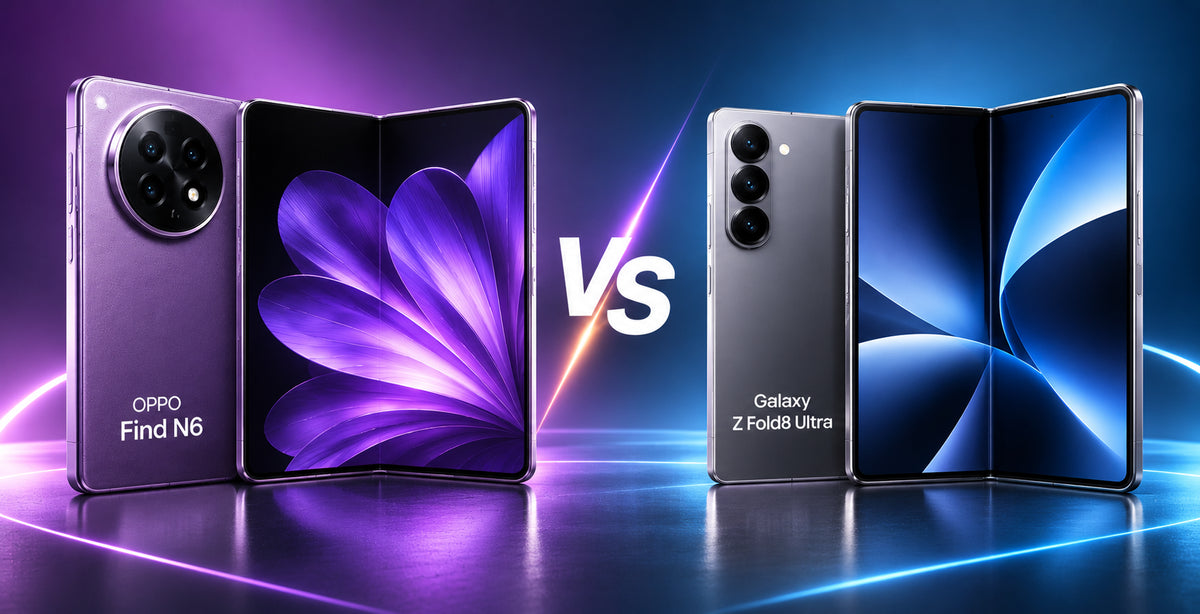
Foldable smartphones have become serious alternatives to traditional flagship devices, combining large displays, powerful processors and advanced camera systems in increasingly slim designs. Two premium options attracting attention are the OPPO Find N6 and Samsung Galaxy Z Fold8 Ultra.Both smartphones promise an impressive combination of productivity, entertainment and photography. The OPPO Find N6 focuses on its Zero-Feel Crease technology, large battery and Hasselblad camera system. Meanwhile, the Samsung Galaxy Z Fold8 Ultra offers a refined foldable design, advanced Galaxy AI features and powerful imaging capabilities.For Australian buyers considering a premium foldable smartphone, understanding their differences is essential. From display quality and camera performance to battery endurance and everyday usability, which device offers the better overall experience?
Design and Build Quality
The OPPO Find N6 features an ultra-slim foldable construction with a titanium-based hinge and refined engineering designed to minimise the display crease.It measures approximately 8.93mm when folded and weighs around 225 grams, making it relatively portable despite its large internal screen.The Samsung Galaxy Z Fold8 Ultra takes a similarly premium approach, measuring approximately 8.9mm when folded and weighing 215 grams.Samsung therefore offers a slightly lighter design, which could make a difference during extended one-handed use.Both devices combine sophisticated materials with advanced folding mechanisms. However, OPPO places particular emphasis on reducing crease visibility, while Samsung focuses on a lightweight construction and its improved foldable display structure.For everyday portability, Samsung has a small advantage in weight, although both phones remain impressively slim.
Display Comparison: Which Foldable Offers a Better Screen?
Display quality is one of the most important considerations when purchasing a foldable smartphone.The OPPO Find N6 features an 8.12-inch internal AMOLED display and a 6.62-inch cover screen. Both support adaptive refresh rates up to 120Hz, delivering smooth scrolling and responsive interactions.Its Zero-Feel Crease technology combines advanced hinge engineering with flexible display materials to make the folding line less noticeable during normal use.The Galaxy Z Fold8 Ultra features an 8-inch Dynamic AMOLED 2X internal display alongside a 6.5-inch cover screen. Both support adaptive refresh rates up to 120Hz.Samsung also advertises up to 3,000 nits of display brightness, while OPPO specifies 1,800 nits in high brightness mode. These figures are not necessarily measured under identical conditions.OPPO offers slightly larger displays and a strong focus on crease reduction. Samsung provides excellent screen technology with particularly impressive advertised brightness.Both are suitable for watching movies, reading and multitasking.
Camera Comparison: 200MP Photography Battle
Both smartphones feature 200MP main cameras, making photography a major selling point.The OPPO Find N6 includes a 200MP main camera, 50MP ultra-wide camera and 50MP telephoto camera with 3x optical zoom.Its Hasselblad imaging system provides specialised portrait photography, colour processing and professional shooting modes.The Samsung Galaxy Z Fold8 Ultra also features a 200MP main camera and 50MP ultra-wide camera, accompanied by a 10MP telephoto camera with 3x optical zoom.Samsung offers advanced HDR processing, Nightography improvements and professional video features, including 8K recording.OPPO's higher-resolution telephoto sensor provides additional flexibility for detailed zoom photography, while Samsung's video capabilities may appeal to content creators.However, megapixel counts alone cannot determine which smartphone produces better photographs. Image processing, lighting and sensor performance remain equally important.For photography enthusiasts, both devices offer impressive hardware, with different strengths in their imaging systems.
Battery Life and Charging Speeds
Battery capacity is one area where the OPPO Find N6 has a clear specification advantage.The Find N6 includes a 6,000mAh silicon-carbon battery, supported by 80W wired charging and 50W wireless charging.The Galaxy Z Fold8 Ultra features a 5,000mAh battery with 45W wired fast charging and wireless charging support.OPPO therefore provides approximately 20 percent more battery capacity and a higher maximum wired charging rate.This could be particularly beneficial for users who frequently use the larger internal display for gaming, streaming or productivity.However, actual battery endurance depends on processor efficiency, display settings and application usage.For Australian buyers who prioritise battery capacity and charging speed, the OPPO Find N6 is the stronger choice on paper.
Processor and Gaming Performance
Both smartphones use Qualcomm's Snapdragon 8 Elite Gen 5 platform, although Samsung features a customised version designed for Galaxy devices.These processors provide flagship-level performance for demanding applications, multitasking and mobile gaming.The Find N6 combines its processor with 16GB RAM in its global specification, while Samsung offers configurations with up to 16GB RAM.Both devices should comfortably handle intensive applications, high-resolution video editing and popular mobile games.Samsung's expanded cooling structure may help manage heat during demanding workloads, while OPPO's large battery provides additional capacity for extended sessions.Without controlled comparative testing, neither device can be declared the definitive gaming winner.For most users, both offer more than enough processing power for everyday tasks and entertainment.
Software, AI and Multitasking
Software experience is another important difference between these premium foldables.The OPPO Find N6 runs ColorOS 16 and introduces Free-Flow Window, allowing users to operate up to four applications simultaneously.Its AI-powered productivity features and optional OPPO AI Pen support make the large internal display useful for professional tasks.Samsung's Galaxy Z Fold8 Ultra runs One UI 9 based on Android 17, offering Multi Window functionality and Galaxy AI features.Tools such as Live Translate, Photo Assist and Now Nudge help users manage communication, editing and everyday activities.Samsung also benefits from its established Galaxy ecosystem, making the Fold8 Ultra attractive to users who already own compatible Galaxy devices.OPPO offers flexible multitasking and stylus-based productivity, while Samsung provides extensive software integration and AI-assisted workflows.The better choice depends largely on personal preferences and existing devices.
Durability and Everyday Reliability
Durability remains an important concern with foldable smartphones because their flexible displays and moving hinges require careful engineering.The OPPO Find N6 offers IP56, IP58 and IP59 dust and water resistance ratings under specified testing conditions.Samsung's Galaxy Z Fold8 Ultra carries an IP48 rating, providing protection against certain solid objects and water immersion under controlled conditions.OPPO's ratings indicate broader tested dust and water resistance capabilities, although neither smartphone should be considered completely waterproof or immune to damage.Both devices feature advanced hinge engineering designed to support repeated folding.Users should still protect the flexible internal displays from sharp objects, impacts and excessive pressure.
Which Premium Foldable Offers Better Value in Australia?
The OPPO Find N6 and Samsung Galaxy Z Fold8 Ultra both deliver premium foldable experiences, but their strengths differ.OPPO stands out with its larger battery, faster charging, high-resolution telephoto camera and advanced crease-reduction technology.Samsung offers a lighter construction, impressive display brightness, advanced video recording and comprehensive Galaxy AI integration.Australian buyers should also compare local pricing, warranty arrangements, network compatibility and after-sales support before purchasing.The best value depends on the price difference between the two devices and which features matter most.