


































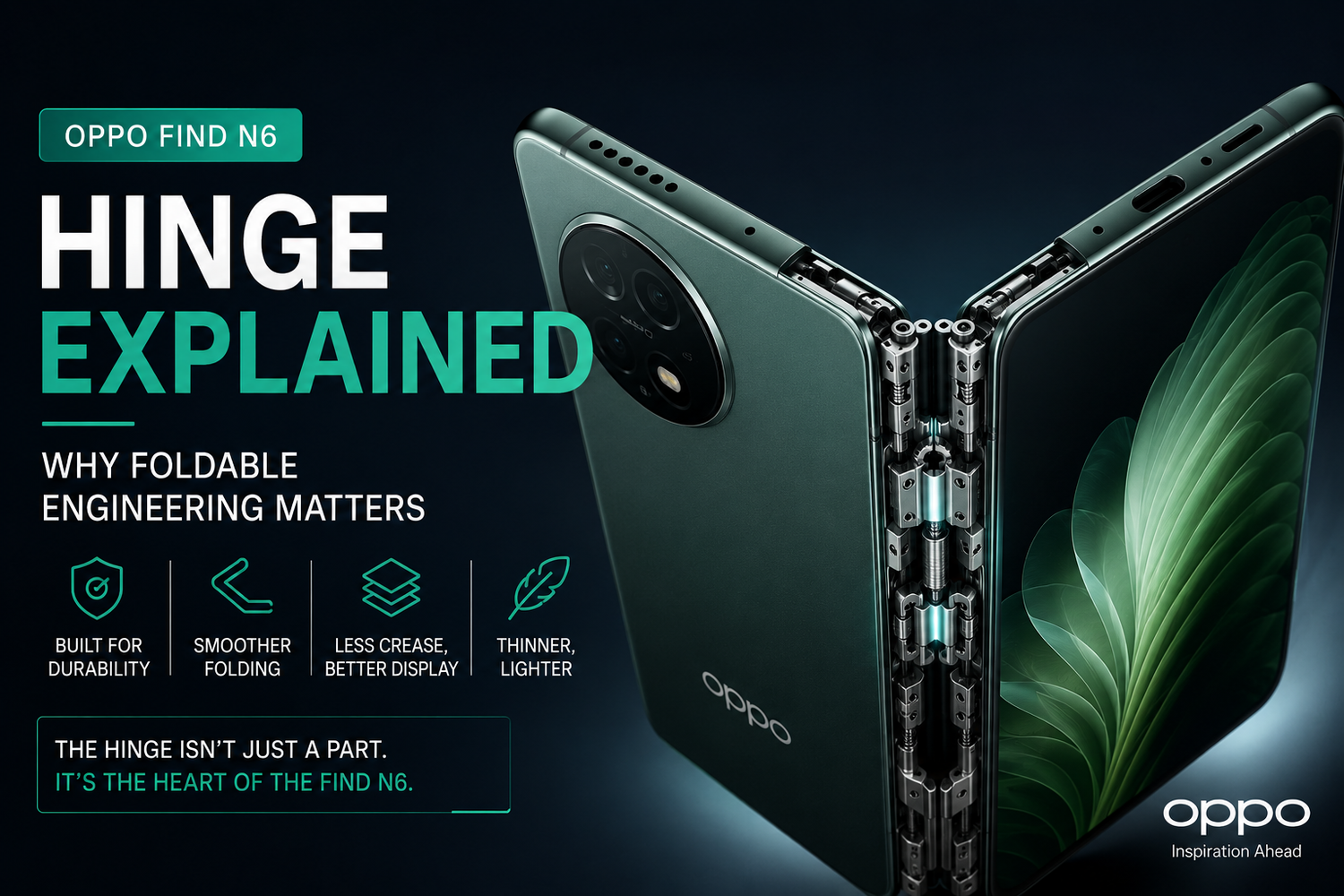
Foldable smartphones are often marketed around their large displays, multitasking features and futuristic designs. However, one of the most important components is something most users rarely think about: the hinge.For a foldable such as the OPPO Find N6, the hinge is much more than a mechanism that lets the phone open and close. It influences how thin the device can be, how noticeable the display crease feels, how durable the phone is and even how comfortable it is to use every day.With the OPPO Find N6 representing the next stage of OPPO's foldable-phone ambitions, understanding hinge engineering can help explain why designing a great foldable is considerably more complicated than simply putting a flexible screen on a smartphone.As detailed official Find N6 hinge specifications were not readily available at the time of writing, this article focuses on what hinge engineering means for the Find N6 experience rather than treating unconfirmed specifications as fact.
1. Why Is the Hinge So Important?
On a conventional smartphone, there are no major moving parts between the display and frame. A book-style foldable introduces an entirely different engineering challenge.Every time you open or close the phone, the hinge needs to guide the flexible display through a controlled movement.It must operate smoothly while supporting the two halves of the device and protecting sensitive internal components. At the same time, manufacturers want the hinge to remain compact so the finished smartphone doesn't become excessively thick or heavy.This means a foldable hinge has to balance several competing priorities: strength, size, weight, smooth movement and display protection.That's why hinge technology is one of the most important areas to examine when evaluating the OPPO Find N6.
2. The Hinge Helps Protect the Foldable Display
Flexible displays may look simple from the outside, but they require careful engineering.A foldable screen shouldn't simply bend sharply at one fixed point every time the device closes. The hinge mechanism needs to manage how the display curves as the two sides move together.Modern foldables commonly use hinge designs that allow the display to form a gentler curve inside the device when closed.Why does this matter?A carefully controlled folding radius can help reduce stress on the flexible display structure. It can also contribute to how the crease looks and feels once the device is opened.For the Find N6, this relationship between the hinge and display is crucial. The large inner screen is one of the phone's main attractions, so the folding mechanism needs to support it without compromising the overall experience.
3. Hinge Engineering Can Affect the Display Crease
The crease remains one of the most discussed characteristics of foldable smartphones.Because the inner display repeatedly bends along the same region, some degree of visible or tactile crease can occur. Manufacturers have spent years trying to make it less distracting.Hinge design plays an important role.By controlling the shape the display takes when folded, engineers can distribute bending across a wider area rather than concentrating it as aggressively along a narrow line.A less noticeable crease can improve the experience when reading, watching videos, editing photographs or simply scrolling through apps.However, buyers should judge crease visibility using the final retail Find N6 rather than relying solely on promotional images. Lighting angle, screen brightness and background colour can dramatically change how noticeable a foldable crease appears.
4. A Better Hinge Can Help Make Foldables Thinner
Early book-style foldables were often extremely thick when closed.That's understandable. You're effectively folding a large smartphone-sized device in half while also making space for a sophisticated hinge.But thickness matters enormously in everyday use.A foldable may have a spectacular internal display, but if it feels like carrying two conventional smartphones stacked together, some users will find it inconvenient.Hinge miniaturisation is therefore critical.Every millimetre engineers can save inside the mechanism potentially helps create a slimmer overall device. Combined with careful battery, motherboard and camera placement, a compact hinge can make a foldable feel much closer to a conventional premium phone when closed.For the OPPO Find N6, this is one area where engineering improvements could matter more than another flashy specification.
5. The Hinge Influences How the Phone Feels
Specifications don't tell you everything about a hinge.The physical sensation of opening and closing a foldable matters too.Ideally, the movement should feel smooth, controlled and reassuring. A hinge that's excessively stiff could make opening the phone inconvenient, while one that feels too loose may reduce confidence in the device.There's also the question of intermediate positions.Depending on how the Find N6's final hinge and software are configured, the ability to hold the phone at useful angles could enable different experiences.For example, a partially folded phone can potentially act as its own stand for photography, video calls or media playback.This demonstrates why hinge engineering isn't purely about durability. It can also create entirely new ways of using the device.
6. Durability Is a Major Engineering Challenge
A smartphone hinge doesn't open once or twice during its lifetime.A frequent foldable user might open and close the device dozens of times every day.Multiply that across several years and the mechanism has to withstand an enormous number of movements.Manufacturers therefore test foldable hinges through repeated folding cycles and environmental conditions.The challenge extends beyond the hinge itself.Engineers must consider how repeated movement affects the display, internal cables and other components positioned around the folding area.Dust and small particles present another challenge because moving mechanisms naturally create areas where debris management becomes important.When OPPO provides official durability ratings or testing claims for the Find N6, buyers should examine exactly what those figures represent rather than treating a single folding-cycle number as a complete guarantee of real-world durability.
7. Water and Dust Resistance Become More Complicated
Sealing a conventional smartphone against the environment is already difficult.Adding a hinge makes the challenge significantly harder.A foldable contains moving sections that must operate freely while still protecting internal electronics as effectively as possible.Water resistance and dust resistance are also different engineering problems. A device can perform well against water exposure without necessarily offering the same protection against fine particles.That's why buyers considering the Find N6 should check its official IP rating once confirmed for their market.Don't assume that because a premium foldable looks tightly constructed, it has the same environmental resistance as a traditional flagship.The hinge is one of the reasons these specifications deserve extra attention.
8. Weight Distribution Matters Too
A foldable's weight isn't determined solely by the hinge, but the hinge contributes to how that weight is distributed.This can affect comfort when holding the phone open for long periods.Imagine reading an ebook, browsing a website or watching YouTube on the large internal display. If the device feels unbalanced, the extra screen space becomes less enjoyable.Engineers therefore need to think about the hinge alongside batteries, cameras, circuit boards and other internal components.The goal isn't simply making the Find N6 lighter on a specification sheet.It's making the device feel manageable in your hands.Good foldable engineering is often noticeable precisely because you stop thinking about the engineering at all.
9. The Hinge Can Influence Camera Design
Foldable phones involve constant competition for internal space.Large camera sensors require room. Batteries require room. Cooling hardware requires room. The hinge also occupies valuable space through the centre of the device.Reducing hinge size can potentially give engineers greater flexibility when designing everything around it.That's particularly important for premium foldables, where buyers don't want to sacrifice flagship-style cameras simply because they chose a folding screen.The Find N6 therefore isn't just a hinge, display and camera system designed independently.Every component affects the others.That's what makes foldable engineering such an interesting challenge.
10. Software Needs to Understand the Hardware
A sophisticated hinge becomes even more useful when software knows what to do with it.If a foldable can detect different positions, applications and system interfaces can potentially adapt accordingly.A camera interface might place controls on one portion of the display while showing a preview elsewhere. A video app could use the upper section for content and the lower section for controls.Not every application will necessarily take advantage of every folding position, and functionality depends on OPPO's software implementation.But the principle is important.The best foldables don't simply have clever hardware and clever software. The two work together.
Why Hinge Quality Matters More Than Specifications
When shopping for a smartphone, we're accustomed to comparing easy numbers: processor speed, megapixels, storage capacity, charging wattage and battery size.Hinges aren't as simple.You need to consider how smoothly the phone opens, whether it closes neatly, how noticeable the crease is, how thick it feels when folded and whether the mechanism inspires confidence after hundreds of uses.These characteristics can affect your experience every single day.A faster processor might save fractions of a second when opening an app. A poorly designed hinge would remind you of itself every time you open the phone.That puts hinge engineering near the centre of the foldable experience.
What Should OPPO Find N6 Buyers Look For?
When evaluating the Find N6, don't focus exclusively on its display size and processor.Pay attention to how the retail device behaves physically.Look at the gap when closed, overall folded thickness, hinge resistance, crease visibility, official durability testing and IP rating. If possible, try opening and closing the phone yourself before buying.Also consider long-term support and warranty coverage available in your region.Foldables are sophisticated devices, so after-sales support can be especially important for buyers planning to keep their phone for several years.