


































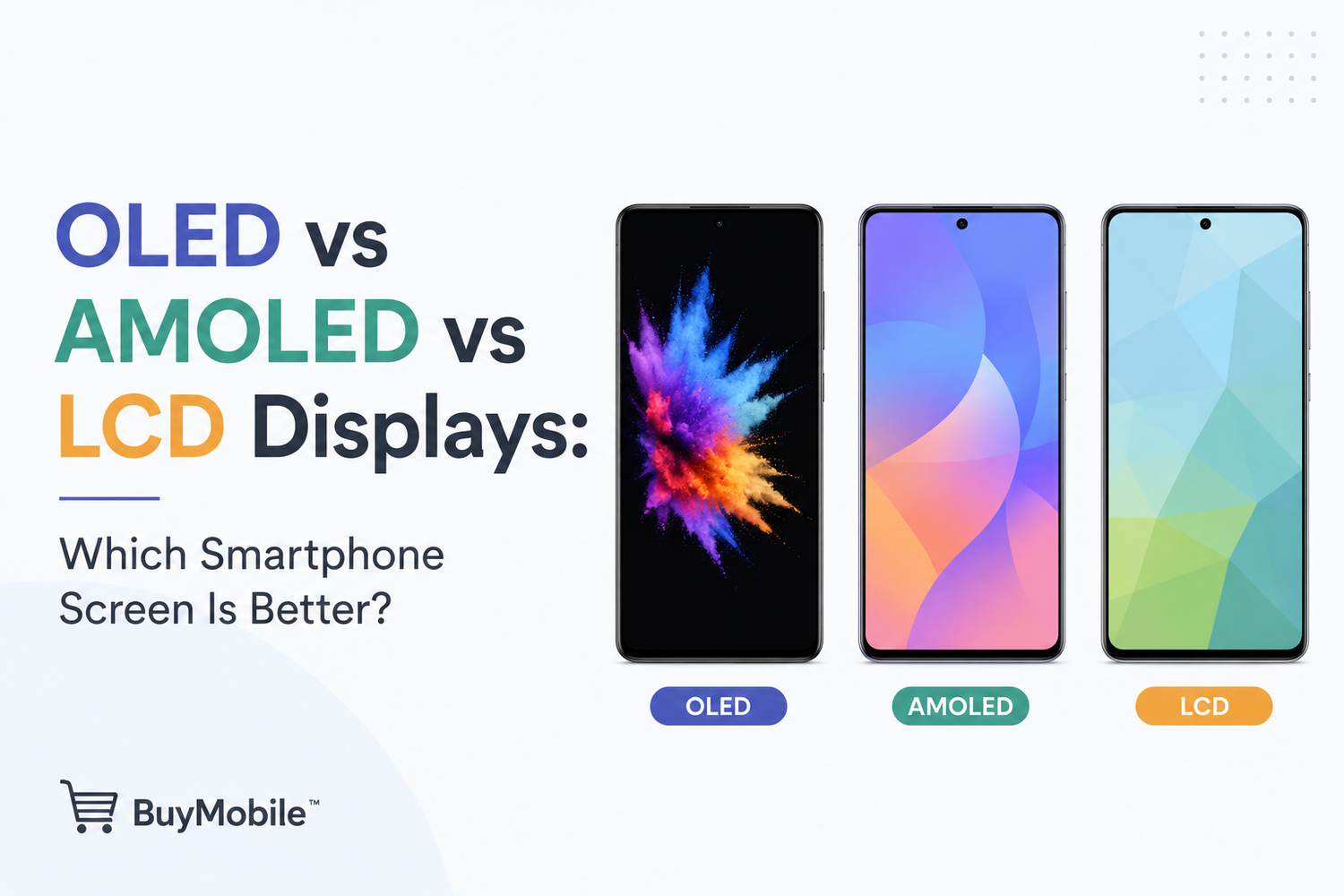
Smartphone displays have become one of the most important features buyers consider before purchasing a new device. Whether you use your smartphone for gaming, watching videos, social media, photography, or daily browsing, the quality of the display directly affects your overall experience.Today, most smartphones use one of three major display technologies: LCD, OLED, or AMOLED. While all three displays perform the same basic function, they differ significantly in color quality, brightness, battery efficiency, contrast, viewing experience, and pricing.If you are confused about which display technology is actually better, this FAQ-style guide explains the major differences between OLED, AMOLED, and LCD displays and helps you choose the right smartphone screen in 2026.
What Is an LCD Display?
LCD stands for Liquid Crystal Display.LCD screens use a separate backlight to illuminate the display because the pixels themselves cannot produce light independently. This means the entire screen remains partially lit even while displaying darker content.LCD displays have been used in smartphones for many years because they are affordable, reliable, and capable of producing good brightness levels.Most budget and mid-range smartphones still use LCD panels because they are cheaper to manufacture compared to OLED-based displays.LCD screens are also known for offering natural-looking colors and decent outdoor visibility.
What Is an OLED Display?
OLED stands for Organic Light Emitting Diode.Unlike LCD screens, OLED displays do not require a separate backlight. Each pixel produces its own light independently.This allows OLED displays to completely turn off black pixels, resulting in deeper blacks, stronger contrast, and improved power efficiency.OLED technology also allows displays to become thinner and lighter while producing more vibrant visuals.Because of these advantages, OLED displays are commonly used in premium smartphones.
What Is an AMOLED Display?
AMOLED stands for Active Matrix Organic Light Emitting Diode.AMOLED is essentially a more advanced version of OLED technology that improves refresh rates, touch responsiveness, and overall display performance.AMOLED displays use an active matrix system that controls individual pixels more efficiently and allows smoother animations and faster screen response.AMOLED displays are widely used in flagship smartphones because they provide:
-
Deep blacks
-
Vibrant colors
-
Better battery efficiency
-
Faster response times
-
High refresh rates
-
Always-On Display support
Most premium Android smartphones now use AMOLED technology.
Which Display Has Better Color Quality?
AMOLED displays generally provide the most vibrant and eye-catching colors.Because AMOLED and OLED displays can individually control pixels, they produce richer contrast and more saturated visuals. Videos, games, and photos often appear more cinematic and immersive on AMOLED screens.OLED displays also deliver excellent color quality with strong contrast and deep blacks.LCD displays usually produce more natural-looking colors, but they cannot fully match the vibrancy and contrast levels offered by OLED and AMOLED technology.For entertainment and media consumption, AMOLED displays usually provide the best visual experience.
Which Display Has the Deepest Blacks?
OLED and AMOLED displays clearly perform better when displaying black colors.Since individual pixels can completely turn off, black areas on OLED and AMOLED screens appear truly black rather than dark gray.LCD displays cannot fully turn off pixels because the backlight always remains active behind the screen.This difference becomes especially noticeable while watching movies, using dark mode, or viewing HDR content.If you prefer cinematic visuals with stronger contrast, AMOLED and OLED displays are much better choices.
Which Display Is Better for Battery Life?
AMOLED and OLED displays are generally more power-efficient, especially when using dark mode.Because black pixels remain turned off, AMOLED and OLED screens consume less power while displaying darker content.LCD displays use a constant backlight regardless of what appears on the screen, which can increase battery consumption.However, LCD screens may sometimes perform slightly better while displaying bright white backgrounds continuously.For most modern smartphone usage involving dark themes, streaming apps, and social media, AMOLED displays usually provide better battery efficiency overall.
Which Display Is Better for Outdoor Visibility?
LCD displays traditionally performed very well outdoors because of their strong brightness levels.However, modern AMOLED and OLED technology has improved significantly over the last few years. Premium AMOLED displays now offer extremely high brightness levels that make outdoor visibility excellent even under direct sunlight.In 2026, flagship AMOLED displays generally offer the best balance between brightness, contrast, and outdoor readability.Budget AMOLED displays may still vary depending on the manufacturer and screen quality.
Which Display Is Better for Gaming?
AMOLED displays are generally the best option for gaming.
They offer:
-
Faster response times
-
Smoother refresh rates
-
Better motion clarity
-
Improved touch responsiveness
-
Stronger contrast
Games appear more immersive because colors look richer and black levels appear deeper.LCD displays can still deliver smooth gaming experiences, especially on high-refresh-rate smartphones, but AMOLED panels usually feel more premium during fast-paced gameplay.For mobile gamers, AMOLED is usually the preferred display technology.
Which Display Is Better for Watching Videos?
AMOLED and OLED displays are clearly superior for watching movies and streaming content.The deeper blacks, higher contrast, and vibrant colors make HDR videos appear more cinematic and visually impressive.Streaming platforms like Netflix, YouTube, and Disney+ benefit greatly from OLED-based displays because darker scenes look far more detailed and immersive.LCD displays still work well for casual viewing, but they cannot fully match the visual depth and contrast provided by AMOLED screens.
Which Display Is More Durable?
LCD displays are generally less vulnerable to burn-in problems.Burn-in happens when static images remain visible on OLED or AMOLED displays after long-term usage. Although modern smartphones now include better protection against burn-in, the possibility still exists slightly on OLED-based screens.LCD panels do not suffer from permanent burn-in as easily because they use traditional backlighting technology.However, AMOLED and OLED displays have improved greatly over the years, and burn-in is now far less common during normal usage.For most users, burn-in is no longer a major concern.
Which Display Is More Affordable?
LCD displays are the cheapest to manufacture.This is why budget smartphones still commonly use LCD panels.OLED displays are more expensive because of their advanced pixel technology, while AMOLED displays are usually the most premium and costly option.If affordability is your biggest priority, LCD smartphones often provide better overall value.If premium display quality matters more, AMOLED smartphones are worth the higher price.
Which Display Is Better for Eye Comfort?
Eye comfort depends on several factors including brightness settings, software optimization, and display quality.Some users find LCD screens slightly easier on the eyes because they use traditional backlighting rather than aggressive pixel dimming.However, modern AMOLED displays now include advanced eye protection features such as:
-
DC dimming
-
Blue light filters
-
Adaptive brightness
-
Eye comfort modes
Premium AMOLED displays in 2026 generally provide very comfortable viewing experiences for most users.
Which Display Should You Choose in 2026?
The best display depends on your personal usage and budget.LCD displays are ideal for users who want affordable smartphones with good brightness and reliable everyday performance.OLED displays are better for users who want deeper blacks, stronger contrast, and better visual quality.AMOLED displays are the best overall choice for users who want flagship-level smartphone experiences including smooth gaming, HDR streaming, vibrant visuals, and premium display quality.AMOLED is generally considered the best smartphone display technology available in 2026.