

































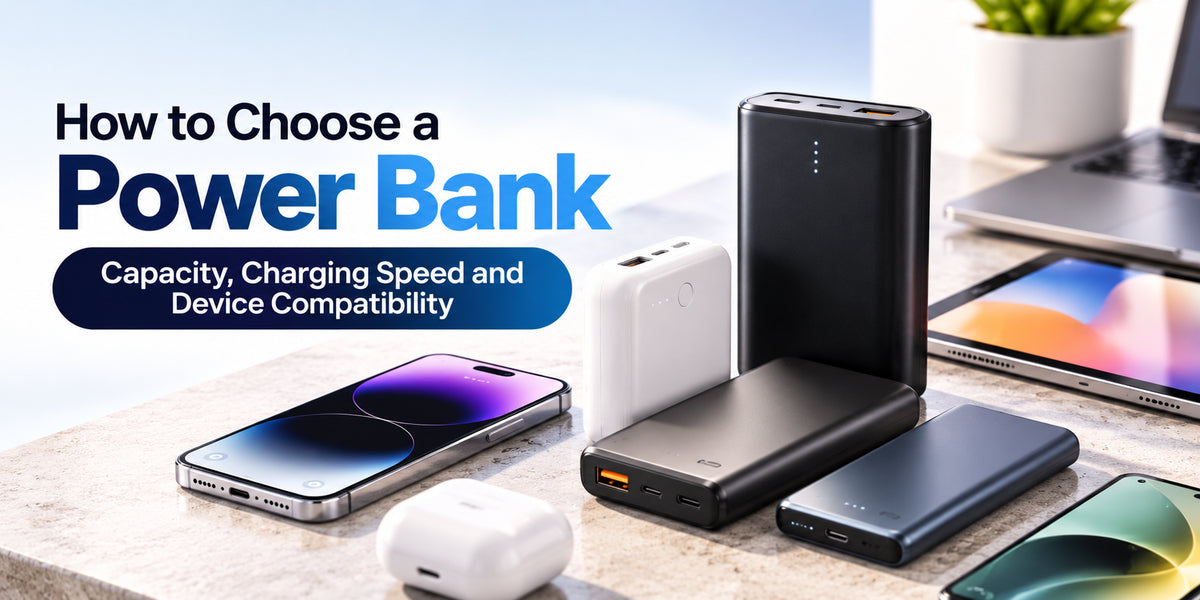
A power bank is one of the most useful accessories for keeping smartphones, tablets and other electronic devices charged throughout the day. Whether you're travelling, working remotely, attending university or spending time outdoors, a reliable portable charger can help prevent unexpected battery problems.However, choosing the best power bank involves more than selecting the model with the highest battery capacity.Factors such as charging speed, USB-C compatibility, power output, battery efficiency and safety features can significantly affect performance.With options ranging from compact 5,000mAh chargers to powerful 20,000mAh and 30,000mAh models, understanding these differences is essential.In this guide, we'll explain how to choose a power bank based on capacity, charging speed and device compatibility, helping Australian buyers find the right portable charging solution.
1. Understand Power Bank Capacity: What Does mAh Mean?
Power bank capacity is usually measured in milliampere-hours (mAh).This measurement indicates how much electrical charge the internal battery can store at its rated voltage.Common capacities include 5,000mAh, 10,000mAh, 20,000mAh and 30,000mAh.Higher-capacity power banks generally store more energy, allowing them to recharge devices multiple times.However, larger batteries also increase weight, size and charging time.
2. How Many Times Can a Power Bank Charge Your Phone?
A common mistake is assuming that a 10,000mAh power bank can fully recharge a 5,000mAh smartphone battery exactly twice.In reality, some energy is lost during voltage conversion, cable transmission and charging.Power banks typically contain lithium batteries with a nominal voltage of approximately 3.6V or 3.7V.Their USB outputs operate at different voltages, commonly 5V or higher.Because of these differences, advertised capacity does not directly translate into usable charging capacity.For example, a 10,000mAh power bank may provide approximately 1.5 to 1.8 full charges for a smartphone with a 5,000mAh battery, depending on efficiency and usage.A 20,000mAh model may provide approximately three to four charges under favourable conditions.Actual results vary according to the device, cable quality, charging speed and power bank efficiency.Buying tip: Compare watt-hours (Wh), not just mAh, when evaluating battery energy.
3. Charging Speed: Understanding Watts and Fast Charging
Charging speed is another important factor when choosing a portable charger.Power output is measured in watts (W).Generally, a higher wattage rating allows a compatible device to charge faster.However, the connected device must support the charging standard and power level.Common power bank outputs include:
-
10W–15W: Basic smartphone charging.
-
20W–30W: Fast charging for many modern smartphones.
-
45W–65W: Suitable for certain tablets, smartphones and laptops.
-
100W or higher: Designed for compatible high-performance laptops and multiple devices.
A 65W power bank will not automatically charge every smartphone at 65W.The phone controls how much power it accepts, and charging speed usually decreases as the battery approaches full capacity.For everyday smartphone charging, a 20W or 30W USB-C power bank is often sufficient.
4. USB-C Power Delivery: Why It Matters
USB Power Delivery, commonly called USB-PD, is a charging standard used by many modern smartphones, tablets and laptops.It allows compatible devices and chargers to negotiate suitable voltage and current levels.USB-PD can support multiple power levels, making it useful for charging different devices with one accessory.For example, a USB-C PD power bank may charge an iPhone, Android smartphone, iPad or compatible laptop.However, not every USB-C port supports the same charging capabilities.Some power banks provide USB-C input only, while others support both input and output.Before purchasing, check whether the USB-C port supports Power Delivery and confirm its maximum output.For higher-powered laptops, also verify cable wattage compatibility.
5. Power Bank Compatibility With iPhone and Android
Not every power bank delivers the same charging performance across different smartphones.
Power Banks for Apple iPhone
Modern USB-C iPhones can use compatible USB-C Power Delivery power banks for wired charging.Older Lightning-equipped iPhones may require a USB-C-to-Lightning cable.Magnetic wireless power banks are another convenient option for compatible iPhones.However, magnetic attachment does not automatically guarantee MagSafe or Qi2 charging speeds.Check the supported wireless charging standard and output rating before purchasing.
Power Banks for Samsung Galaxy Phones
Many Samsung Galaxy smartphones support USB-C fast charging.However, certain Galaxy models require USB-PD Programmable Power Supply (PPS) support to achieve their highest advertised charging speeds.For example, a power bank may advertise 45W output but still charge a compatible Samsung phone more slowly if it lacks the required PPS profile.
Power Banks for Other Android Smartphones
Brands such as Google Pixel, OnePlus, Xiaomi and OPPO may support different charging technologies.Some proprietary fast-charging systems require specific chargers or cables.Always check your smartphone's supported charging standard rather than relying solely on the power bank's advertised wattage.
6. Can You Charge a Tablet or Laptop With a Power Bank?
Yes, but the power bank must provide sufficient output.Most tablets can charge from a compatible USB-C power bank, although larger batteries may require more energy.For laptops, wattage becomes particularly important.Many lightweight USB-C laptops support charging at 45W or 65W.More demanding models may require 100W or higher.A low-output power bank might charge a laptop slowly, only while it is sleeping, or not at all.Before buying a laptop power bank, check the laptop's USB-C charging requirements and the power bank's maximum output per port.A 20,000mAh or larger capacity can also be useful, although the available runtime depends on the laptop's energy consumption.
7. Wired vs Wireless Power Banks: Which Is Better?
Wired power banks are generally more energy-efficient and often support faster charging.They are also versatile because they can charge different devices using suitable cables.Wireless power banks offer greater convenience by reducing the need for cables.Magnetic models can attach directly to compatible smartphones, making them useful for commuting and everyday activities.However, wireless charging usually generates more heat and wastes more energy than wired charging.If charging speed and efficiency are your priorities, choose a wired USB-C PD power bank.If convenience matters more, consider a compatible magnetic wireless model.
8. Safety Features to Look for in a Power Bank
Power bank safety should never be overlooked.Poor-quality batteries or inadequate protection circuits may increase the risk of overheating, swelling or electrical faults.Look for products from reputable manufacturers with appropriate safety testing and clearly stated specifications.Useful safety features include overcharge protection, overcurrent protection, short-circuit protection, temperature monitoring and over-discharge protection.Avoid damaged power banks, particularly those showing swelling, unusual heat or leaking.Do not leave portable chargers in hot vehicles or direct sunlight for extended periods.A well-designed power bank should provide reliable charging while managing temperature and electrical conditions.
9. Choosing a Power Bank for Travel and Flights
Power banks are popular travel accessories, but airline restrictions are important.Airlines generally require spare lithium batteries and power banks to be carried in cabin baggage rather than checked luggage.Battery limits are commonly expressed in watt-hours.Under widely used aviation guidelines, power banks rated at up to 100Wh are generally permitted in carry-on baggage, subject to airline requirements.Batteries above 100Wh and up to 160Wh may require airline approval, and some airlines apply stricter restrictions.For example, a typical 20,000mAh power bank rated at 3.7V contains approximately 74Wh of energy.A 30,000mAh model rated at the same voltage contains approximately 111Wh and may face additional restrictions.Australian travellers should always check the latest airline rules before flying.
10. What Is the Best Power Bank Capacity for Everyday Use?
The best capacity depends on your daily charging needs.A compact 5,000mAh model is suitable for emergency charging.A 10,000mAh power bank provides a good balance between portability and everyday performance.A 20,000mAh model is better suited to frequent travellers, students and users who charge multiple devices.For laptop charging or extended trips, consider a higher-capacity USB-C PD model with sufficient wattage.Remember that larger power banks are generally heavier and take longer to recharge.