
































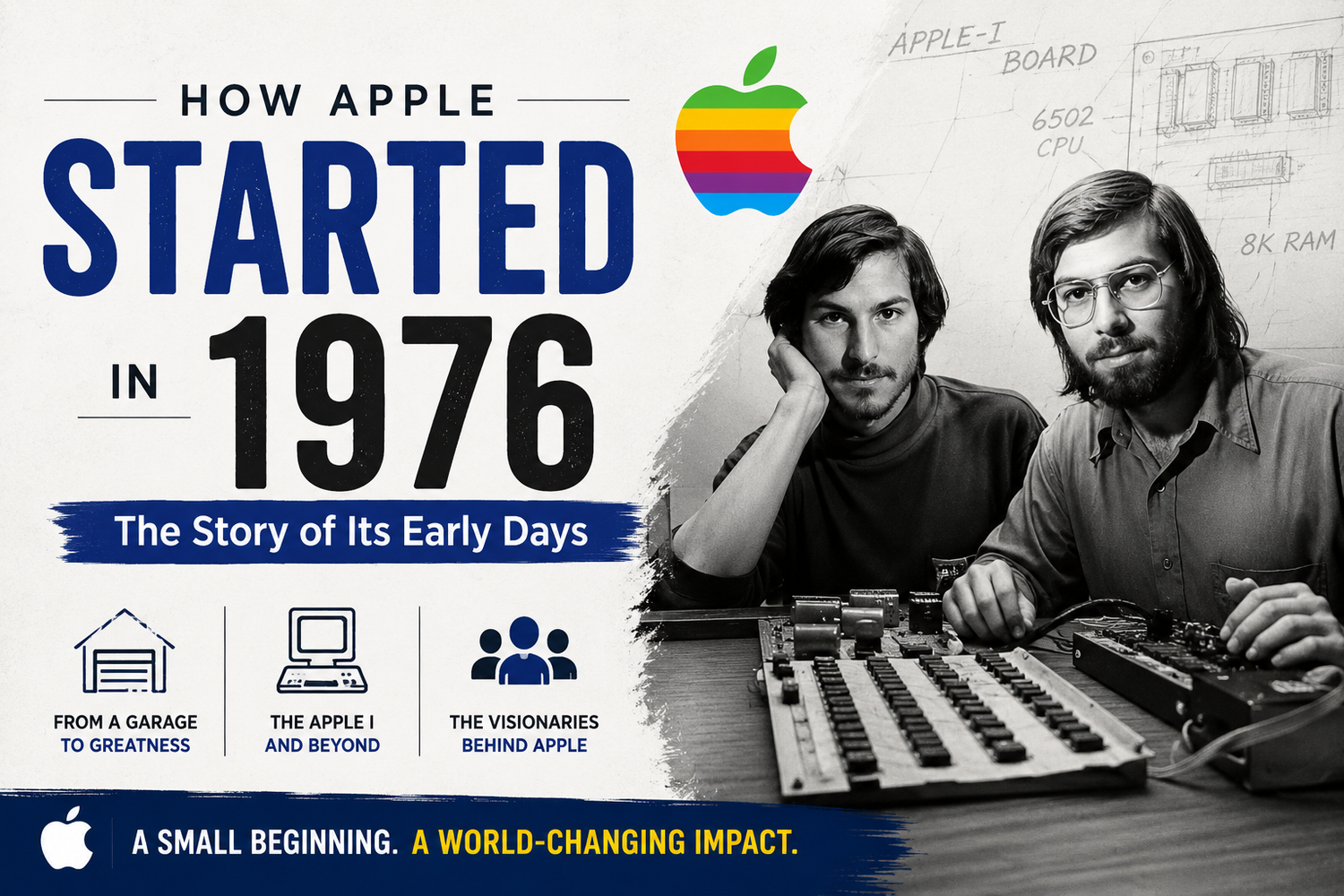
Today, Apple is known around the world for products such as the iPhone, Mac, iPad, Apple Watch and AirPods. Its devices are used by millions of people, and its product launches regularly attract enormous attention.But Apple's story did not begin with smartphones, enormous offices or global retail stores.It began in 1976, when personal computers were still unfamiliar to most households and a small group of technology enthusiasts saw an opportunity to make computing more accessible.The early history of Apple is closely connected to three people: Steve Jobs, Steve Wozniak and Ronald Wayne. Their different skills helped create a company that would eventually become one of the most influential names in consumer technology.
Personal Computers Were Very Different in 1976
To understand Apple's beginning, it helps to understand what computers were like at the time.Computers were already important in universities, businesses and government organisations, but they were nothing like the personal devices we use today. Many systems were expensive, complicated and inaccessible to ordinary consumers.At the same time, a growing community of electronics enthusiasts was becoming interested in smaller computers built around microprocessors.This hobbyist movement created an opportunity.Steve Wozniak was fascinated by electronics and computer design. His technical ability would become essential to Apple's first product.Steve Jobs saw something else: the possibility of turning Wozniak's engineering work into a product that people could actually buy.That combination of engineering and business ambition became central to Apple's early identity.
Steve Jobs Meets Steve Wozniak
Jobs and Wozniak had met several years before Apple was founded.Although they had different personalities, they shared an enthusiasm for electronics.Wozniak was particularly interested in designing computers efficiently. He developed a computer that could connect to a keyboard and display information on a screen, an important idea during an era when many hobbyist systems required less convenient methods of interaction.Wozniak demonstrated his work at the Homebrew Computer Club, a famous gathering of computer enthusiasts in Silicon Valley.Jobs recognised commercial potential in the design.Instead of treating the computer purely as a personal engineering project, he believed they could build circuit boards and sell them.That idea would become the foundation of Apple.
Apple Computer Was Founded
Apple Computer Company was founded on April 1, 1976, by Steve Jobs, Steve Wozniak and Ronald Wayne.Jobs was 21 years old, while Wozniak was 25.Ronald Wayne was older and had previous business experience. He helped create an early partnership agreement and designed Apple's first logo.Wayne's involvement, however, would be extremely brief.Concerned about the financial risks associated with the partnership, Wayne decided to leave the company only days after it was established. He sold his share back for a relatively small amount.The decision later became one of the most famous "what if?" stories in business history because of how valuable Apple eventually became.At the time, however, Apple's future was anything but guaranteed.
Why Was It Called Apple?
The company's name was unusual for a technology business.Rather than choosing something that sounded highly technical, the founders settled on Apple Computer.Jobs later explained that he had been visiting an apple farm and liked the name because it sounded fun, energetic and approachable.It also had another practical advantage: Apple would appear before Atari in alphabetical listings. Jobs had previously worked at Atari.The simplicity of the name helped distinguish the company from technology businesses with more complicated or industrial-sounding identities.Even at this early stage, Apple was developing an identity that felt different.
The Apple I Became the First Product
Apple's first commercial product was the Apple I, designed primarily by Wozniak.Compared with today's computers, the Apple I was extremely basic.It wasn't a complete desktop computer packaged with everything a customer needed. Buyers received an assembled circuit board and still had to provide items such as a keyboard, display and power supply.However, selling an assembled motherboard was significant.Many early computer enthusiasts were accustomed to kits requiring substantial assembly. The Apple I reduced some of that complexity.Jobs and Wozniak initially intended to sell circuit boards directly to enthusiasts.Then came an opportunity that changed the young company's direction.
The Byte Shop Order
One of the most important people in Apple's early story was Paul Terrell, owner of a computer store called the Byte Shop.Jobs approached Terrell about selling the Apple I.Rather than buying bare circuit boards in the form Jobs initially expected, Terrell wanted fully assembled boards that customers could purchase more easily.He placed an order for 50 Apple I computers, reportedly paying $500 for each unit.For a tiny company with limited resources, fulfilling that order was a serious challenge.Jobs and Wozniak needed components, money and somewhere to assemble the machines.This is where one of the most famous parts of Apple's origin story appears.
What About the Famous Apple Garage?
Apple is often described as a company that was "started in a garage."The garage belonged to Steve Jobs' family home in Los Altos, California, and it did play a role in Apple's early operations.However, the popular version of the story can make it sound as though every part of Apple was created entirely inside the garage.Reality was more complicated.Wozniak had designed the Apple I before the company became established there, and different parts of the early work happened in multiple locations.Still, the Jobs family home became an important base where early Apple computers were assembled and prepared.The garage remains a powerful symbol because it represents how small the company was compared with what it eventually became.
They Needed Money to Build Computers
Apple didn't begin with enormous venture-capital funding.Jobs and Wozniak had to find ways to finance their early production.Jobs sold his Volkswagen microbus, while Wozniak sold his HP-65 programmable calculator to help raise money.They also relied on arrangements with component suppliers to obtain parts needed for the Byte Shop order.This involved considerable risk.They needed to build the computers, deliver them and receive payment before their financial situation became unsustainable.The order was successfully completed.Apple now had something extremely important: a real product being sold through a computer retailer.
The Apple I Was Only the Beginning
The Apple I proved that Wozniak's designs could become commercial products.But the next computer would be far more important.Wozniak began developing what became the Apple II.Unlike the Apple I, the Apple II was designed to feel much more like a complete consumer product. It featured a case, keyboard and colour graphics capabilities.Jobs wanted the computer to look like something that could belong in a home rather than a piece of equipment intended only for electronics hobbyists.This distinction would become a recurring theme throughout Apple's history.The company wasn't satisfied with simply making technology work.It increasingly wanted technology to be approachable, attractive and easier to use.
Mike Markkula Helped Apple Grow
By late 1976, Apple needed additional investment and business expertise.That arrived through Mike Markkula, a former Intel marketing manager who became an early investor and important adviser.Markkula helped provide financing and contributed to Apple's business planning.In 1977, the original partnership structure was replaced as Apple Computer, Inc. was incorporated.The company was beginning its transformation from a small operation into a serious computer business.The Apple II would become central to that growth.
The Apple II Changed Everything
Introduced in 1977, the Apple II became one of the important early mass-market personal computers.Its success pushed Apple beyond the small community of electronics hobbyists.People could imagine using a computer in a home, school or small business.Software also increased the usefulness of personal computers. Programs such as VisiCalc, an early spreadsheet application, helped demonstrate that machines such as the Apple II weren't simply interesting gadgets.They could be practical business tools.Apple grew rapidly as the personal-computer market expanded.Just a few years after its modest beginning, the company was heading toward a completely different scale.
Apple's Early Philosophy Was Already Visible
Looking back at Apple in 1976 reveals ideas that would continue appearing throughout the company's history.Wozniak concentrated on clever engineering and efficient design.Jobs focused heavily on turning technology into products that could appeal beyond engineering enthusiasts.That relationship between sophisticated technology and approachable consumer products eventually became fundamental to Apple.You can see versions of the same idea in later products such as the Macintosh, iPod, iPhone and iPad.Apple didn't invent every underlying technology used in those products.Its strength was often in combining technologies into experiences that ordinary consumers could understand and use.
From the Apple I to a Global Brand
Nobody assembling Apple I computers in 1976 could have known exactly what Apple would eventually become.The company would experience enormous successes, internal conflicts, leadership changes and periods when its future looked uncertain.Steve Jobs would eventually leave Apple and later return.The Macintosh would reshape the company's identity.The iPod would transform Apple's relationship with music.Then the iPhone would turn Apple into one of the defining companies of the smartphone era.But all of that came later.In 1976, Apple was simply a tiny new computer business trying to deliver its first significant order.