


































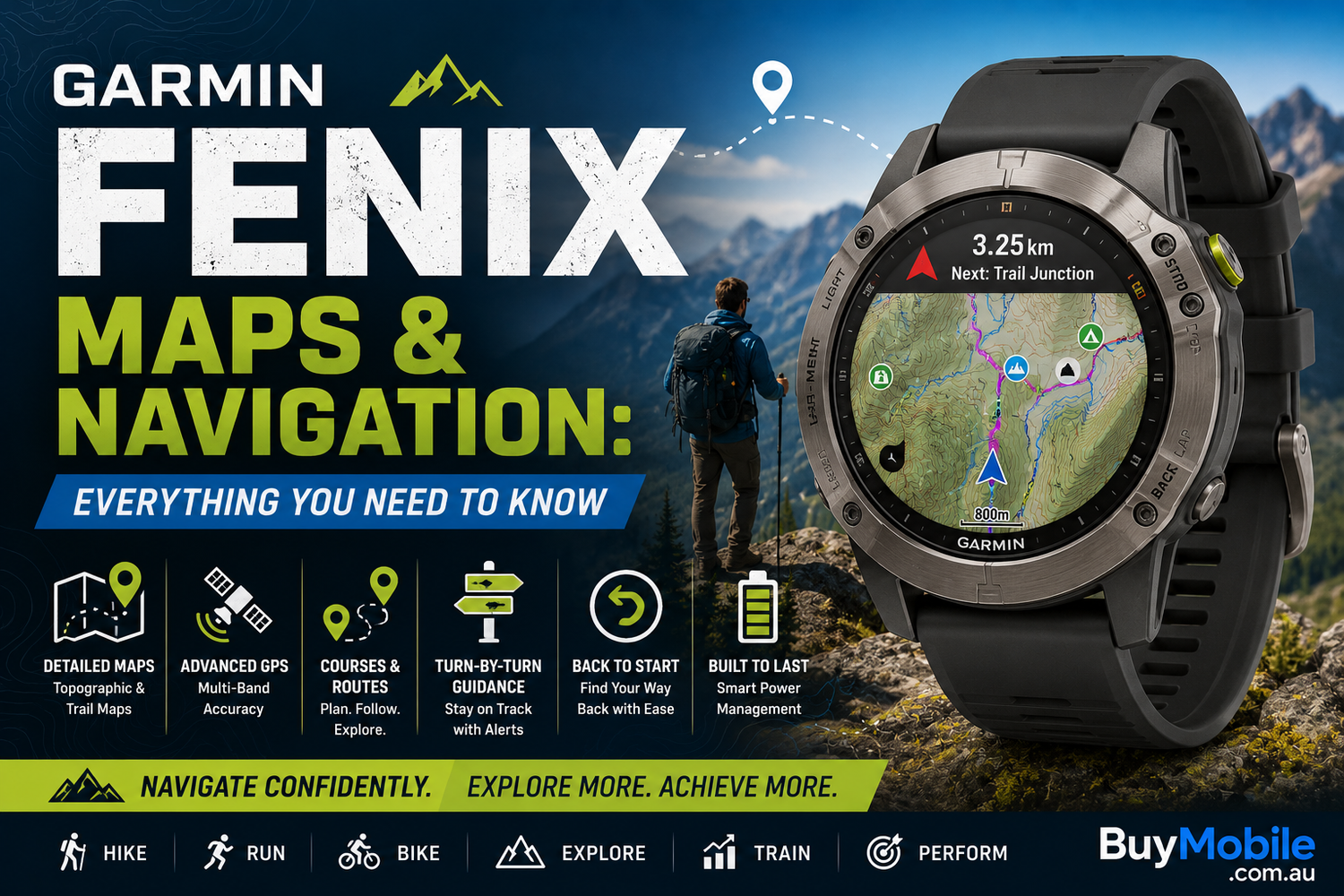
For runners, hikers, cyclists, and outdoor adventurers, navigation can be just as important as fitness tracking. Knowing where you're going and how to get back is particularly valuable when exploring unfamiliar trails or travelling through remote areas.That's one reason the Garmin Fenix series has become popular among outdoor enthusiasts. Beyond tracking workouts, compatible Fenix models offer sophisticated GPS, mapping, routing, and navigation tools directly on your wrist.Instead of constantly taking out your smartphone to check directions, a Garmin Fenix can provide useful navigation information while you're moving. But how do these features work, and which ones are actually useful?Here's everything you need to know about Garmin Fenix maps and navigation.
1. Built-In Mapping Makes a Big Difference
One of the biggest advantages of compatible Garmin Fenix models is access to detailed mapping directly on the watch.Rather than simply displaying an arrow pointing toward your destination, mapping-capable Fenix watches can show roads, trails, terrain information, points of interest, and routes on the display.This makes navigation easier because you can understand where you are in relation to your surroundings.For hikers, runners, and cyclists exploring unfamiliar locations, seeing an actual map can be much more useful than following basic directional prompts.Map availability and functionality vary between Fenix generations and configurations, so it's important to check the exact model you're considering.
2. GPS Tracks Your Position Outdoors
Navigation begins with accurate positioning.Garmin Fenix watches use satellite navigation systems to determine your location during outdoor activities. Depending on the model, this can include support for multiple Global Navigation Satellite Systems and advanced positioning modes.The watch can record where you've travelled while calculating metrics such as distance, pace, and speed.This information isn't only useful for workout statistics. It allows navigation features to understand your current position and guide you along a selected route.For outdoor users, reliable positioning becomes particularly important when routes aren't clearly marked.
3. Multi-Band GPS Can Improve Positioning
Some Garmin Fenix models include multi-band satellite technology designed to improve positioning in challenging environments.GPS signals can become more difficult to interpret around tall buildings, mountains, cliffs, or dense tree cover. Advanced satellite modes can help compatible watches maintain better location accuracy under these conditions.However, higher-accuracy modes can consume more battery power.Garmin therefore provides different satellite settings on compatible models, allowing users to balance positioning performance and battery life depending on the activity.For a short trail run, maximum accuracy may be desirable. During a multi-day adventure, conserving battery could become more important.
4. Topographic Maps Are Excellent for Hiking
Topographic information is particularly useful for hikers and trail runners.Instead of only showing roads, topographic maps help users understand the surrounding landscape and trail network.This can make it easier to evaluate where a route is heading and navigate through unfamiliar outdoor areas.When you're hiking, a standard street map may provide limited value. Trail and terrain information is much more relevant.This is one of the reasons mapping-capable Fenix watches are attractive to serious outdoor users compared with simpler fitness trackers.
5. Courses Let You Plan Your Route
Garmin's course functionality allows you to follow a predefined route.You can create or obtain a course before beginning an activity and then use the watch for navigation while running, hiking, or cycling.This can be extremely useful when exploring somewhere new.For example, you could prepare a hiking route before leaving home and then follow it from your wrist instead of repeatedly checking a phone.Courses can also be useful for training. Runners and cyclists can prepare routes based on desired distances or destinations and then follow them during workouts.Planning beforehand makes navigation much less stressful once you're outdoors.
6. Turn Guidance Helps You Stay on Course
Constantly studying a small watch map isn't always practical, especially while running or cycling.Compatible Garmin navigation features can provide alerts and directional information as you move along a course.This helps you know when a change in direction is approaching without continuously staring at the display.It's particularly useful for cyclists because stopping repeatedly to check a route can interrupt the ride.However, navigation behavior can vary depending on the watch, map data, course, and activity type.Users should familiarize themselves with navigation settings before relying on them during an important trip.
7. Back to Start Is Incredibly Useful
Sometimes the most important navigation question isn't "Where am I going?" but "How do I get back?"Garmin's navigation tools can help users return toward their starting location during supported activities.This is useful if you're running in an unfamiliar city, hiking a complicated trail network, or exploring an area without a carefully planned return route.Depending on the watch and navigation mode, return guidance can use your recorded activity or mapping capabilities to help direct you back.It's one of those features you may not use every day but can appreciate enormously when you need it.
8. Points of Interest Make Exploration Easier
Mapping isn't limited to following trails.Compatible Garmin maps can include useful locations and points of interest that help with orientation and exploration.Depending on the installed map and region, these could include landmarks, facilities, geographic features, and other useful destinations.Having this information available on your wrist can be convenient when travelling or spending long periods outdoors.Instead of reaching for a phone every time you want to understand what's nearby, you can check the watch.
9. Navigation Works Well With Outdoor Activities
The biggest strength of Garmin Fenix navigation is how closely it integrates with activity tracking.You're not choosing between recording your hike and using navigation—the watch can provide both within the same outdoor experience.During a hike, for example, you can track distance, time, heart rate, elevation-related information, and other supported metrics while also following a course.This integration makes the Fenix particularly useful for people who take outdoor training seriously.Navigation becomes part of the activity rather than a completely separate feature.
10. Battery Management Matters
Advanced navigation and satellite tracking consume battery power.Using high-accuracy positioning, keeping maps active, and recording long activities can increase battery usage compared with normal smartwatch operation.Fortunately, battery management has traditionally been an important part of the Fenix experience.Compatible models provide satellite and power-management options that let users choose between maximum positioning performance and longer endurance.Before a long hike or multi-day trip, it's worth reviewing battery settings, charging the watch fully, and selecting an appropriate GPS mode.For serious adventures, battery planning should be treated as part of route planning.
Can Garmin Fenix Replace a Handheld GPS?
For many recreational activities, a mapping-capable Garmin Fenix can significantly reduce how often you need a dedicated navigation device.Having maps, routes, GPS positioning, activity tracking, and return navigation on your wrist is extremely convenient.However, that doesn't mean a smartwatch should always be your only navigation tool.For remote expeditions or environments where navigation is safety-critical, carrying appropriate backup navigation, offline maps, and emergency equipment remains sensible.A watch has a smaller display than a smartphone or dedicated handheld GPS, and batteries can eventually run out.The Fenix is an excellent navigation companion, but responsible outdoor planning still matters.
Tips for Using Garmin Fenix Navigation
Before heading into unfamiliar terrain, download or update the maps and courses you'll need where supported. Don't wait until you're standing at the trailhead to learn how navigation works.Practice using the map controls, zoom functions, course navigation, and return features somewhere familiar.Check your battery level and satellite settings before beginning a long activity.It's also wise to keep your watch software and relevant map data updated.Most importantly, remember that electronic navigation should complement good outdoor preparation rather than replace it completely.
Who Benefits Most From Garmin Fenix Maps?
Garmin Fenix navigation features are particularly useful for hikers, trail runners, cyclists, endurance athletes, travellers, and outdoor adventurers.If most of your workouts happen inside a gym, detailed maps may not justify choosing a Fenix specifically for navigation.But if you frequently explore unfamiliar outdoor routes, having mapping and navigation available directly on your wrist can become one of the watch's most valuable features.