


































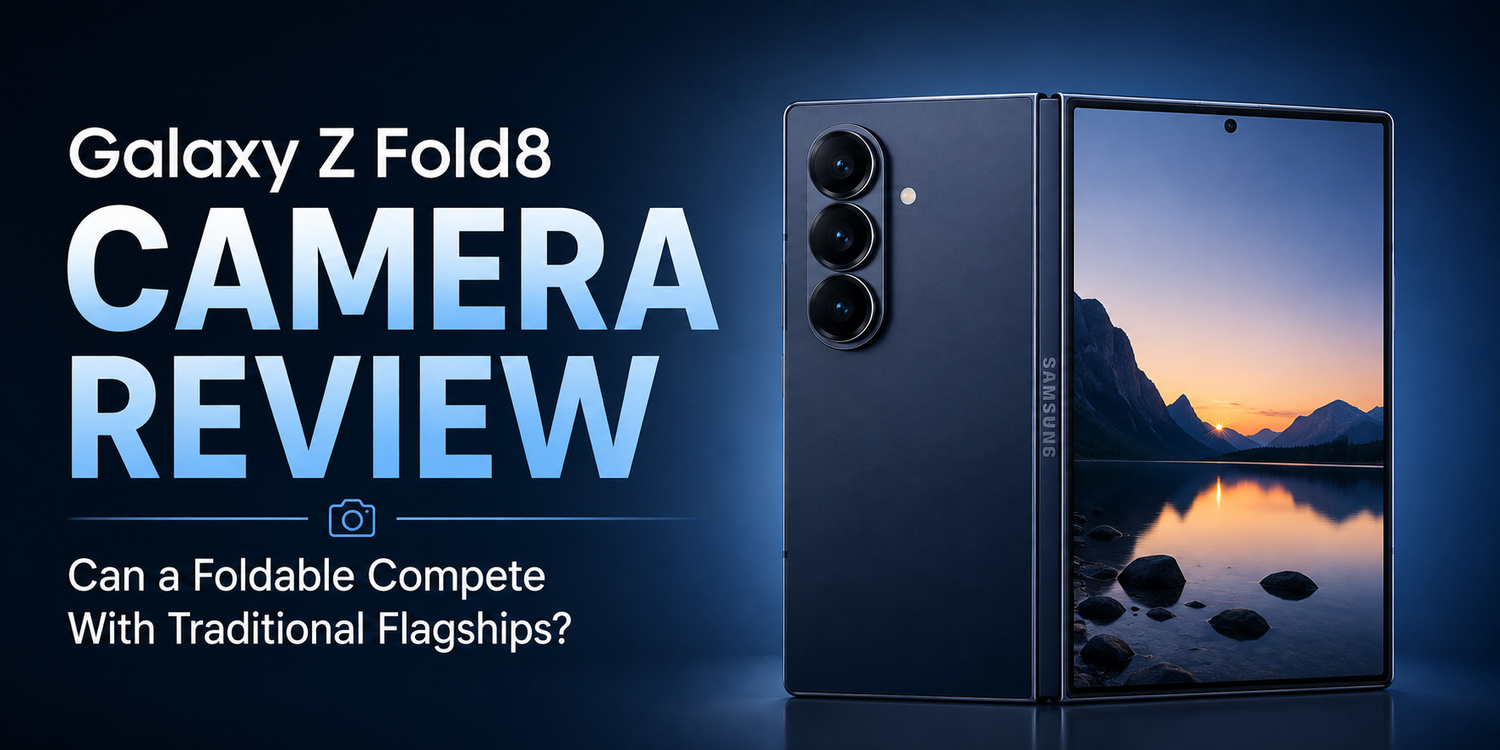
Galaxy Z Fold8 Camera Review: Can a Foldable Compete With Traditional Flagships?
Foldable smartphones have improved dramatically over the last few years, but cameras have traditionally been one of the areas where they have had to compromise. A foldable phone needs room for a hinge, two displays, multiple batteries, cooling hardware and a complex internal structure. That leaves less freedom for oversized camera sensors and large telephoto systems.The Samsung Galaxy Z Fold8 challenges that old assumption.Rather than being judged only as a foldable, it increasingly has to compete with traditional premium flagships on photography as well. Buyers spending flagship money expect excellent photos, strong video, useful zoom and dependable low-light performance.So can the Galaxy Z Fold8 really compete with conventional flagship phones, or does the foldable design still hold the camera back?
The Camera Has to Do More Than Look Impressive on Paper
Camera specifications are useful, but they do not tell the whole story.A high megapixel count does not automatically mean better photos. Sensor size, lens quality, optical stabilisation, image processing and software all influence the final result.Samsung’s biggest challenge with a Fold model is balance.The company has to make the device thin enough to carry comfortably while still fitting serious camera hardware into one half of the phone.A traditional flagship has more freedom because its internal structure is simpler.That means the Fold8 camera should be judged not only by absolute quality but also by how well Samsung combines photography with the foldable form factor.
Everyday Photos Are Where It Needs to Be Reliable
Most people are not taking professional photographs every day.They are photographing friends, food, pets, documents, buildings and holidays.For these situations, consistency matters more than extreme camera specifications.A premium phone should be able to open the camera quickly, focus accurately and produce a photograph you are happy to share without requiring manual adjustments.Samsung’s image processing traditionally aims for a bright, punchy look that works well for casual photography.That approach can be particularly useful on a Fold because the large inner display makes reviewing images immediately much more enjoyable.Take the photo, unfold the device and suddenly you have a much larger screen for checking sharpness, colour and composition.That is one camera advantage traditional phones cannot easily match.
The Large Inner Display Changes the Photography Experience
This may be one of the Galaxy Z Fold8’s strongest photographic advantages.On a normal flagship phone, you take a photograph and review it on a relatively narrow display.With the Fold8, you can open the phone and inspect the image on a much larger screen.That makes it easier to notice whether a subject is slightly out of focus or whether you need to retake the shot.It also helps when editing.Cropping, adjusting brightness, changing colour or working with creative tools can feel more natural when you have more screen space.So even if a traditional flagship had slightly stronger camera hardware, the Fold8 could still offer a better photography workflow.
The Foldable Design Helps With Hands-Free Photos
The hinge can also become a photography tool.Partially fold the Galaxy Z Fold8 and place it on a stable surface, and the phone can effectively act as its own stand.That can be useful for group photographs, video calls, time-lapse shots and self-recording.A traditional phone normally needs a tripod, stand or something to lean against.The Fold8 can position itself.That may sound like a small feature, but it can become genuinely useful while travelling.Want a group photo without asking someone else to hold your phone?Set the Fold8 down, adjust the angle and use a timer or compatible remote control method.This is one area where the foldable design does more than simply change screen size.
Rear-Camera Selfies Can Be a Real Advantage
Foldable phones also allow you to use the main rear camera system for selfies more easily.On a conventional smartphone, most selfies are taken with the front camera because that is the only practical way to see yourself while framing the shot.A Fold device can use the external display as a preview while the rear cameras face you.That means you can potentially use the stronger main camera hardware for selfies and group shots.For travellers, couples and social media users, this can be a meaningful advantage.The better camera is no longer always pointed away from you.
Daylight Photography Should Be the Easy Part
In good lighting, modern premium smartphones are extremely capable.That means the Galaxy Z Fold8 needs to deliver sharp detail, strong dynamic range and reliable colour without making the user work for it.Traditional flagship phones from Samsung, Apple, Google and Xiaomi already set a very high standard in daylight.The Fold8 therefore cannot rely on the novelty of its design.Its photos need to look genuinely premium.In bright outdoor conditions, differences between flagship cameras can actually become smaller because there is plenty of light available.Where the real differences become more obvious is when lighting becomes difficult.
Low Light Is a Bigger Test
Night photography places more pressure on camera hardware and image processing.The sensor receives less light, meaning the phone needs to combine information from longer exposures and computational processing while trying to control noise and preserve detail.A traditional flagship with a large main sensor may have an advantage here.The Fold8 has to fit its camera system into a thinner folding body.That could limit how large some of its camera components can be compared with a photography-first slab flagship.However, Samsung’s computational photography can help reduce that gap.Modern phone cameras do not rely entirely on physical sensor size. Multiple frames can be combined to brighten dark scenes, reduce noise and improve dynamic range.The question is whether the Fold8 can do this consistently without producing overly processed results.
Zoom Is Where Traditional Ultra Flagships May Still Lead
Telephoto photography is one of the hardest areas for foldables.Long-range zoom cameras require physical space.Periscope-style systems in particular use internal optical paths that can be difficult to fit into a slim folding body.This means a traditional Ultra flagship may still have an advantage if you regularly photograph distant subjects.Wildlife, sports, concerts and architecture can all benefit from stronger optical zoom.For many users, however, extreme zoom is not something they use every day.A useful mid-range telephoto capability can be more important than chasing the longest possible focal length.So whether this is a serious compromise depends on how often you actually zoom.
Video Could Be More Important Than Photos
Video has become just as important as still photography for many buyers.People record family moments, travel clips, social media videos and work content directly from their phones.The Galaxy Z Fold8 needs to deliver stable footage, reliable autofocus and strong exposure transitions if it wants to compete with traditional flagships.The foldable design creates some interesting opportunities here too.You can partially fold the device and place it on a table for hands-free recording.The large internal screen can also make reviewing and editing video easier.That creates a complete content workflow inside one device.Shoot on the rear camera, unfold the phone, edit on the large display and publish without needing a separate tablet.For content creators, that flexibility could be more valuable than a small difference in raw camera quality.
Camera Processing Matters More Than Ever
Samsung’s software plays a huge role in the final result.Modern smartphone photography uses computational techniques for HDR, night mode, portrait effects and image sharpening.The Fold8 does not simply capture what the sensor sees.It processes the image almost instantly.Good processing should preserve detail, control highlights and shadows, and make colours look pleasing without appearing unnatural.Poor processing can make even excellent hardware look disappointing.This is one reason flagship camera comparisons are difficult.Two phones can use similar sensor sizes yet produce very different results because their image processing philosophies are different.
Portrait Photography Is a Useful Test
Portrait mode is another area where traditional flagships have become extremely sophisticated.The phone needs to recognise the subject, separate it from the background and create convincing blur.Hair, glasses and complex edges can expose weaknesses quickly.The Galaxy Z Fold8 should be competitive here, particularly because Samsung has years of experience with portrait processing.The large inner display also makes reviewing portraits easier.You can immediately inspect whether the background separation looks natural instead of judging everything on a small screen.
The Fold8 May Be Better for Editing Than Shooting
This sounds strange in a camera review, but it may be one of the device’s biggest strengths.Traditional flagships may still have advantages in certain hardware-heavy areas, particularly extreme zoom or very large camera sensors.But the Galaxy Z Fold8 can potentially offer a better complete photography experience.Taking the photo is only one step.You may also want to crop, edit, compare, organise and share.The Fold8’s larger display gives it a clear advantage for those tasks.A photographer who frequently edits images on the same device may therefore value the foldable more than someone interested only in the initial shutter press.
What About Social Media?
For Instagram, TikTok and other social platforms, the Fold8 can be particularly interesting.The large display gives you more room for editing captions, reviewing videos and managing content.Hands-free recording can also be useful for creators.The key question is application optimisation.Social media apps need to work properly with the unusual inner display size.Poor optimisation can reduce the advantage of having a larger screen.As foldables become more common, app support continues to improve, which makes the concept increasingly practical for creators.
Can It Replace a Dedicated Camera?
For most everyday users, potentially yes.But the same can be said about many premium smartphones.A dedicated camera still has major advantages when you need interchangeable lenses, large sensors, long telephoto reach, advanced manual controls or specialised professional workflows.The Fold8’s strength is convenience.You already have it in your pocket.You can shoot, review, edit and share using one device.That is difficult for a dedicated camera to match.The real question is not whether the Fold8 can completely replace professional camera equipment.It is whether it can eliminate the need to carry additional gear for everyday photography.For many people, the answer will be yes.
Where Traditional Flagships Still Have an Advantage
The most important disadvantage comes from physical constraints.A traditional flagship can dedicate more internal volume to the camera.That can allow larger sensors, more ambitious telephoto systems and more sophisticated optical hardware.The Fold8 has to share its internal space with a hinge and flexible display system.That means Samsung must make engineering compromises somewhere.The gap may not be noticeable in ordinary daylight photography.It becomes more relevant when comparing specialised camera capabilities.
Where the Fold8 Has an Advantage
Traditional smartphones cannot easily replicate the Fold8’s photography workflow.The large inner screen makes image review and editing easier.The hinge provides a built-in stand.The cover screen can help with rear-camera selfies.The device can move between shooting, editing and publishing without requiring a second screen.Those are practical benefits rather than camera-specification advantages.And practical benefits often matter more during real ownership.
Who Should Choose the Fold8 for Photography?
The Fold8 makes sense for people who want strong flagship photography but also value productivity and creative flexibility.Travellers can benefit from the large viewing screen and self-standing design.Content creators may enjoy shooting and editing on the same device.Families can use hands-free positioning for group photographs.Business users can photograph documents and immediately review them on a larger display.If photography is your absolute number-one priority, however, a traditional camera-focused flagship may still make more sense.