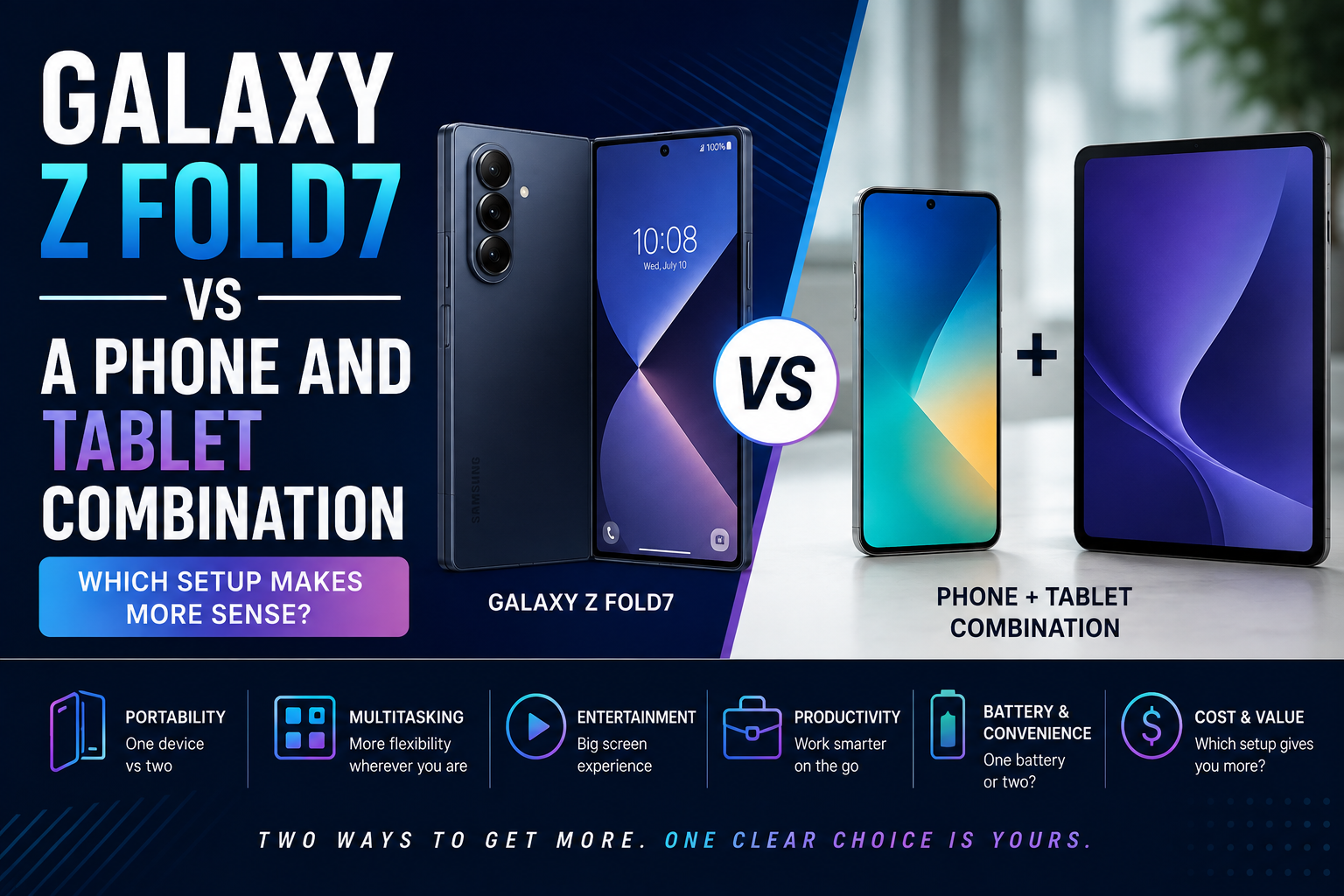


































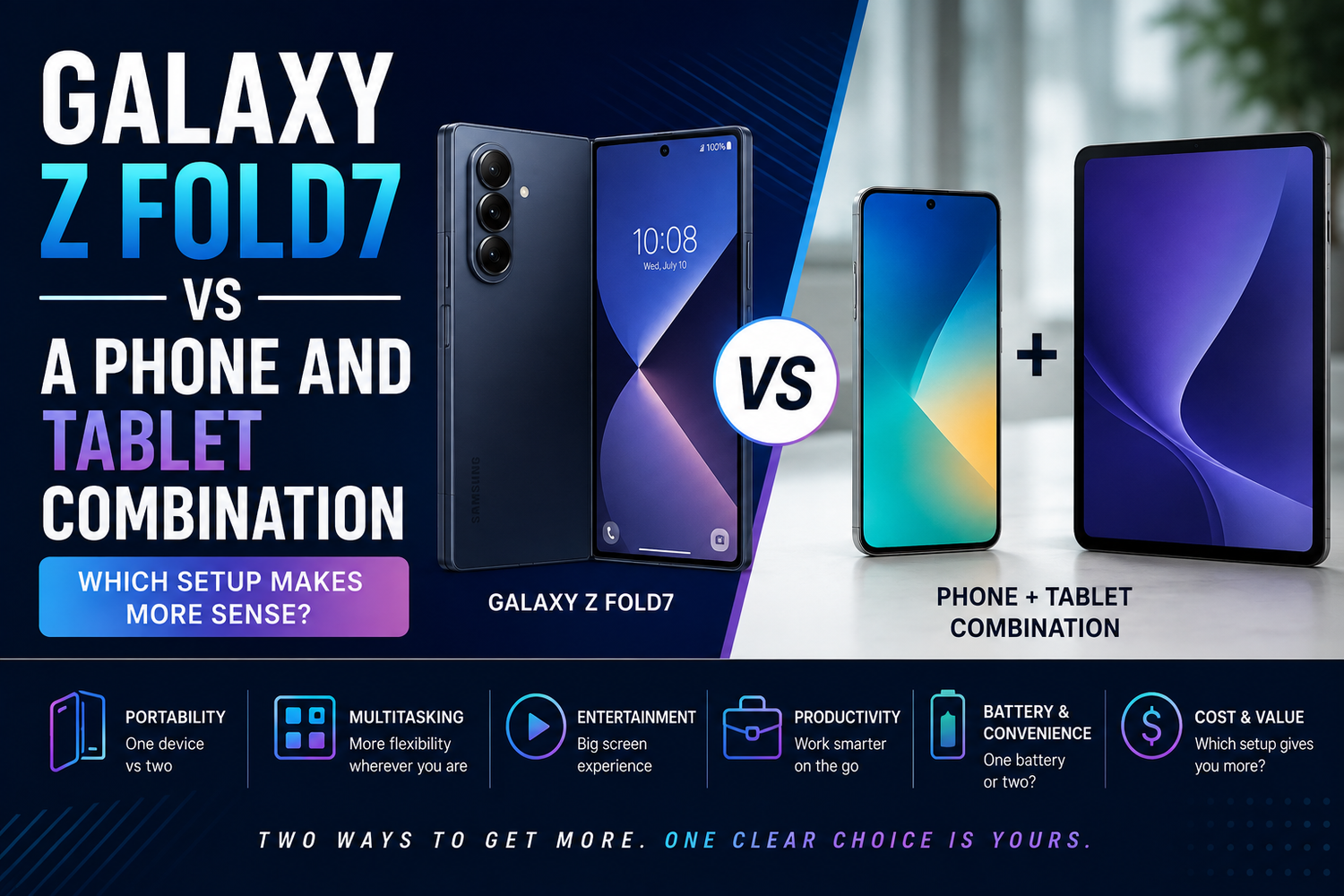
For years, anyone wanting both portability and a large screen had a straightforward solution: carry a smartphone and a tablet.Your phone handled calls, messages, navigation and quick everyday tasks, while the tablet came out when you wanted more screen space for movies, reading, gaming or work.The Samsung Galaxy Z Fold7 offers a very different approach. Instead of carrying two devices, you get a conventional smartphone-style cover screen and a much larger folding display inside.On paper, that sounds like the perfect combination.But does one foldable really make more sense than owning a separate phone and tablet?The answer depends less on specifications and more on how you actually use your devices.
One Device vs Two
The biggest advantage of the Galaxy Z Fold7 is obvious: you only have to carry one device.With a traditional phone-and-tablet setup, you need to remember two devices, potentially two chargers and possibly accessories for both. You'll also need somewhere to carry the tablet.A Fold7 goes into your pocket like a smartphone.When you need more room, unfold it.This simplicity can be particularly attractive to commuters, business travellers and anyone who frequently moves between locations.However, a separate tablet offers something the Fold7 can't fully reproduce: a genuinely larger display.So the choice begins with a simple question.Do you value maximum screen size or minimum number of devices?
Everyday Smartphone Use Favors the Fold7
Most of your daily interactions with technology probably happen on your phone.Checking messages.Looking at notifications.Making payments.Taking photographs.Using navigation.Answering calls.With the Galaxy Z Fold7, you can perform those quick tasks from the outer display without opening the device.When you need more space, the inner screen is waiting.That's the clever part of the foldable concept. You don't need to decide in advance whether to bring your tablet.It's always with you.With a phone-and-tablet combination, your tablet might stay at home because you didn't think you'd need it.The Fold7's larger display is available whenever the moment arises.
But a Tablet Still Wins for Screen Size
Open the Galaxy Z Fold7 and you get a significantly larger workspace than a conventional smartphone.But it's still designed to remain portable enough to fold into a phone.A dedicated tablet doesn't have that restriction.An 11-inch or larger tablet provides substantially more physical space for documents, spreadsheets, drawing, video editing and entertainment.If you're watching a two-hour movie at home, you may prefer the tablet.If you're working on a detailed spreadsheet, you'll probably appreciate the additional space.If you're reading a document while taking notes, a full-size tablet can be more comfortable.The Fold7 offers a compromise between phone and tablet.A dedicated tablet doesn't need to compromise as much on screen size.
Multitasking Is Where the Fold7 Gets Interesting
One of the strongest arguments for a book-style foldable is multitasking.A conventional smartphone is generally optimised around viewing one application at a time, even if split-screen features are available.The Fold7's inner display gives apps more breathing room.You might have email open alongside a browser.You could watch a video while checking messages.You could reference information in one app while writing something in another.This can make the Fold7 feel less like an oversized phone and more like a small productivity device.A tablet can do similar things and often with more room.The difference is accessibility.The Fold7 is already in your pocket when you need to multitask.
Which Setup Is Better for Work?
That depends entirely on the work.For quick productivity, the Galaxy Z Fold7 can be extremely convenient.Reading emails, reviewing PDFs, joining video calls, editing documents and checking spreadsheets all benefit from the larger folding display.Imagine you're waiting at an airport and need to review a contract.On a regular phone, you may spend your time zooming and scrolling.With a Fold7, you can open the device and get a much more useful view immediately.A tablet still makes more sense for longer sessions.If you're writing thousands of words, editing a complex presentation or spending hours in spreadsheets, a larger tablet with a physical keyboard may provide a more comfortable workspace.The Fold7 is excellent for work that unexpectedly happens while you're mobile.A tablet is better suited to work sessions you planned to have.
Entertainment Creates an Interesting Trade-Off
The Fold7's large inner display sounds ideal for Netflix, YouTube and other streaming platforms.And it can be.But there's an important consideration: aspect ratio.Movies and television programmes aren't necessarily formatted to fill a foldable's squarer display completely. Depending on the content, you may see unused space around the video.A conventional widescreen tablet can sometimes make better use of its display for movies.YouTube, however, can benefit from the extra room, particularly when you're browsing comments or other content alongside the video.For social media, web browsing and reading, the Fold7's unusual screen shape can be highly useful.For pure movie watching, a larger conventional tablet may still provide the more cinematic experience.
Gaming Depends on the Games You Play
Gaming presents a similar situation.The Fold7 gives mobile games a larger canvas without requiring you to carry a separate device.For compatible titles, that can be fantastic.Touch controls have more room, interfaces can feel less cramped and games can become more immersive.A tablet still has advantages.Its larger body can be easier to hold during certain games, while the bigger screen can provide a more expansive experience.Game optimisation also matters. Not every title necessarily takes perfect advantage of a foldable aspect ratio.Casual mobile gamers may love having a bigger gaming display permanently available.Someone who sits down specifically for extended gaming sessions might prefer a tablet or a dedicated gaming device.
Reading May Be the Fold7's Secret Strength
Reading is one area where the Fold7 concept makes enormous sense.Websites, PDFs, digital magazines, comics and eBooks all benefit from additional screen space.Unlike watching widescreen video, reading doesn't always require a specific aspect ratio.Open the Fold7 and a web article immediately has more room.Documents become easier to inspect.Comics can feel more natural.The best part is that you don't need to remember your tablet.For someone who spends a lot of time reading while commuting, this alone could make a foldable appealing.
Cameras Are Much Simpler With One Device
A phone-and-tablet combination introduces an obvious camera reality.You'll probably still use your phone for almost every photograph.Tablets have cameras, but their size makes them less convenient for everyday photography.With the Galaxy Z Fold7, your camera and large editing screen exist in the same device.Take a photograph, unfold the phone and review it on the bigger display.You can then edit, share or upload it without moving the file to another device.For travellers and content creators, that consolidated workflow can be extremely useful.
Battery Life Changes When You Have Two Devices
Two devices mean two batteries.That can be annoying because both need charging.But it can also be an advantage.If your phone battery is running low, you can use your tablet for entertainment and preserve your phone for communication.With the Fold7, everything depends on one battery.Navigation, photography, gaming, video streaming and productivity all draw energy from the same device.That makes charging habits particularly important for heavy users.The one-device lifestyle is simpler, but two devices provide more total battery resources and redundancy.
Durability Is Another Consideration
Traditional smartphones and tablets use established rigid-screen designs.Foldables are more mechanically complex.The Galaxy Z Fold7 contains a hinge and flexible internal display because folding is the entire point.Samsung has spent multiple generations improving its foldable hardware, but owners should still understand that a folding phone is structurally different from a conventional slab smartphone.If you're someone who keeps a phone for many years or works in particularly demanding environments, long-term durability may deserve extra consideration.A separate conventional phone and tablet can also spread usage across two devices rather than putting everything onto one.
Cost Isn't as Simple as It Looks
A premium foldable can be expensive.But comparing its price only with a conventional phone isn't necessarily fair.The Fold7 is trying to perform some of the roles of both a smartphone and tablet.The more useful comparison is:
Galaxy Z Fold7 vs the total cost of the phone and tablet you would otherwise buy.
If you'd normally purchase a premium flagship phone plus a premium tablet, a foldable may look more reasonable.If you'd buy a mid-range phone and an affordable tablet, the two-device combination could provide much more screen space for your money.Accessories, storage requirements and upgrade cycles should also be considered.
Which Setup Makes More Sense?
Choose the Galaxy Z Fold7 if you value portability above everything else.It's particularly compelling if you frequently read documents, multitask, browse the web, edit content or watch videos while away from home.The ability to transform your everyday phone into a larger-screen device whenever you need it is difficult for a conventional setup to match.Choose a separate phone and tablet if you spend long periods using the larger screen.A tablet makes more sense for extended productivity, drawing, serious note-taking, long movie sessions and situations where maximum display space matters more than portability.There's also another advantage: two people can use the devices at once, something no foldable can replicate.