


































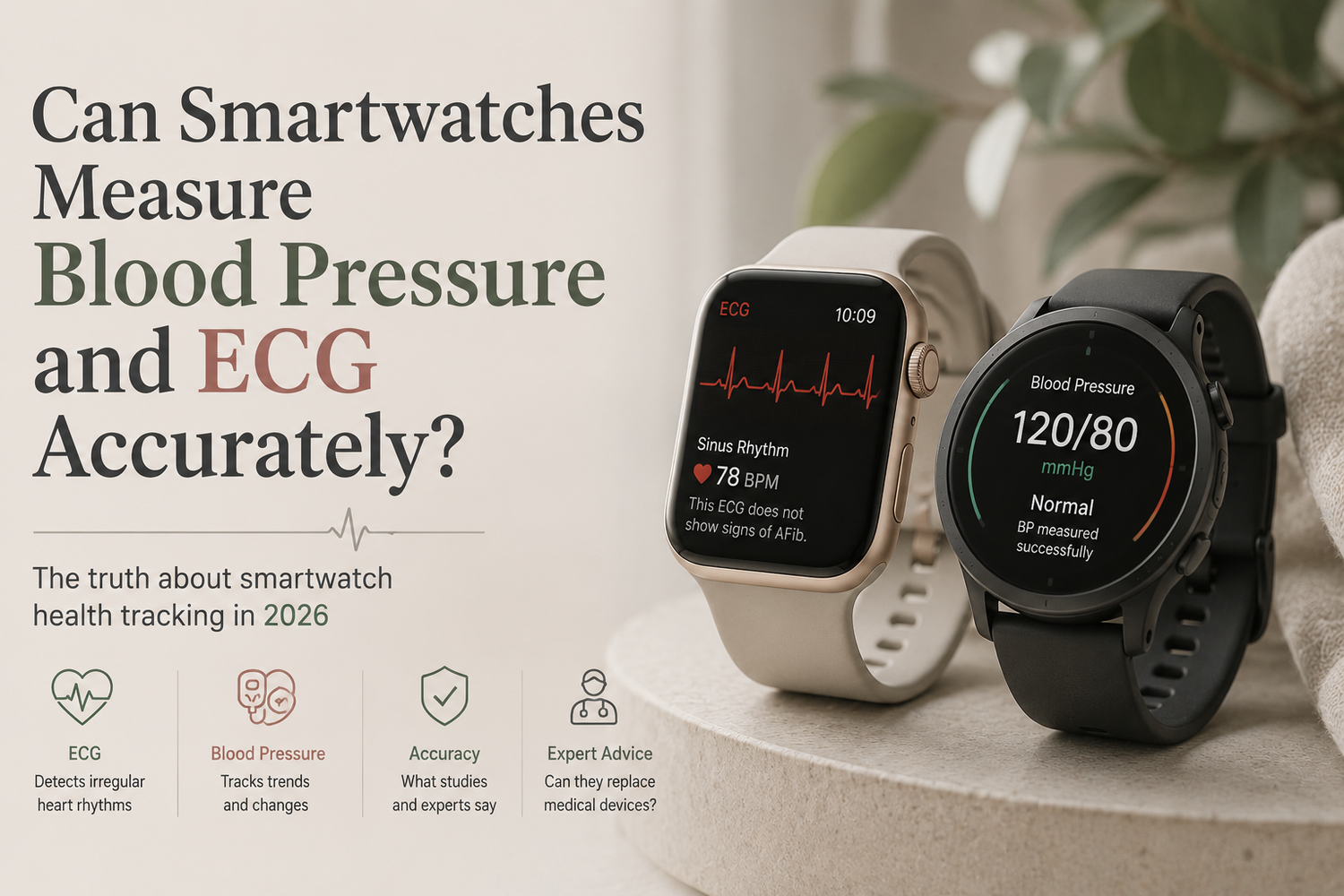
Smartwatches are no longer just devices for counting steps and showing notifications. Modern wearables now include advanced health features such as heart rate tracking, sleep analysis, ECG monitoring, oxygen level detection, stress tracking, and even blood pressure estimation. As smartwatch technology continues to evolve, many people are beginning to wonder whether these health features are actually accurate enough to trust.Brands like Apple, Samsung, Huawei, Fitbit, and Withings are investing heavily in wearable health technology. Some smartwatches can now warn users about irregular heart rhythms and estimate blood pressure directly from the wrist.But how reliable are these readings in real life? Can smartwatches replace medical devices, or are they simply helpful wellness tools? In this FAQ-style guide, we answer the most important questions about smartwatch ECG and blood pressure monitoring accuracy.
What Is ECG on a Smartwatch?
ECG stands for electrocardiogram, a medical test that records the electrical activity of the heart.Some smartwatches now include ECG functionality that allows users to take quick heart rhythm readings directly from their wrist. Devices like the Apple Watch, Samsung Galaxy Watch, and Withings ScanWatch can generate single-lead ECG reports that help identify irregular heart rhythms such as atrial fibrillation.The process is usually simple and takes around 30 seconds. Users place a finger on the watch sensor while remaining still, and the watch records electrical signals from the heart.Unlike hospital ECG systems that use multiple sensors attached to the body, smartwatch ECG systems are simplified versions designed mainly for convenience and early warning detection.
Are Smartwatch ECG Readings Accurate?
Smartwatch ECG readings can actually be quite accurate for detecting certain heart rhythm problems.Studies and medical experts have shown that devices like the Apple Watch and Samsung Galaxy Watch can successfully identify atrial fibrillation and irregular heart rhythms in many situations. This makes smartwatch ECG features especially useful for users who may experience occasional heart rhythm abnormalities that would otherwise go unnoticed.However, smartwatch ECG systems still have important limitations.They are not designed to fully replace professional medical ECG machines used in hospitals and clinics. Smartwatches mainly act as screening tools rather than complete diagnostic devices.They may struggle to detect:
-
Heart attacks
-
Blocked arteries
-
Complex arrhythmias
-
Certain electrical abnormalities
Medical professionals still recommend proper clinical testing if users receive unusual ECG alerts from their smartwatch.For general heart rhythm monitoring and wellness tracking, though, smartwatch ECG technology has become surprisingly useful and reliable.
Can Smartwatches Measure Blood Pressure?
Yes, some smartwatches can estimate blood pressure, but this technology is much more complicated than ECG monitoring.Traditional blood pressure monitors use inflatable cuffs to physically measure pressure changes inside arteries. Most smartwatches, however, rely on optical sensors and algorithms to estimate blood pressure based on blood flow patterns and pulse wave analysis.Samsung Galaxy Watches, for example, support blood pressure tracking in certain regions. However, users must regularly calibrate the watch using a traditional blood pressure cuff.This calibration process is necessary because smartwatch blood pressure systems still depend heavily on reference measurements from standard medical devices.
Are Smartwatch Blood Pressure Readings Accurate?
Blood pressure monitoring on smartwatches is improving, but it is still not as accurate as medical-grade blood pressure monitors.Most smartwatch blood pressure systems are designed more for tracking trends and wellness insights rather than delivering perfectly precise clinical measurements.Experts continue to emphasize that traditional cuff-based monitors remain the gold standard for accurate blood pressure readings.Some advanced smartwatches attempt to improve accuracy by including miniature inflatable cuff systems directly inside the watch strap. Devices like the Huawei Watch D use this approach to provide more reliable measurements compared to purely sensor-based estimation systems.Still, most mainstream smartwatches cannot fully replace traditional blood pressure monitors used by doctors.Factors such as movement, wrist position, watch fit, body posture, and calibration can all affect reading accuracy.
Why Is Blood Pressure Tracking More Difficult Than Heart Rate Tracking?
Blood pressure measurement is significantly more complex than heart rate monitoring.Heart rate tracking mainly relies on optical sensors detecting pulse patterns through light reflection beneath the skin. Blood pressure estimation requires far more advanced calculations involving blood flow speed, arterial stiffness, pulse timing, and cardiovascular behavior.Even small wrist movements or incorrect positioning can affect measurement quality.This is why smartwatch companies continue investing heavily in AI, machine learning, and advanced sensors to improve cuffless blood pressure technology.Researchers are also exploring ways to combine ECG signals, motion sensors, temperature data, and optical sensors to improve wearable blood pressure estimation accuracy.While progress is promising, truly medical-grade cuffless blood pressure monitoring is still evolving.
Which Smartwatches Offer ECG Features?
Several major smartwatch brands now support ECG functionality.Popular devices with ECG support include the Apple Watch series, Samsung Galaxy Watch lineup, Withings ScanWatch, and Fitbit Sense series.Among these, the Apple Watch is often considered one of the most reliable and widely approved ECG smartwatches available today.These devices are mainly designed to help users identify irregular heart rhythms and potential signs of atrial fibrillation.For users interested in heart rhythm monitoring, ECG functionality has become one of the most valuable smartwatch health features currently available.
Which Smartwatches Support Blood Pressure Monitoring?
Blood pressure tracking is less common because of the technology’s complexity and medical regulations.Some smartwatches that currently support blood pressure monitoring include Samsung Galaxy Watches and Huawei health-focused smartwatch models.Samsung’s system requires regular calibration with a traditional blood pressure monitor, while Huawei’s Watch D uses an inflatable mini cuff built directly into the watch strap to improve accuracy.Users should also be cautious with cheaper smartwatches that advertise instant blood pressure monitoring because many lack proper medical validation or consistent accuracy testing.
Can Smartwatches Replace Medical Devices?
No, smartwatches should not replace professional medical equipment or doctor consultations.Health experts consistently warn that smartwatch health features are best viewed as wellness tools and early warning systems rather than complete medical diagnostic devices.Smartwatches can help users:
-
Detect unusual heart rhythm changes
-
Monitor wellness trends
-
Track resting heart rate
-
Observe sleep patterns
-
Encourage healthier habits
-
Notice potential warning signs earlier
However, professional medical devices remain significantly more accurate and reliable for diagnosis and treatment decisions.Users who receive unusual smartwatch readings should always consult healthcare professionals rather than relying entirely on smartwatch data.
Are Smartwatch Health Features Improving?
Yes, smartwatch health technology is improving very rapidly.Companies are investing heavily in artificial intelligence, sensor technology, machine learning, and advanced algorithms to improve wearable health tracking accuracy.Future smartwatches may eventually offer more reliable continuous monitoring for:
-
Blood pressure
-
Heart rhythm abnormalities
-
Stress levels
-
Glucose monitoring
-
Cardiovascular health
At the moment, ECG technology is generally more mature and reliable than smartwatch blood pressure estimation.However, wearable health tracking continues improving every year, and the gap between consumer smartwatches and medical devices is slowly becoming smaller.
Should You Trust Smartwatch Health Readings?
Smartwatch health readings can be useful, but they should always be interpreted carefully.ECG features on reputable smartwatches can provide meaningful insights into heart rhythm irregularities and may even encourage users to seek medical attention earlier.Blood pressure tracking can also help users observe long-term trends and general cardiovascular changes.However, smartwatch readings should never be treated as fully accurate medical diagnoses.The safest approach is to use smartwatch health features as supportive wellness tools while continuing to rely on professional healthcare providers and medical-grade equipment for serious medical concerns.
Are Smartwatches Worth Buying for Health Tracking?
For many users, yes.Modern smartwatches can encourage healthier lifestyles by helping users become more aware of their sleep quality, activity levels, stress, heart rate, and overall wellness.Features like ECG monitoring and blood pressure tracking add extra value for users who want additional health insights and early warning tools.While they cannot fully replace medical devices, smartwatches can still play an important role in helping users stay more connected to their health and fitness goals.