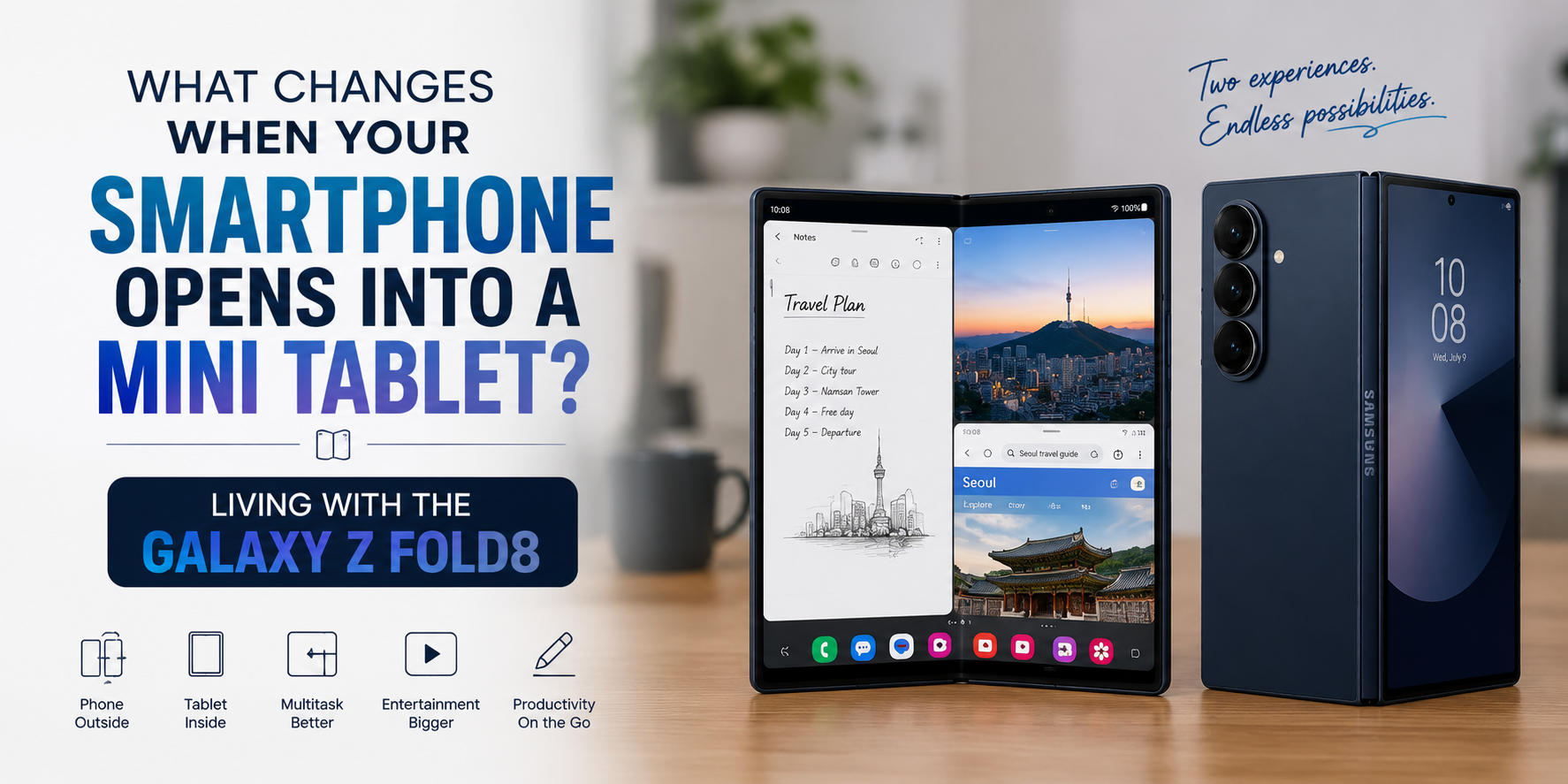































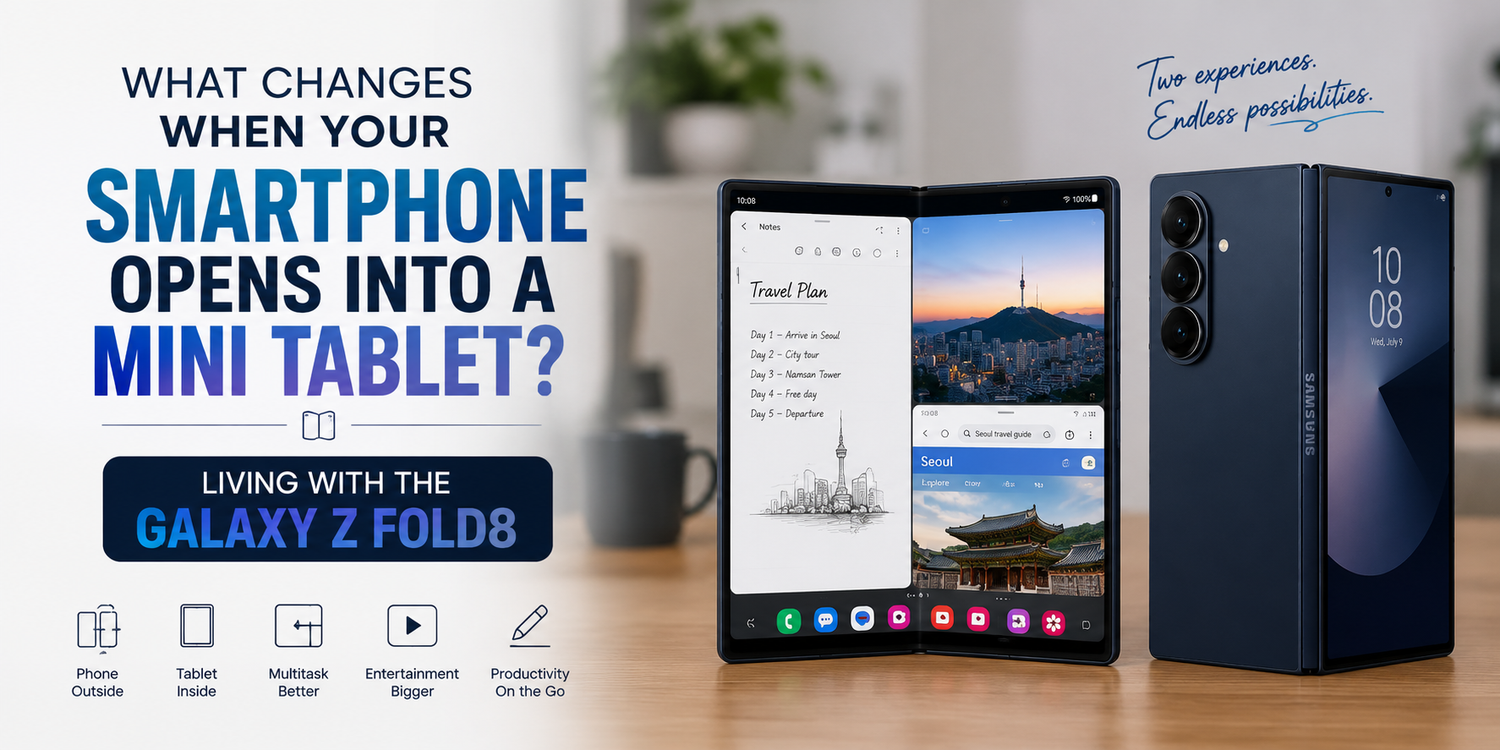
Foldable smartphones have spent years trying to prove that they are more than expensive technology experiments. Hardware has become thinner, hinges have improved, flexible displays have matured and manufacturers have found ways to make foldables easier to carry. But one challenge has always remained: the apps.A device like the Samsung Galaxy Z Fold8 can open from a conventional smartphone into a mini tablet, but that larger screen is only valuable when applications know what to do with it.Stretching a phone app across a bigger display does not automatically create a better experience. A genuinely foldable-friendly app needs to adapt its interface, make intelligent use of additional space and transition smoothly as the device moves between folded and unfolded states.So, after years of Android foldables, are apps finally ready for devices like the Galaxy Z Fold8?
Why Foldable Apps Were Initially a Problem
Android applications were traditionally designed around one basic assumption: people would use them on rectangular smartphone screens.Developers had to support different screen sizes, but the fundamental layout remained relatively predictable.Foldables changed that.One moment, an application could be running on a narrow cover display. Seconds later, the user could unfold the device and give that same app substantially more space.Early foldable apps did not always respond elegantly.Some simply stretched their smartphone interfaces across the larger display. Buttons could appear unusually far apart, photographs could become unnecessarily large and huge areas of the screen could remain unused.The hardware was ready to transform.The software was still thinking like a phone.
A Bigger App Is Not Necessarily a Better App
This distinction is important when discussing the Galaxy Z Fold8.Imagine opening a messaging application on the inner display.If the app simply makes each conversation wider, you gain very little from unfolding the phone.A better design might place your conversation list on one side and the active chat on the other.Email provides another example.Instead of displaying one enormous inbox, an optimised layout can show the inbox alongside the selected message.The same principle applies to file managers, calendars, note-taking tools and productivity applications.The best foldable apps do not simply become larger.They become more useful.
Android Has Become More Aware of Large Screens
The good news is that Android's approach to larger displays has evolved considerably.Tablets, foldables and other large-screen devices have encouraged developers to think beyond fixed smartphone layouts.Modern Android development tools support adaptive interfaces that can reorganise themselves according to the available screen space.That means developers do not necessarily need to create an entirely separate application specifically for the Galaxy Z Fold8.Instead, one app can intelligently change its layout depending on whether it is running on a small cover display, a large unfolded screen or another Android device.This is an important shift.Foldable optimisation becomes less about supporting one unusual Samsung phone and more about building an Android app that works well across different screen sizes.
App Continuity Is Essential
One of the most important parts of the foldable experience happens during the transition between screens.Suppose you are reading an article on the Galaxy Z Fold8's cover display.You decide you want more room, so you unfold the phone.Ideally, the application should continue exactly where you were.You should not have to reopen the article, find your position again or restart the application.This concept is often referred to as app continuity.When implemented properly, unfolding feels natural.The physical device changes shape, but your activity continues.This is the kind of software behaviour that determines whether a foldable feels futuristic or frustrating.
Multitasking Is Where Foldable Apps Start Making Sense
One of the strongest arguments for the Galaxy Z Fold8 is not necessarily running one enormous application.It is running multiple applications together.The inner display gives Android enough room to make split-screen multitasking genuinely useful.You might keep a browser open while writing notes.You could watch a video while responding to messages.You might compare two shopping websites or reference an email while adding an appointment to your calendar.On a conventional smartphone, split-screen can feel cramped because each application receives very little room.On a Fold-style display, the idea becomes much more practical.This means an application does not always need a spectacular foldable-specific interface to benefit from the hardware.Sometimes it simply needs to behave properly when sharing the screen.
Productivity Apps Benefit the Most
Certain categories naturally make better use of large displays.Email is an obvious example.A two-pane interface can show folders or messages on one side and content on the other.Calendar applications can display more appointments and information simultaneously.Document editors gain more room for formatting controls.File managers can make navigating folders easier.Note-taking applications can provide additional space for handwriting, reference material and organisation tools.These are small changes individually.Together, they can make the unfolded Galaxy Z Fold8 feel closer to a compact productivity tablet than an oversized smartphone.For business users, this may be where foldable software provides its strongest argument.
Social Media Is More Complicated
Social media presents a different challenge.Many social platforms were built around vertical smartphone screens.A single photograph, short video or post naturally fills that format.Opening the same interface across a much wider display does not automatically improve anything.Developers therefore have to decide how additional space should be used.Should more posts appear simultaneously?Should navigation move to the side?Should comments appear next to content instead of underneath it?There is no single correct answer.As a result, social applications can still vary considerably in how effectively they use foldable displays.This is one area where owning a larger screen does not guarantee a dramatically better experience.
Video Apps Face the Aspect Ratio Problem
Streaming video sounds like the perfect use for a large foldable display.And in many ways, it is.The physical image can be considerably larger than it would be on a conventional smartphone.However, the Galaxy Z Fold8's unfolded display shape may not perfectly match the aspect ratio of films and television programmes.That means black areas can appear around some content.This is not necessarily poor app optimisation.It is simply a consequence of displaying rectangular video formats on a differently shaped screen.The extra screen area can still be useful for controls, comments, recommendations or multitasking.But users should not assume that unfolding the phone means every movie will suddenly occupy the entire display.
Gaming Remains an Interesting Challenge
Games are another category where foldable optimisation can vary.Some games scale beautifully and provide a more immersive view.Strategy games, simulation titles and games with complicated interfaces can particularly benefit from additional screen space.Other games may use fixed aspect ratios or interface elements originally designed for conventional smartphones.That can create awkward scaling or unusual control placement.There is also a competitive consideration.A larger view is not automatically better if important touchscreen controls become harder to reach.Developers need to think about both visual presentation and ergonomics.The Fold8 can be an impressive gaming device, but individual game optimisation still matters.
Flex Mode Creates Another Possibility
Foldable phones can do something ordinary tablets cannot: remain partially folded.This introduces another type of interface opportunity.An application can potentially place content on one half of the display and controls on the other.For video, that might mean the upper portion displays the content while playback controls appear below.For photography, the preview could occupy one section while camera controls remain accessible on another.Not every application needs this functionality.But when developers use the physical folding position intelligently, the software begins to feel designed around the hardware rather than simply compatible with it.
Google's Own Apps Help Set Expectations
Google has a major role in improving foldable software because Android developers often look to Google's applications and design guidance for examples.Large-screen optimisation across productivity, communication and media applications helps establish patterns other developers can follow.This matters because Samsung cannot solve the app problem alone.Samsung can optimise One UI, multitasking features and its own applications, but the Galaxy Z Fold8 experience also depends on thousands of third-party developers.The more large-screen Android devices enter the market, the stronger the incentive becomes for developers to improve adaptive layouts.
Samsung's Software Helps When Apps Are Not Perfect
The Galaxy Z Fold8 does not depend entirely on developers making dedicated foldable interfaces.Samsung's multitasking tools can help users take advantage of the large screen even when individual apps remain relatively conventional.Running multiple applications simultaneously is a good example.Instead of stretching one poorly optimised application across the entire display, you can give it only part of the screen and use the remaining space for something else.This can make ordinary phone-style apps more useful on a foldable.Samsung's software therefore acts as a bridge between the unusual hardware and Android applications that were not necessarily created specifically for it.
Are All Android Apps Ready?
No.That is the important reality.The Android ecosystem is enormous. Applications are created by companies ranging from global technology businesses to individual developers.Not every developer has the resources or incentive to redesign an application for foldables.Some apps will look excellent.Others will simply become larger.A few may still behave awkwardly when switching between display sizes.This inconsistency is unlikely to disappear completely.But perfection is not necessary for foldables to become practical.The more important question is whether enough of the applications people use every day now provide a good experience.
The Situation Is Much Better Than Early Foldables
This is where the answer becomes encouraging.Foldables are no longer an entirely new category developers can ignore.Android's large-screen ecosystem now includes tablets and multiple styles of foldable devices.Adaptive app design therefore has value beyond supporting a single expensive smartphone.That gives developers a stronger reason to build flexible interfaces.At the same time, operating-system improvements and Samsung's own multitasking features can compensate for applications that do not fully exploit the display.The software ecosystem still has weaknesses, but the large inner screen is far less likely to feel wasted than it did during the earliest generations of foldable phones.