


































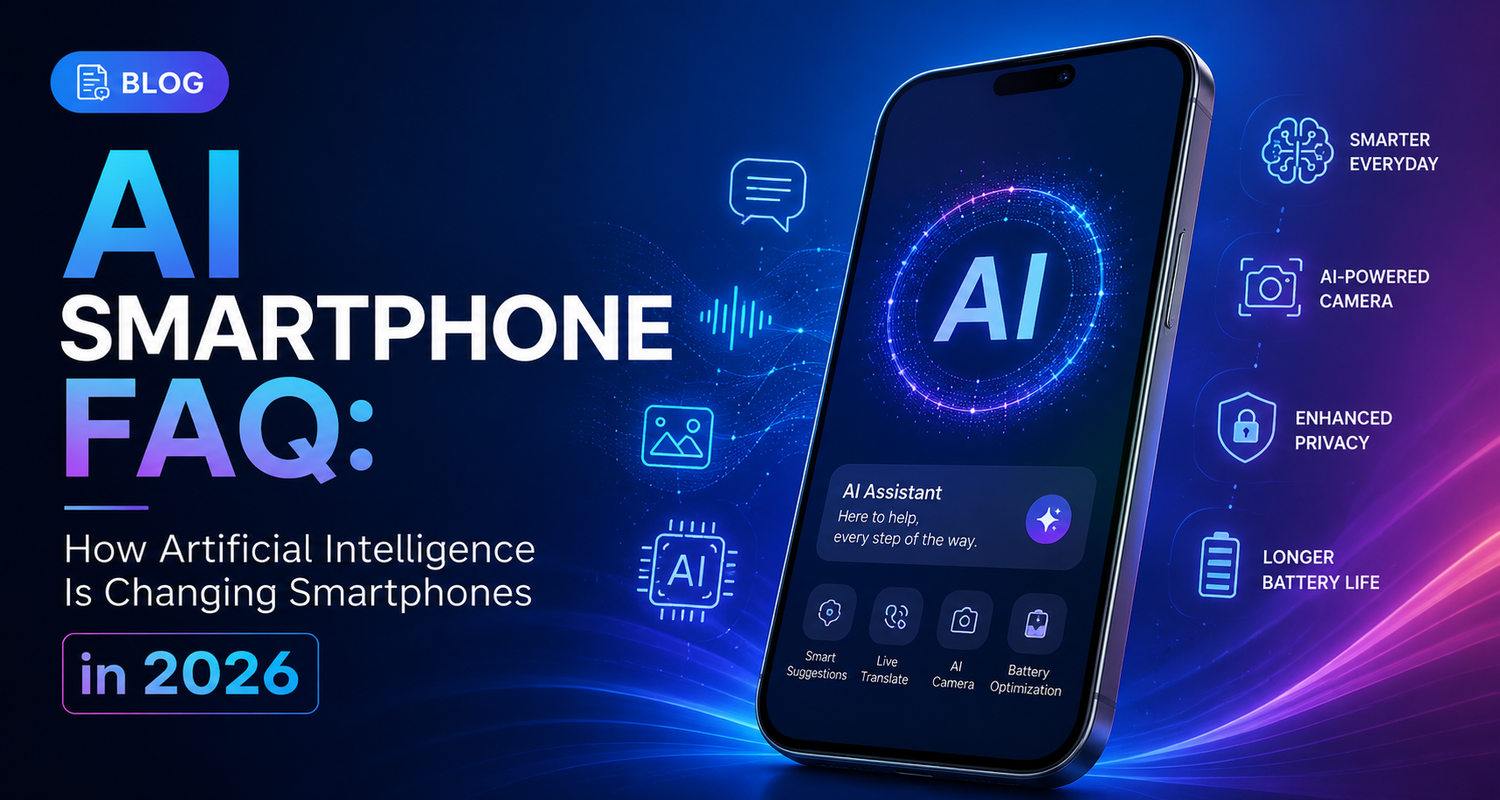
Artificial intelligence is no longer just a marketing buzzword in smartphones. In 2026, AI has become one of the biggest technologies shaping how modern phones work, how users interact with their devices, and how brands compete against each other.From smarter cameras and real-time translation to battery optimization and advanced voice assistants, smartphones are becoming more intelligent every year. Companies like Google, Samsung, Apple, Xiaomi, and OnePlus are heavily investing in AI to create faster, smarter, and more personalized experiences.But what does AI actually mean for smartphone users in real life? Is it genuinely useful, or is it mostly marketing hype?In this FAQ-style guide, we answer the biggest questions about AI smartphones and explain how artificial intelligence is changing smartphones in 2026.
What Is an AI Smartphone?
An AI smartphone is a device that uses artificial intelligence and machine learning to improve different parts of the user experience.Instead of relying only on traditional software, AI-powered smartphones can learn user behavior, optimize performance automatically, improve photography, understand voice commands more naturally, and perform smart tasks in real time.Modern AI smartphones use dedicated AI hardware called NPUs, or Neural Processing Units, which help process AI tasks directly on the device without always relying on cloud servers.This allows smartphones to perform AI-powered features faster, more privately, and more efficiently.In 2026, AI has become a major part of nearly every flagship smartphone.
How Does AI Improve Smartphone Cameras?
Camera technology is one of the biggest areas where AI makes a noticeable difference.Modern smartphone cameras no longer rely only on hardware sensors. AI now helps process images instantly after they are captured. This allows phones to improve colors, lighting, sharpness, dynamic range, and low-light performance automatically.AI also improves portrait mode, night photography, video stabilization, motion tracking, background blur, and real-time photo editing.Phones like the Google Pixel series and Samsung Galaxy flagship devices use advanced computational photography powered heavily by AI.In many situations, AI processing helps smartphones produce photos that look far better than what traditional camera hardware alone could achieve.This is one of the main reasons smartphone photography has improved so dramatically over the past few years.
Can AI Replace Professional Cameras?
Not completely, but AI is helping smartphones get surprisingly close in some situations.Professional cameras still have major advantages in sensor size, lens flexibility, and manual controls. However, AI allows smartphones to compensate for hardware limitations using advanced computational photography techniques.For casual photography, travel content, social media, and even professional-looking videos, modern AI smartphones are now extremely capable.Features like AI image enhancement, cinematic video modes, object tracking, and automatic editing make smartphones much easier to use than traditional cameras for everyday users.In 2026, many people are choosing smartphones instead of dedicated cameras because AI makes photography faster, simpler, and more convenient.
How Does AI Improve Battery Life?
AI helps smartphones optimize battery usage much more intelligently.Modern AI systems learn how users interact with their phones throughout the day. The device can identify which apps are used frequently, when charging usually happens, and which background processes should be limited.This allows smartphones to reduce unnecessary battery drain, improve standby time, optimize charging speed, prevent overheating, and extend long-term battery health.Some phones now use AI charging systems that slow charging overnight and finish charging right before the user wakes up.AI battery optimization has become especially important because modern smartphones now handle much heavier workloads than older devices.
How Is AI Changing Smartphone Assistants?
AI assistants are becoming far more advanced and conversational.Voice assistants in 2026 can understand natural language much better than older systems. Instead of requiring exact commands, AI assistants can interpret context, follow conversations, summarize information, and complete more complex tasks.Google Gemini AI, Samsung Galaxy AI, and Apple Intelligence are pushing smartphone assistants closer to real-time digital companions.Modern AI assistants can summarize messages, rewrite text, translate conversations live, generate responses, organize schedules, edit photos, and search information faster.The biggest change is that AI assistants now feel more personalized and context-aware instead of simply responding to basic voice commands.
What Is On-Device AI?
On-device AI means AI processing happens directly on the smartphone instead of relying entirely on cloud servers.This is becoming increasingly important in 2026 because it improves privacy, speed, offline functionality, battery efficiency, and security.Phones with strong AI processors can now perform tasks like voice recognition, image editing, translation, and smart suggestions locally on the device.This allows users to access many AI features even without an internet connection.On-device AI is quickly becoming one of the most important areas of smartphone development.
How Is AI Improving Gaming on Smartphones?
AI is helping mobile gaming become smoother and more efficient.Many gaming smartphones now use AI to optimize graphics settings, improve frame stability, reduce overheating, and manage power consumption during long gaming sessions.AI systems can dynamically adjust CPU and GPU performance depending on what the game requires in real time.Some smartphones also use AI to improve touch response, motion prediction, thermal management, and battery efficiency during gaming.This creates a more stable and responsive gaming experience without requiring users to manually adjust settings constantly.
Can AI Improve Smartphone Security?
Yes, AI is making smartphones much more secure.Modern AI systems help detect suspicious behavior, improve facial recognition accuracy, and strengthen biometric security systems.AI-powered security features can now identify unusual activity patterns and warn users about potential scams or security threats.Some smartphones also use AI for spam detection, scam call filtering, malware protection, secure payment verification, and privacy monitoring.Because AI systems can analyze large amounts of data very quickly, they are becoming increasingly important for smartphone security.
Are AI Features Mostly Marketing Hype?
Some AI features are definitely marketing-focused, but many are genuinely useful.In earlier years, smartphone brands often used “AI” mainly as a buzzword. However, in 2026, AI features are becoming far more practical and noticeable in daily use.Features like live translation, AI photo editing, smart search, writing assistance, battery optimization, voice transcription, and AI-generated summaries are now genuinely improving the smartphone experience.The key difference is that AI is finally becoming deeply integrated into everyday smartphone tasks instead of existing as isolated gimmicks.
Which Smartphone Brands Lead in AI?
Google currently leads heavily in AI software integration.Pixel smartphones continue offering some of the smartest AI features available, especially for photography, voice processing, live translation, and assistant functionality.Samsung is also investing aggressively in Galaxy AI, bringing AI features across productivity, editing, and communication tools.Apple focuses more heavily on privacy-focused AI experiences and on-device processing through Apple Intelligence.Meanwhile, brands like Xiaomi, Honor, Oppo, and OnePlus are rapidly improving their AI systems as competition intensifies.In 2026, AI has become one of the biggest competitive areas in the smartphone industry.
Will AI Replace Traditional Smartphone Apps?
Not entirely, but AI is changing how users interact with apps.Instead of opening separate apps for every task, AI assistants are beginning to combine multiple functions into one smoother experience.Users can now ask AI systems to edit photos, write messages, search emails, create summaries, plan schedules, and translate conversations without constantly switching between apps.AI is making smartphones feel more proactive and conversational rather than purely app-based.This shift could completely reshape smartphone software experiences over the next few years.
Are AI Smartphones Worth Buying in 2026?
Yes, especially if you want the smartest and most future-ready smartphone experience.AI now affects nearly every major part of modern smartphones including photography, productivity, gaming, battery management, voice assistants, security, and communication.The difference between AI-powered flagship phones and older smartphones is becoming increasingly noticeable in daily usage.While not every AI feature feels revolutionary, many are now genuinely practical and useful.As smartphone innovation slows in traditional hardware areas, AI is becoming the biggest factor driving the next generation of mobile experiences.