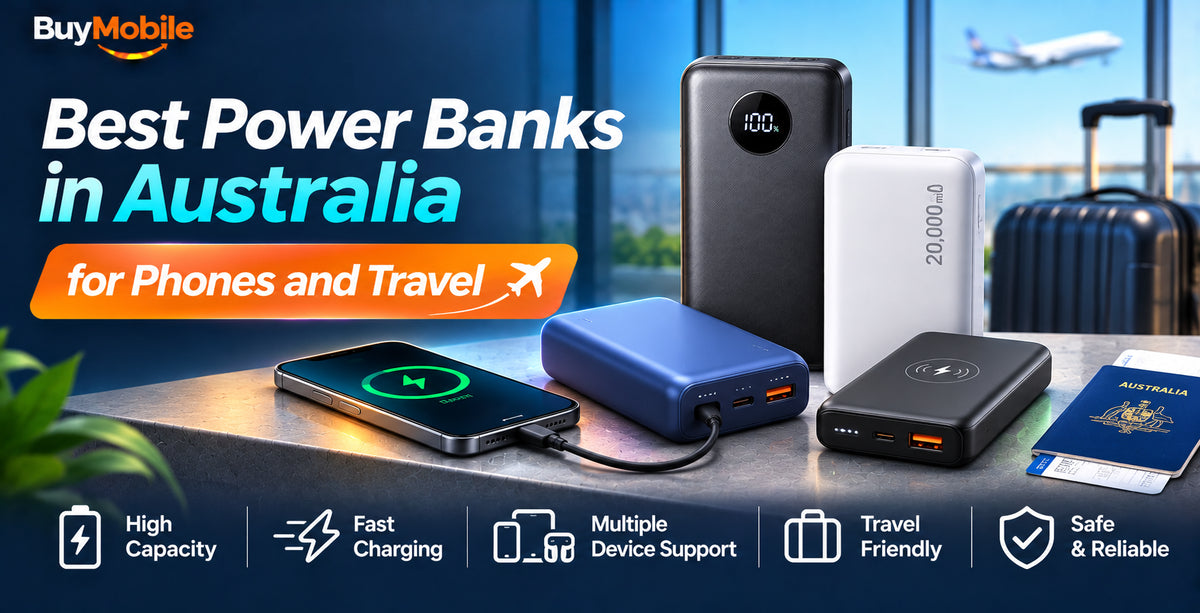
The best power bank in Australia for most people is a 10,000mAh to 20,000mAh model with USB-C Power Delivery, a clearly printed watt-hour (Wh) rating and a reputable brand behind it. That size recharges a modern phone one to four times, fits in a bag and sits comfortably inside airline limits. If you travel often, the airline rules now matter almost as much as capacity, so we cover those in detail below.
We already have a general guide to how to choose a power bank. This post focuses on the best types for Australian phone owners and travellers, plus the carry-on rules you need to know before your next flight.
How much capacity do you really need?
Power bank capacity is listed in milliamp-hours (mAh), but you'll never get the full figure into your phone. Voltage conversion and heat mean you typically get around 60% to 70% of the rated capacity.
- 5,000mAh: roughly one partial top-up. Pocket-sized, ideal for a night out.
- 10,000mAh: about one to two full phone charges. The best all-rounder for daily carry.
- 20,000mAh: two to four phone charges, or a tablet top-up. Great for travel and camping.
- 25,000mAh and above: heavy, often laptop-capable, and closer to airline limits.
The best power bank types for 2026
Everyday carry: slim 10,000mAh USB-C
A slim 10,000mAh bank with a 20W to 30W USB-C PD port fast charges iPhones, Pixels and Galaxy phones. Look for PPS support if you own a Samsung, as it enables Super Fast Charging.
Cable-free: magnetic Qi2 power banks
Magnetic power banks snap onto the back of an Apple iPhone 18 Pro or a Pixel 11, letting you use the phone while it charges. Qi2 25W models are the quickest wireless option. Samsung Galaxy S26 owners need a magnetic case for these to attach.
Travel: 20,000mAh with multiple ports
For long trips, a 20,000mAh bank with two USB-C ports can charge your phone and earbuds, or a tablet such as the Apple iPad Air 11-inch, at the same time. A built-in cable is handy so you never forget one.
Laptop-capable: 60W to 100W output
If you need to charge a laptop, choose a bank rated for 60W or more over USB-C PD. These are larger, so check the Wh rating against airline rules.
Airline carry-on rules for power banks
Australian airlines tightened their power bank rules in late 2025 after a series of lithium battery incidents on aircraft. Virgin Australia's rules took effect from 1 December 2025, and Qantas, QantasLink and Jetstar's from 15 December 2025. Under these policies:
- Carry-on only: power banks are banned from checked luggage.
- Maximum of two power banks per passenger in the cabin.
- 160Wh limit: each bank must be 160Wh or less. Banks over 100Wh generally need airline approval.
- No use on board: you can't use a power bank to charge devices during the flight.
- No charging the power bank on board, including from seat power or USB ports.
- Visible specifications: the battery rating must be printed on the bank.
- Keep it within reach: store it in the seat pocket or under the seat in front where possible. Storage rules can differ between airlines, so check yours.
Internationally, ICAO approved guidance in 2026 that limits passengers to two power banks in the cabin, with the 100Wh and 160Wh thresholds unchanged. Many overseas airlines also restrict in-flight use, so check each carrier's website before you fly, as policies can change.
How to work out watt-hours
If only mAh is printed, multiply mAh by the battery voltage (usually 3.6V or 3.7V) and divide by 1,000. A 20,000mAh bank at 3.7V works out to 74Wh, comfortably under 100Wh. Most banks up to about 26,000mAh fall below the 100Wh line.
Safety tips for power banks
- Buy from reputable brands with clear specifications and Australian compliance markings.
- Stop using any bank that swells, gets unusually hot or smells of burning.
- Don't leave a power bank charging on a bed or in a hot car.
- Store it at around half charge if you won't use it for months.
Power bank checklist
| Feature | What to look for |
|---|---|
| Capacity | 10,000mAh for daily use, 20,000mAh for travel |
| Output | USB-C PD, 20W+ for phones, 60W+ for laptops |
| Samsung support | PPS for Super Fast Charging |
| Wireless | Qi2 certification for magnetic charging |
| Labelling | Printed Wh rating for airline checks |
FAQ
Can I take a 20,000mAh power bank on a plane in Australia?
Yes. A typical 20,000mAh bank is about 74Wh, under the 100Wh threshold. It must travel in your carry-on and can't be used during the flight on Qantas, Jetstar or Virgin Australia.
Can I charge my phone from seat power instead?
Yes, where seat power is available you can charge your phone directly. You just can't charge the power bank itself.
Is a magnetic power bank worth it?
If you value convenience and own a magnetic phone, yes. For maximum speed and capacity, a wired USB-C bank is better.
Conclusion
A 10,000mAh USB-C PD power bank suits most Australians, while frequent flyers should pick a well-labelled 20,000mAh model and remember the two-bank, carry-on-only, no-use rules. Pair it with a phone that already has strong battery life, such as the Samsung Galaxy S26 Ultra, and you'll rarely run flat. Browse power banks and cables in our accessories collection.
Shop at BuyMobile: Samsung Galaxy S26 Ultra | Apple iPhone 18 Pro | Accessories