


































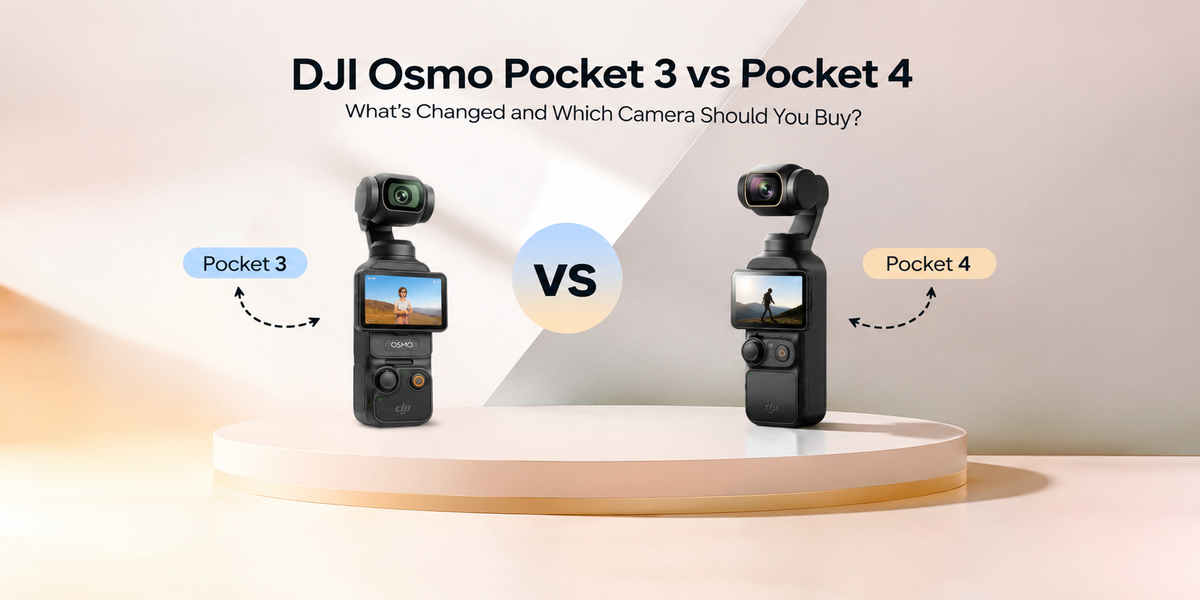
DJI's Osmo Pocket series has become a popular choice for vloggers, travellers and content creators who want professional-looking videos without carrying bulky camera equipment.The DJI Osmo Pocket 3 introduced a 1-inch CMOS sensor, three-axis mechanical stabilisation and impressive 4K video capabilities. Its successor, the DJI Osmo Pocket 4, builds on that foundation with improved slow-motion recording, intelligent tracking, internal storage and upgraded camera controls.But are these improvements worth paying extra for?In this DJI Osmo Pocket 3 vs Pocket 4 comparison, we'll explore camera quality, video features, battery life, accessories and value to help Australian buyers choose the right camera.
1. Design and Build Quality: What's Different?
At first glance, the DJI Osmo Pocket 3 and Pocket 4 look remarkably similar.Both feature a compact handheld design, integrated gimbal and rotating touchscreen that makes switching between horizontal and vertical recording convenient.The Pocket 3 remains an excellent lightweight option for travelling.However, the Pocket 4 introduces additional physical controls, including dedicated buttons for zoom and customisable functions.Its improved joystick also provides more flexible gimbal control.These changes reduce the need to navigate touchscreen menus while recording.Design verdict: The Pocket 4 offers more convenient controls, while the Pocket 3 remains highly portable.
2. Camera Sensor and Image Quality
Both cameras use a 1-inch CMOS sensor, making them capable of producing detailed footage with attractive background separation.However, the Pocket 4 introduces a newer stacked CMOS sensor.DJI advertises up to 14 stops of dynamic range, helping preserve detail in bright highlights and darker areas.This can be useful when filming landscapes, sunsets and scenes with challenging lighting.The Pocket 3 already delivers impressive image quality, particularly for everyday vlogging and travel footage.Both cameras also use a 20mm-equivalent f/2.0 lens.Although the Pocket 4 introduces imaging improvements, the difference may be less noticeable in ordinary daylight recordings.Camera verdict: The Pocket 4 offers greater imaging flexibility, but the Pocket 3 remains capable of producing excellent 4K footage.
3. Video Recording: 4K 120fps vs 4K 240fps
One of the biggest differences is slow-motion recording.The DJI Osmo Pocket 3 supports 4K video at up to 120fps in its dedicated Slow Motion mode.This is useful for capturing sports, movement, flowing water and cinematic B-roll.The Pocket 4 increases the maximum slow-motion frame rate to 4K at 240fps.When played back at 30fps, this can create footage slowed to one-eighth of its original speed.That provides additional creative flexibility for dramatic action sequences.However, both cameras support standard 4K recording at up to 60fps, which is sufficient for most YouTube videos, travel vlogs and social media content.Video verdict: Pocket 4 is better for creators who frequently use high-resolution slow motion.
4. Stabilisation and ActiveTrack Improvements
Both cameras feature DJI's three-axis mechanical gimbal stabilisation.This technology helps reduce unwanted camera movement while walking, travelling or filming handheld.The Pocket 3 uses ActiveTrack 6.0 to follow subjects automatically.The Pocket 4 upgrades to ActiveTrack 7.0, offering improved subject recognition and tracking flexibility.It can track people, vehicles, pets and other subjects, with additional framing options.The newer camera also introduces gesture controls for selected recording functions.These improvements are particularly helpful for solo vloggers who regularly film themselves.Tracking verdict: Pocket 4 provides more advanced tracking features, although Pocket 3 remains effective for everyday recording.
5. Low-Light Video Performance
Low-light recording is important for travellers and content creators who film indoors or after sunset.The Pocket 3 performs well in many challenging lighting conditions thanks to its relatively large sensor.The Pocket 4 introduces a newer sensor with improved dynamic range and a dedicated low-light video ISO range extending to 25,600.These capabilities can help capture usable footage in darker environments.However, higher ISO settings can introduce image noise, and real-world results depend on exposure and lighting conditions.For occasional nighttime videos, the Pocket 3 remains a capable option.Creators who regularly record evening events or challenging scenes may appreciate the Pocket 4's additional flexibility.
6. Battery Life and Charging
Battery life is another important difference.The Pocket 3 includes a 1,300mAh battery, while the Pocket 4 increases capacity to 1,545mAh.DJI rates the Pocket 3 for up to 166 minutes of operating time under specified conditions.The Pocket 4 offers up to 240 minutes under its published test conditions.Actual recording time will vary depending on resolution, frame rate, screen usage and wireless connectivity.Both cameras support fast USB-C charging and compatible battery accessories.Battery verdict: The Pocket 4 offers a meaningful improvement for longer filming sessions.
7. Storage and File Transfers
Storage is one of the Pocket 4's most convenient upgrades.The Pocket 3 requires a compatible microSD card for recording.In comparison, the Pocket 4 includes approximately 107GB of usable built-in storage while retaining microSD support.This means users can start filming without immediately inserting a memory card.The newer model also supports faster wired transfers, with DJI advertising speeds up to 800MB/s under compatible conditions.For creators regularly transferring large video files, these improvements can simplify the editing workflow.Storage verdict: Pocket 4 wins for convenience and faster file management.
8. Audio Recording and Accessories
Clear audio is essential for professional-looking videos.Both cameras include built-in microphones and support compatible DJI wireless microphone systems.The Pocket 3 works well for interviews, travel commentary and talking-head content when paired with suitable accessories.The Pocket 4 adds enhanced audio capabilities, including support for four-channel output in compatible setups.It also supports additional accessories, such as a magnetic fill light, to improve recording flexibility.Before purchasing accessories, check compatibility with the exact camera model.Not every accessory designed for one generation will necessarily work with the other.
9. DJI Osmo Pocket 3 vs Pocket 4: Price in Australia
Price plays a major role in deciding which camera offers better value.The Pocket 3 is generally the more affordable option, especially when retailers offer discounts or clearance promotions.The Pocket 4 costs more but includes newer hardware and additional features.Australian launch pricing for the Pocket 4 started at approximately A$749 for the Essential Combo and A$949 for the Creator Combo.Actual retail prices may vary depending on promotions, stock availability and included accessories.When comparing packages, consider whether you need a wireless microphone, battery handle or other filming equipment.A discounted Pocket 3 Creator Combo may offer better value than a newer camera package with fewer accessories.
10. Which DJI Osmo Pocket Camera Should You Buy?
Choose the DJI Osmo Pocket 3 if:
-
You're buying your first dedicated vlogging camera.
-
You mainly record travel videos and everyday content.
-
You want excellent stabilised 4K footage at a lower price.
-
You don't need 4K 240fps slow motion or built-in storage.
Choose the DJI Osmo Pocket 4 if:
-
You regularly create professional video content.
-
You want improved tracking and low-light capabilities.
-
You need longer battery life and faster file transfers.
-
You frequently record slow-motion footage.
-
You prefer the convenience of internal storage.
Existing Pocket 3 owners should consider whether these improvements solve specific limitations in their current workflow.